

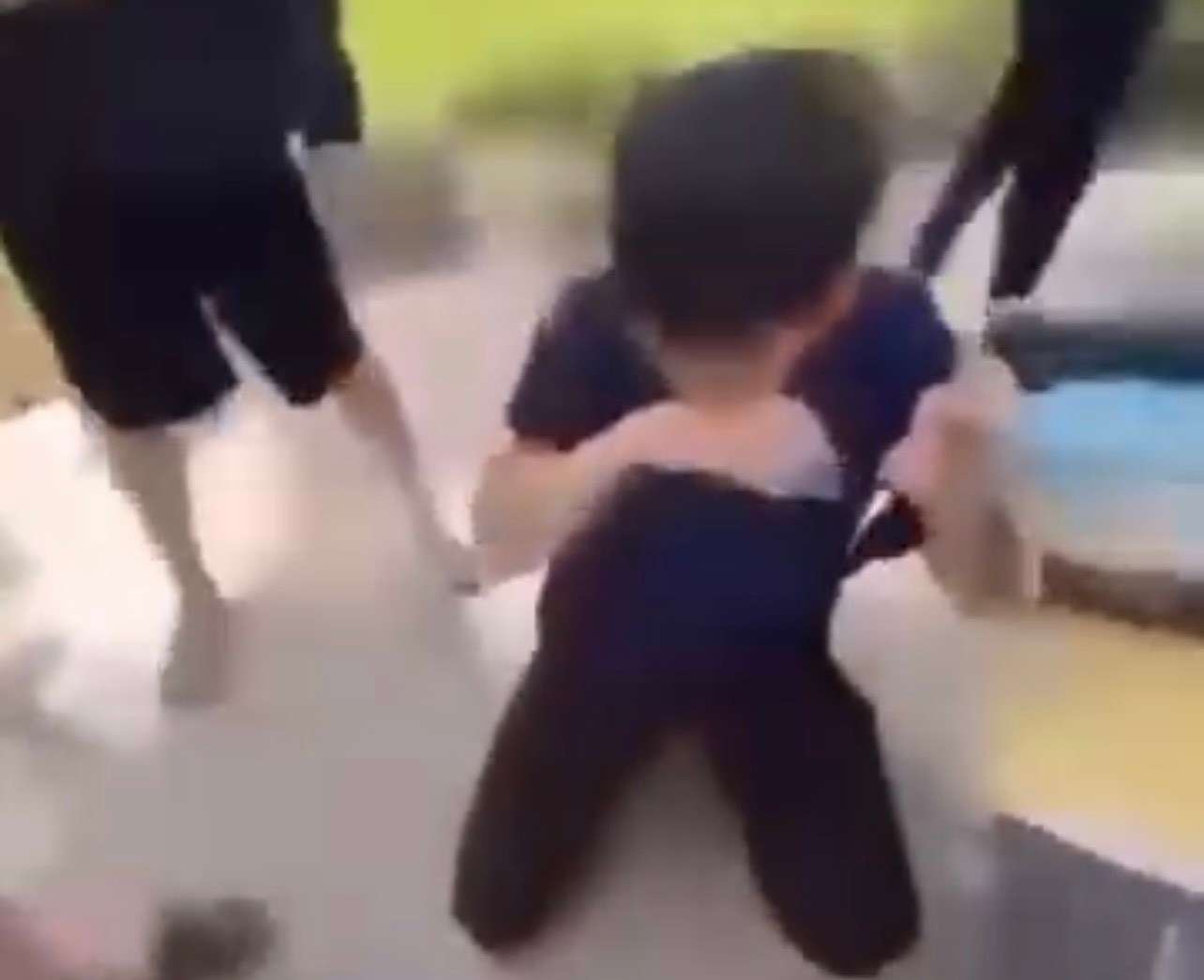
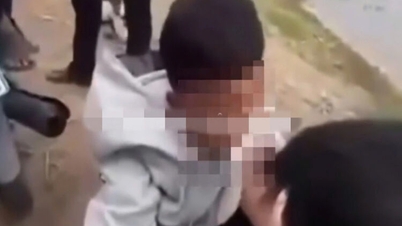
On October 15th, N.D.H, a 10th-grade student from Minh Phu High School in Kim Anh commune, Hanoi, was stopped and assaulted by a group of six people (including two students). A video shows H being forced to kneel and apologize, then crawling behind a parked motorbike to lick its license plate. When H hesitated, the assailant kicked him in the face. Even after licking the license plate, H continued to be kicked and slapped in the face.
Following the incident, the Hanoi City Police Investigation Agency issued a decision to initiate a criminal case and prosecute two suspects for the offenses of "humiliating others" and "disturbing public order".
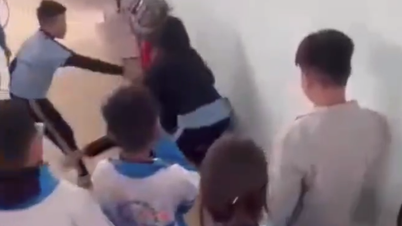
The principal of a high school in Hanoi stated that among the more than 1,000 students currently enrolled, there are still some who are considered "troublemakers" or "problem students." These students often lack motivation and willpower to study, constantly violate school rules, and even instigate their classmates to participate in fights and violence, causing teachers a great deal of trouble in dealing with them.
Especially when a simple scolding or a slap to teach students a lesson they'll never forget and avoid repeating the offense can now lead to disciplinary action against teachers for violating regulations.
The teacher explained that the school regulations stipulate that all students' phones are confiscated at the beginning of class and returned at the end. However, some students hand over one phone but hide another one or two in their pockets. While the teachers continue teaching, these students still play video games or browse the internet.
"Overindulgence from parents at home and a lack of discipline at school are the reasons why children become unruly," the principal said.
Students are not afraid of disciplinary reports.
Dr. Nguyen Thanh Nhan, Senior Advisor of the Asia- Pacific Young Talent Education System, shared that some teachers recounted that in the past, simply speaking harshly to a student would cause the entire family of the parents to storm the school, even threatening to attack the teachers. In fact, there have been instances of parents attacking teachers right inside the school.
The truth is, it's not just vulnerable students who face the risk of becoming victims of violence; teachers also face the threat.
"We talk a lot about 'quality-competency education' and 'continuous assessment,' but who assesses, what tools are used, and how do we intervene when students have problems? Serious research is needed, and this needs to be put into practice," said Dr. Nguyen Thanh Nhan.
The slogan "discipline without tears" was preached, but it was the vulnerable who cried the most. The consequences are clear: fear, low self-esteem, psychological trauma, and even dropping out of school because they didn't dare confront the perpetrator," said Dr. Nguyen Thanh Nhan.
He also argued that Circular 19 of the Ministry of Education and Training, which stipulates that the highest form of punishment for student violations is writing a self-criticism report, does not instill fear in students. They will think that all their mistakes can be erased by a self-criticism report. A sufficiently strict yet tolerant environment would deter even the most rebellious students who like to bully the weak, while also helping those who have made mistakes to correct them.
In reality, many schools have shown that, without specific intervention measures, misbehavior becomes repetitive and increasingly serious, affecting the group as a whole and creating a feeling of "unfairness" for well-behaved and disciplined students.
We need tools for observation and protection, because many students resort to violence instead of words; many parents unconditionally defend their children, bringing the whole family into school in the same way they behave in society.
The incident, in which a group of people blocked a student's path, forced him to kneel, apologize, and lick a car's license plate, shocked the public due to its behavior that defied all moral values.
Therefore, at the societal level, firm measures are needed for juvenile repeat offenders of violence, measures that are strict enough to regulate behavior and strong enough to deter future offenses.
According to this expert, in the moral and disciplinary education of students, the regulatory role of schools and the policy responsibility of the Ministry of Education and Training are crucial. A clear process is needed, involving coordination with various parties including the police, health services, and psychologists, along with a mechanism for immediate victim protection.
Parents of students who engage in violence must participate in mandatory courses with their children to change their behavior. Regular meetings with specialists, as a mandatory requirement, are also necessary to acknowledge progress.
"Stories of students fighting and being beaten could continue for decades to come. The extent to which this happens depends on whether we take decisive action starting today," he warned.

Associate Professor Tran Thanh Nam: Misunderstanding positive discipline, teachers 'ignore' students' violations.
The 'exceptional' case of the teacher who strangled a colleague after being reprimanded for parking illegally.

Police investigate case of Hải Phòng student whose nose was broken after being beaten.
Source: https://tienphong.vn/hoc-sinh-bi-bat-quy-liem-bien-so-xe-may-ky-luat-chua-nghiem-de-ran-de-anh-chi-dai-post1789500.tpo


![[Photo] Prime Minister Pham Minh Chinh holds a phone call with the CEO of Russia's Rosatom Corporation.](/_next/image?url=https%3A%2F%2Fvphoto.vietnam.vn%2Fthumb%2F1200x675%2Fvietnam%2Fresource%2FIMAGE%2F2025%2F12%2F11%2F1765464552365_dsc-5295-jpg.webp&w=3840&q=75)

































































Comment (0)