Subjects that frequently appear in the 10th grade entrance exams, such as Math, Literature, and English, are always considered core subjects by students and parents, receiving significant investment of time and money. The remaining subjects are considered secondary, and students tend to neglect them or study them superficially.
The mentality is: study whatever is on the exam.
Having worked in education for over 10 years, Pham Thi Ha, an art teacher in Hanoi, is saddened to see that many parents and students still discriminate against certain subjects even in school. This is evident in the fact that students only focus on subjects that are relevant to exams, while other subjects are studied superficially, just enough to pass and graduate.
On numerous occasions during class, the female teacher caught students hiding their Math, Literature, and English textbooks in their desk drawers, occasionally pulling them out to read or do homework. When the teacher asked, the students innocently replied that they were reviewing because they had an upcoming test.
" During an art class, students bring out books from other subjects to study. Which teacher wouldn't feel disheartened and disappointed?" Ms. Hai said, adding that the mentality of "study only what's on the exam" still persists in the minds of many students and parents. They consider subjects not on the exam as secondary, thus neglecting them and being uncooperative during the teaching and learning process.
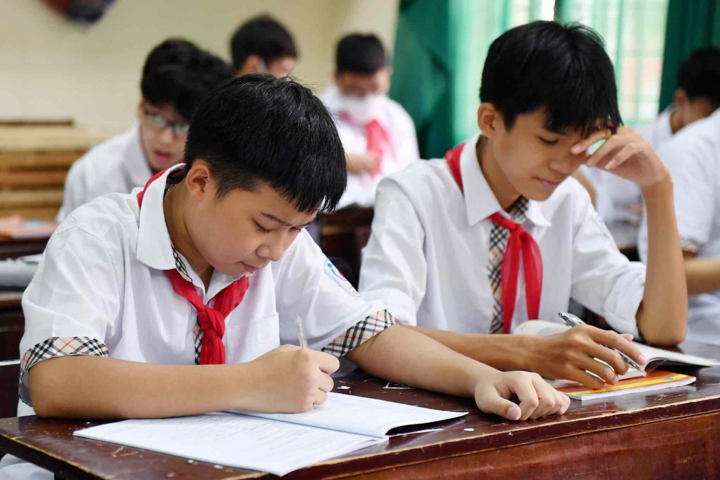
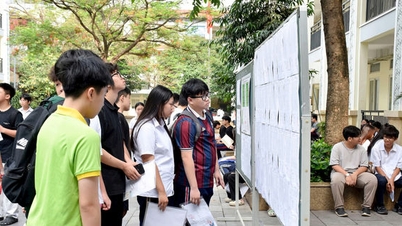
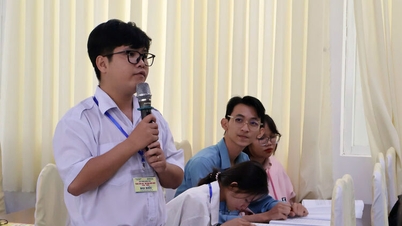
Many students focus only on subjects included in the exam syllabus, neglecting the others. (Illustrative image)
According to the female teacher, currently in the education sector, there is no document that defines or distinguishes between core and elective subjects. However, subjects that serve exams, such as Math, Literature, and English, are usually given more attention by schools. Because of this, students and parents implicitly understand these to be core subjects. Learning at school is not enough; they also seek out tutoring centers and extra classes to reinforce their knowledge.
Negative consequences for the future
Discussing students' attitudes towards subjects not included in the exams, Dr. Vu Thu Huong, an education expert, argues that the fault doesn't lie entirely with the children but stems from the family, the school, and, more fundamentally, from examination policies. This is evident in everything from how teachers teach, to how parents encourage their children to study, and the way they choose subjects for the 10th grade and university entrance exams.

"Even at the primary school level, there have been cases where teachers used time allocated for other subjects to teach Math and Vietnamese. At home, many parents also focus most of their attention on these two subjects when managing their children's studies," Dr. Huong said, adding that such actions will cause children to develop a mindset of differentiating between core and elective subjects.
Students focusing solely on exam subjects and studying superficially, neglecting other subjects just to get enough points to graduate, not only leads to unbalanced learning and a lack of intellectual equilibrium but also has dangerous consequences for their future. However, parents and students often fail to recognize this, focusing only on grades and immediate achievements.
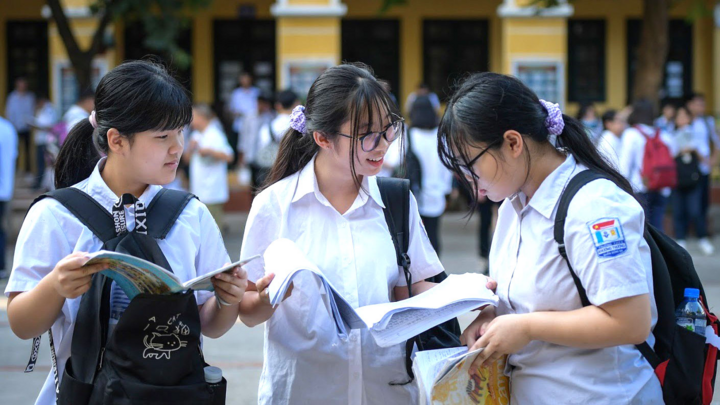
The mindset of "study only what's on the exam" will lead to students focusing on only certain subjects, causing negative consequences for their future. (Illustrative image)
According to Dr. Huong, many students excel in Math and Literature, achieving IELTS scores of 7.0 or 8.0, but lack basic life skills. Some "don't even know what water spinach or sweet potato leaves look like, or how a carp differs from a catfish…". These shortcomings are addressed through subjects that these students themselves label as minor and disregard.
"Many students still have the illusion that being good at Math, Literature, and English means they are excellent students. However, in reality, they lack other knowledge about life and society, leading to mistakes and failures when they enter the workforce. In many cases, when asked about historical figures, they answer incorrectly. Even in basic communication, students lack confidence," Dr. Huong emphasized.
The female doctor argued that, within the education system, all subjects play an important role in providing knowledge, while also contributing to the orientation and formation of personality and skills.
Natural sciences help develop logical thinking and reasoning skills, while social sciences offer important moral lessons. This diverse approach gives students the opportunity to explore and develop their individual potential to the fullest. Therefore, the notion that "subjects that aren't on the exam shouldn't be studied" should be abandoned.
Focusing solely on subjects like Math, Literature, and English for exam preparation is a form of unbalanced learning that doesn't provide students with a broad range of knowledge and further hinders their overall development and future success. "We should diversify the subjects for the 10th-grade entrance exam, giving students the freedom to choose, not just focusing on Math, Literature, and English. To achieve this, the entire education system needs to change to respect students' abilities," the female doctor stated.
The Ministry of Education and Training is concerned about students focusing on only certain subjects.



At the government press conference on the afternoon of October 7th, Deputy Minister of Education and Training Pham Ngoc Thuong stated that in the past, the entrance exam for grade 10 was conducted independently by local authorities regarding the number of subjects, duration, and exam questions. The Ministry observed that most provinces and cities chose to have exams in three subjects.
The previous practice of localities independently deciding the number of subjects for the 10th grade entrance exam created inconsistencies and a "hundreds of different choices" in the selection process, leading to shortcomings in the assessment of teaching and learning. Therefore, the Ministry plans to issue regulations stipulating that the public high school entrance exam will consist of three subjects: two compulsory subjects (Mathematics and Literature), and a third subject chosen by lottery from a group of subjects assessed by scores (Foreign Language, Civic Education, Natural Sciences, History and Geography, Technology, Informatics). The exam subjects will be announced before March 31st each year.
According to Mr. Thuong, allowing localities to choose subjects independently could lead to subjective opinions from leaders, causing many negative consequences. On the other hand, if a fixed subject is chosen, the Ministry of Education and Training is concerned about rote learning and unbalanced learning.
"The Ministry is studying various methods for selecting the third subject. It could involve not fixing it on one subject; this year it could be social sciences, next year it could be natural sciences, and the year after that a different subject, or it could be a random draw as proposed in the draft," the Deputy Minister said.
Source: https://vtcnews.vn/hoc-nguyen-toan-van-anh-de-thi-vao-lop-10-cung-la-hoc-lech-ar900984.html

![[Photo] Prime Minister Le Minh Hung presides over the thematic session on promoting science and technology development and innovation.](https://vphoto.vietnam.vn/thumb/1200x675/vietnam/resource/IMAGE/2026/06/23/1782207872934_ndo_br_dsc-1724-jpg.webp)