

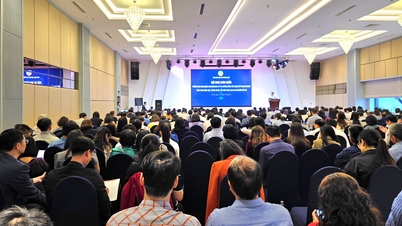
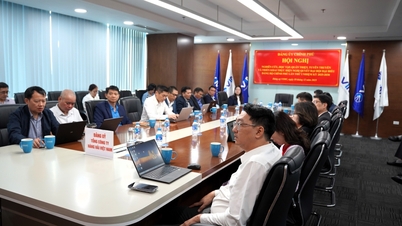
On the morning of October 31, Deputy Prime Minister Tran Hong Ha chaired an online conference with localities on finalizing the Plan for implementing the National Power Development Plan for the period 2021-2030, with a vision to 2050 (Power Plan VIII).
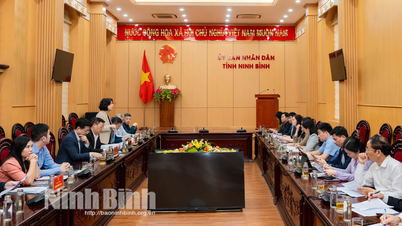
The conference was attended by leaders from central ministries and agencies, as well as provinces and cities nationwide. At the Ninh Binh branch, Mr. Pham Quang Ngoc, Deputy Secretary of the Provincial Party Committee and Chairman of the Provincial People's Committee, attended and chaired the meeting. Leaders from relevant departments and agencies also participated.
According to the Power Development Plan VIII, Vietnam needs approximately US$11.3 - US$11.5 billion annually for investment in power generation and transmission projects until 2030. Specifically, the capital needed for 2025 will exceed US$57 billion, with power generation accounting for over 84% and transmission 16%. Five years later, power generation projects will require US$72 billion for investment and construction, while transmission will require approximately US$6 billion.
Regarding the demand for renewable energy for the production of new energy sources (such as green hydrogen and green ammonia) to serve domestic needs and exports, priority will be given to development in areas with high renewable energy potential and convenient transportation, namely the Southern and South Central regions of Vietnam. The development scale aims to reach 5,000 MW by 2030 (primarily offshore wind power), and this will be clearly defined once feasible projects in terms of technology and cost are available. The capacity of renewable energy sources for new energy production will not be included in the power supply structure for the national power grid.
To implement the Master Plan, the draft plan also proposes solutions such as ensuring electricity supply security; creating capital sources and mobilizing investment capital for industry development; laws and policies; environmental protection and disaster prevention; science and technology; efficient and economical electricity use; human resource development; international cooperation; strengthening domestic capacity, localizing electricity industry equipment, building and developing the electrical engineering industry; organizing management and improving the efficiency of electricity operations; and organizing and monitoring the implementation of the plan.
Speaking at the conference, Deputy Prime Minister Tran Hong Ha emphasized: The Power Development Plan VIII is a very important national plan that requires early investment in the synchronous construction of power sources and grids, ensuring a solid electricity supply security to serve socio-economic development and contribute to maintaining national defense and security. Therefore, Power Development Plan VII must closely adhere to the development plan for power sources and grids, including criteria, solutions, and resources.
The Deputy Prime Minister requested the Ministry of Industry and Trade to take the lead in coordinating with ministries, sectors, and localities to urgently supplement and finalize the Plan for implementing the Power Development Plan VIII, ensuring compliance with the Planning Law and relevant legislation.
In particular, it should be noted that the identification of projects, schemes, and the scale of capacity of various types of power sources must ensure balance across regions; and balance supply and demand within each region in order to develop and exploit power sources effectively.
Ministries, sectors, and People's Committees of provinces and cities shall specifically identify the methods, resources, and coordination mechanisms for implementation, ensuring that the Plan for implementing the Power Development Plan VIII is effectively implemented, contributing to providing sufficient electricity to serve socio-economic development.
The People's Committees of provinces and centrally-administered cities shall organize the selection of investors for power projects and allocate land for the development of power facilities in accordance with the law; they shall preside over and closely coordinate with investors in carrying out land clearance, compensation, relocation, and resettlement for power generation and grid projects in accordance with regulations; the Vietnam Electricity Group shall play the main role in ensuring a stable and safe electricity supply for socio-economic development.
Implement investment projects for power generation and transmission grids according to assigned tasks; Regularly review and assess the balance of electricity supply and demand, the operational status of the national and regional power systems, and report to competent authorities; Thoroughly implement solutions to innovate corporate governance, improve production and business efficiency, increase labor productivity, reduce power losses, save costs, and lower production costs.
Nguyen Thom - Anh Tuan
Source






















![[Video] The craft of making Dong Ho folk paintings has been inscribed by UNESCO on the List of Crafts in Need of Urgent Safeguarding.](https://vphoto.vietnam.vn/thumb/402x226/vietnam/resource/IMAGE/2025/12/10/1765350246533_tranh-dong-ho-734-jpg.webp)


















































Comment (0)