

Strategic signals from New Delhi
Attention to the 23rd summit stems from a series of special circumstances. First, Washington has just imposed trade tariffs to pressure New Delhi, reflecting US displeasure over India's purchase of Russian oil. Media speculated about the possibility of India "changing course" under pressure, forcing Prime Minister Modi to publicly deny it.
Secondly, the event holds symbolic value: 25 years of strategic partnership and 15 years of special strategic cooperation. Prior to the visit, President Putin gave a television interview to send a direct message to the Indian public. The delegation accompanying President Putin this time was large, including the Minister of Defense and many key officials.
Agreements were signed in various fields: trade and investment, healthcare, maritime affairs, migration, and labor mobility. More importantly, the economic cooperation roadmap to 2030 aims for a trade volume of $100 billion, compared to the current figure of approximately $65 billion. The prospect of establishing a free trade area between the Eurasian Economic Union (EAEU) and India was also discussed, although its implementation is hampered by pressure from the United States.
The business forum, attracting 3,000 delegates, took place simultaneously under the slogan "Balanced Trade - Shared Growth." Two notable milestones were the project to build a Russian-Indian pharmaceutical plant in Kaluga to produce cancer treatment drugs; and the official launch of Russia Today in India – a media move to counterbalance the channel's exclusion from Western markets.
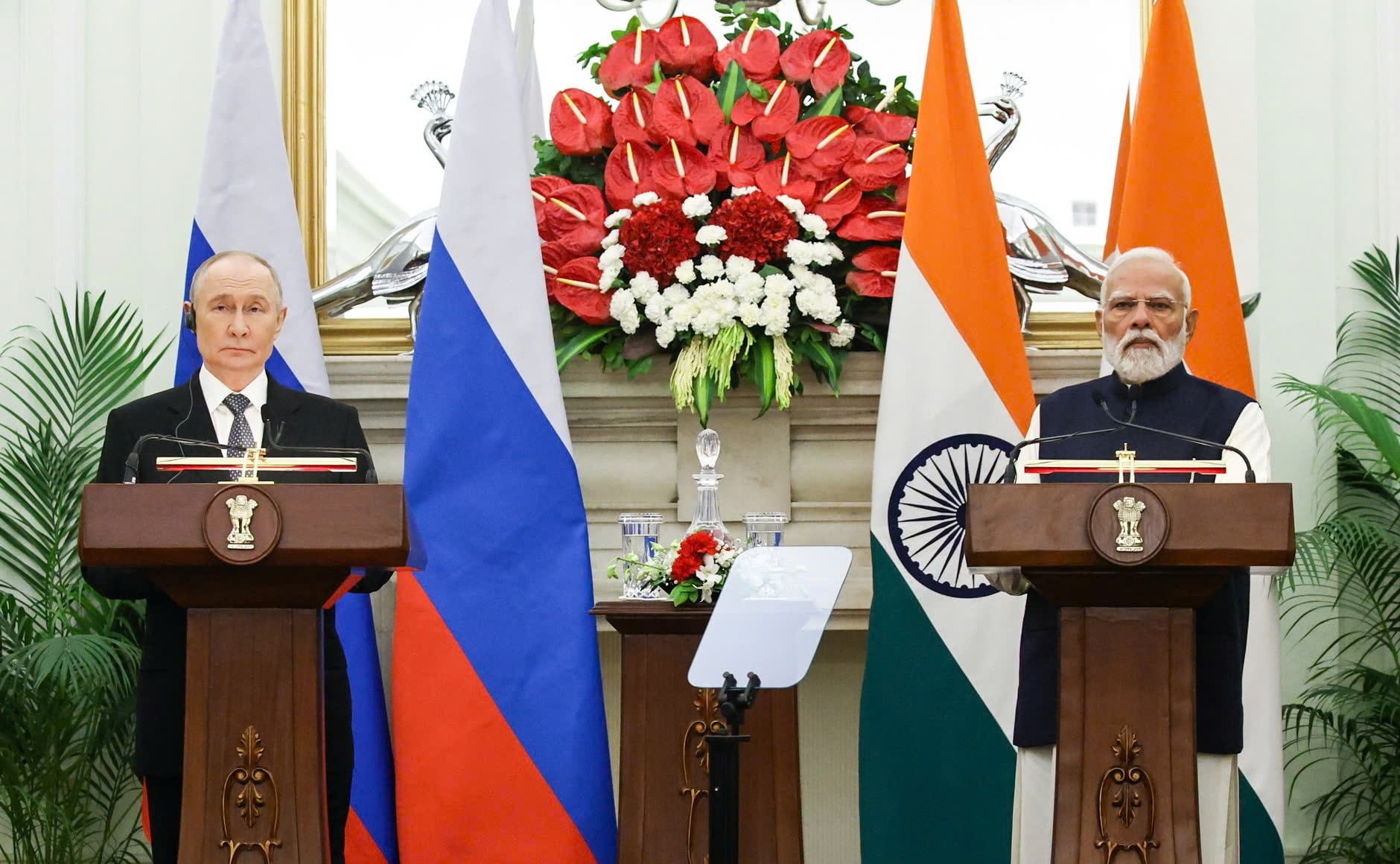
The political and strategic significance of the meeting extended far beyond the documents themselves. Russia and India reaffirmed their commitment to building relations based on the principles of sovereignty, non-alignment, and multipolarity. For the Russian public, the warm welcome in New Delhi reinforced the message that Western efforts to isolate Russia had failed. For Indian voters, Modi signaled independent foreign policy planning, despite the economic ultimatum from Washington.
In other words, the 23rd summit created a crucial "anchor point" in the emerging multipolar structure, in which India is emerging as an independent strategic actor, while Russia continues to consolidate its network of partners outside the Western system.
The US adjusts, Europe falters, and China remains cautious.
The unique nature of the Russia-India summit cannot be separated from its broader context: the strategic shift in the US, the changing security thinking in Europe, and the technological and geopolitical competition between the US and China.
On December 4, 2025, the Trump administration unveiled its new National Security Strategy. The 33-page document represents a shift in thinking: abandoning a globalized approach, narrowing the list of core interests, and establishing the principle of "America First." From there, Washington prioritizes border control, ending mass migration, rebuilding energy and industry, strengthening nuclear deterrence, and establishing a "golden dome" for missile defense.
A key feature is the strategy prioritizing the Western Hemisphere: maintaining a military presence, controlling shipping lanes, preventing illegal migration, and cracking down on human trafficking and drug trafficking. This policy employs both a "stick" (military) and a "carrot" (investment and cooperation).
With regard to China, the tone is tough but avoids direct confrontation, due to the influence of trade negotiations. The goals of "economic rebalancing" and technological competition remain central. Security in the Taiwan Strait is also a top priority.
For Russia, the document adopts a relatively neutral tone. Unlike previous strategies that viewed Moscow as an adversary, this document avoids using language that lists "enemies." The perspective
The move to “end the perception of NATO as an ever-expanding alliance” resonated positively in Moscow. Some analysts believe Washington is “breaking free from its post-Cold War anti-Russian legacy.”
This is the underlying reason why Russia and India have new strategic space. As the US prioritizes the Western Hemisphere and restructures its security thinking, the gap in interaction between Eurasia widens, creating conditions for increased cooperation between New Delhi and Moscow without falling into direct competition with Washington.
In Europe, the US National Security Strategy strongly criticizes the EU's supranational model, arguing that this structure undermines the autonomy of nations. The document questions migration policies and expresses concerns about the loss of identity. With Ukraine, the US demonstrates a pragmatic approach: prioritizing a "quick resolution" to stabilize the strategic relationship with Russia, rather than pursuing the goal of prolonging the conflict.
From a systems perspective, this creates three new variables on the world chessboard: (1) Europe's reduced ability to act strategically on its own; (2) America prioritizing the Western Hemisphere, selectively competing with China; (3) Russia's increased shift in focus towards Eurasia, with India as a key anchor.
Source: https://congluan.vn/hop-tac-nga-an-do-diem-nhan-moi-tren-ban-co-dia-chinh-tri-the-gioi-10322151.html
![[Photo] Closing Ceremony of the 10th Session of the 15th National Assembly](/_next/image?url=https%3A%2F%2Fvphoto.vietnam.vn%2Fthumb%2F1200x675%2Fvietnam%2Fresource%2FIMAGE%2F2025%2F12%2F11%2F1765448959967_image-1437-jpg.webp&w=3840&q=75)

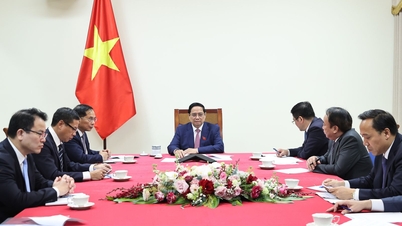
![[Photo] Prime Minister Pham Minh Chinh holds a phone call with the CEO of Russia's Rosatom Corporation.](/_next/image?url=https%3A%2F%2Fvphoto.vietnam.vn%2Fthumb%2F1200x675%2Fvietnam%2Fresource%2FIMAGE%2F2025%2F12%2F11%2F1765464552365_dsc-5295-jpg.webp&w=3840&q=75)































![[OFFICIAL] MISA GROUP ANNOUNCES ITS PIONEERING BRAND POSITIONING IN BUILDING AGENTIC AI FOR BUSINESSES, HOUSEHOLDS, AND THE GOVERNMENT](https://vphoto.vietnam.vn/thumb/402x226/vietnam/resource/IMAGE/2025/12/11/1765444754256_agentic-ai_postfb-scaled.png)



































Comment (0)