

To boost sustainable industrial development, the Department of Agriculture and Rural Development advised the Provincial People's Committee to issue a plan for the development of the livestock industry towards safety, efficiency, and high economic value by 2030; guiding localities to focus on reviewing and restructuring industrial activities appropriately, promoting propaganda and mobilization efforts to encourage farmers to boldly invest and expand the scale of livestock development associated with grass cultivation; and strengthening the transfer and application of scientific and technological advancements in production. Along with this, many policies have been implemented to support and attract businesses to invest in the strong development of the livestock industry along the entire value chain from production to consumption in the province.
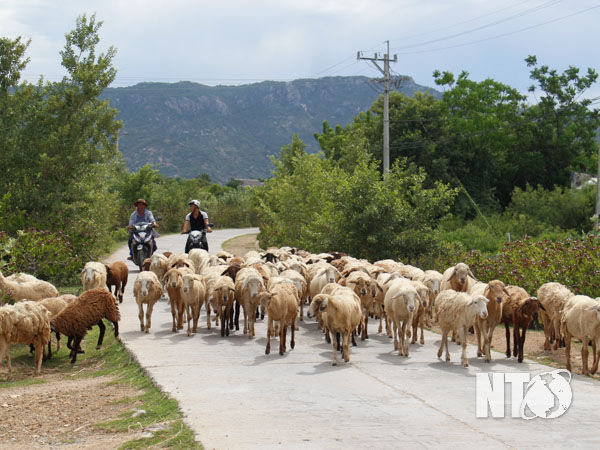
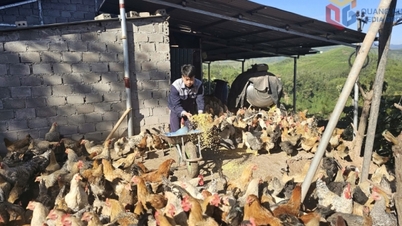
Farmers in Bac Son commune (Thuan Bac district) are developing livestock farming, bringing economic stability.
With guidance from relevant agencies and local authorities, the practice of industrial farming has seen a significant shift in people's awareness. Many farming households no longer rely heavily on natural pastures but proactively build barns and stockpile feed and water to ensure a sufficient supply. Mr. Mang San, from Xom Bang village, Bac Son commune (Thuan Bac district), shared: "My family has 10 cows. In the current drought conditions, natural pastures are shrinking, and if we graze them, there won't be enough food, and the cows will not develop well. Therefore, in addition to utilizing corn stalks and straw after harvest, I set aside 1.2 acres of land to plant elephant grass and ensure full vaccination, so the herd always thrives." To meet the demand for industrial feed, people are proactively planting grass in areas around lakes and dams, along rivers and streams, and using well water, with the current area reaching over 1,265 hectares. At the same time, agricultural by-products are stockpiled, meeting approximately 45% of livestock feed needs.
In particular, the value chain-based livestock farming model is increasingly being replicated, with many businesses and establishments linking with farmers in a way that farmers provide barns, labor for care, and land for growing grass, while businesses invest capital and provide technical guidance for production in a closed cycle, bringing harmonious benefits to all participating parties. Typical examples include the Bich Huyen goat and sheep slaughterhouse in Do Vinh ward (Phan Rang - Thap Cham city); the Le Thi Hoa facility in Phuoc Vinh commune (Ninh Phuoc district) which links with hundreds of households in the localities to provide goat and sheep breeding stock and organize product procurement. CP Vietnam Livestock Corporation and CJ ViNa Agri Co., Ltd. link with farmers in Ninh Phuoc, Ninh Son, and Bac Ai districts to raise over 40,000 animals; and the Suoi Da Cooperative in Loi Hai commune (Thuan Bac district) links with local people to raise hundreds of black pigs and native chickens... averaging about 22 tons of livestock and poultry meat sold to the market per day. According to assessments by relevant authorities, through industrial linkages along the value chain, the situation of scattered, small-scale farming is gradually shifting to concentrated farming. Businesses have effectively played the role of intermediaries in organizing production, rationally regulating market demand, reducing intermediaries, and driving up production costs, creating enthusiasm among farmers.
Furthermore, to improve the quality of livestock breeds, the Provincial Agricultural Extension Center also supports several localities in implementing measures to crossbreed new breeds through models such as: a model to improve the quality of local cattle herds using artificial insemination techniques, achieving a pregnancy rate of over 70%, shortening the calving interval, and reducing breeding costs; a model using Brahman bull semen, resulting in cattle weighing 22.5 kg/animal, generating an income 1.5-1.7 million VND/animal higher than local cattle; and a method of exchanging male goats and sheep between households to avoid the risk of inbreeding, helping people gradually access new scientific and technical advancements, increasing production and product quality. Along with this, farm operations are expanding, with 51 pig farms, 12 poultry farms, 7 sheep farms, 4 goat farms, and 31 cattle farms. Most livestock farmers focus on investing in large-scale barn systems combined with grass cultivation, good disease control, and high income. Typical examples include the model of fattening 600 sheep in confinement by Mr. Pham Minh Quang, Nhi Ha commune (Thuan Nam); the model of fattening 250 cattle by Mr. Le Tan Quy, Phuoc My ward (Phan Rang - Thap Cham city); and the model of breeding over 420 cattle, goats, and sheep by Mr. Dang Ngo, Phuoc Huu commune (Ninh Phuoc).
Thanks to synchronized solutions, industrial activities in the province have achieved certain results; the scale of livestock herds has developed stably, increasing by an average of 4.5% per year; boosting the value of industrial production by an average of 6.34%, accounting for 12.2% of the total industry, an increase of 0.4% compared to the beginning of the term.
To achieve the targets by 2025, the entire province aims to reach 150,000 cattle, 280,000 goats and sheep, 270,000 pigs, and 2.4-2.6 million poultry. The agricultural sector will focus on stabilizing concentrated farming areas, linked with improving herd quality through breed improvement; and prioritize the application of high-tech farming processes. Medium and large-scale farm models will be encouraged; cooperatives and production groups will be established to form linkages in production and consumption, and geographical indications and brands will be developed for advantageous livestock products... The goal is to create a large volume of industrially produced goods, resulting in high productivity and good quality.
Hong Lam
Source

![[Photo] Prime Minister Pham Minh Chinh holds a phone call with the CEO of Russia's Rosatom Corporation.](/_next/image?url=https%3A%2F%2Fvphoto.vietnam.vn%2Fthumb%2F1200x675%2Fvietnam%2Fresource%2FIMAGE%2F2025%2F12%2F11%2F1765464552365_dsc-5295-jpg.webp&w=3840&q=75)


![[Photo] Closing Ceremony of the 10th Session of the 15th National Assembly](/_next/image?url=https%3A%2F%2Fvphoto.vietnam.vn%2Fthumb%2F1200x675%2Fvietnam%2Fresource%2FIMAGE%2F2025%2F12%2F11%2F1765448959967_image-1437-jpg.webp&w=3840&q=75)



































![[OFFICIAL] MISA GROUP ANNOUNCES ITS PIONEERING BRAND POSITIONING IN BUILDING AGENTIC AI FOR BUSINESSES, HOUSEHOLDS, AND THE GOVERNMENT](https://vphoto.vietnam.vn/thumb/402x226/vietnam/resource/IMAGE/2025/12/11/1765444754256_agentic-ai_postfb-scaled.png)














































Comment (0)