


Linking agricultural product consumption
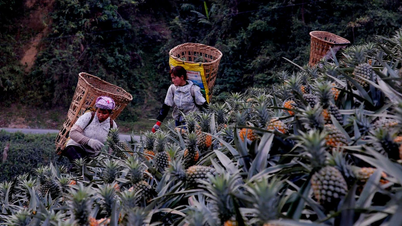
Currently, the establishment of growing area codes and the issuance of international standard certificates such as VietGAP, GlobalGAP, etc. have created stable raw material areas, contributing to creating a solid foundation for agricultural exports. Currently, Hanoi is developing many products with export potential, such as: 7,000 hectares of Japonica rice, 3,200 hectares of pink bananas, 5,000 hectares of safe vegetables, 50 hectares of organic vegetables, and many processed products with export potential.
According to the Hanoi Department of Agriculture and Environment, in the first 10 months of 2025, Hanoi's agricultural and forestry exports reached 1.88 billion USD, of which agricultural exports reached 1.22 billion USD. Currently, in Hanoi, there are over 250 enterprises exporting agricultural products. For example: Cinnamon, star anise, spices (garlic, ginger, chili) products have 62 establishments exporting to markets in Europe, the US, Korea, India... Green tea and black tea products have 60 companies exporting to markets in Taiwan (China), Pakistan, Afghanistan, Russia... with an export output of over 20 thousand tons/year. Coffee products are exported by 15 companies to markets in Europe, the US, Taiwan (China), Singapore... In which, Minh Tien Berest Group Joint Stock Company has a coffee processing factory in Hanoi with the capacity to supply the market with about 750-1,200 containers of Arabica coffee/year and 750-1,000 containers of Robusta coffee/year...
Other agricultural products such as rice, shiitake mushrooms, wood ear mushrooms, pepper, tapioca starch... have 50 companies exporting to markets in Korea, China, Japan, Malaysia, Russia... Some large exporting companies such as Duong Kien Production, Trade and Import-Export Company Limited (with wood ear mushrooms, shiitake mushrooms, vermicelli...), Hiep Long - Hanoi Trading Joint Stock Company (wood ear mushrooms products), Northern Food Corporation, Toan Tam Import-Export Joint Stock Company...
Director of Duong Kien Production, Trade and Import-Export Company Limited (Hung Dao Commune) Duong Dinh Khoi said that in order to have vermicelli products with quantity and quality, the company has cooperated with households and provinces and cities to build raw material areas. Currently, the product is available in China, Taiwan (China), Malaysia, Cambodia and is negotiating with partners in Canada.
In addition, in recent times, Hanoi has promoted cooperation with provinces and cities to bring clean agricultural products to meet the consumption needs of the capital's people and many branded products have been sold in supermarkets and convenience stores. Director of Le Gia Food and Trade Services Company Limited ( Thanh Hoa province) Le Anh shared: Le Gia's fish sauce products have gradually conquered demanding markets such as: Taiwan (China), Korea, Japan, Russia, South Africa. In addition, Le Gia fish sauce is also one of the few traditional fish sauce products selected for sale on the shelves of the Vinmart+ system in the whole North...
It can be affirmed that, in recent times, the Hanoi Department of Agriculture and Environment has proactively advised, directed, and supported businesses in understanding regulations and standards for food quality and safety, while also connecting domestic agricultural product consumption and export. This has helped businesses invest with confidence, enhance their competitiveness, and achieve sustainable development.
Improve quality and expand export markets.
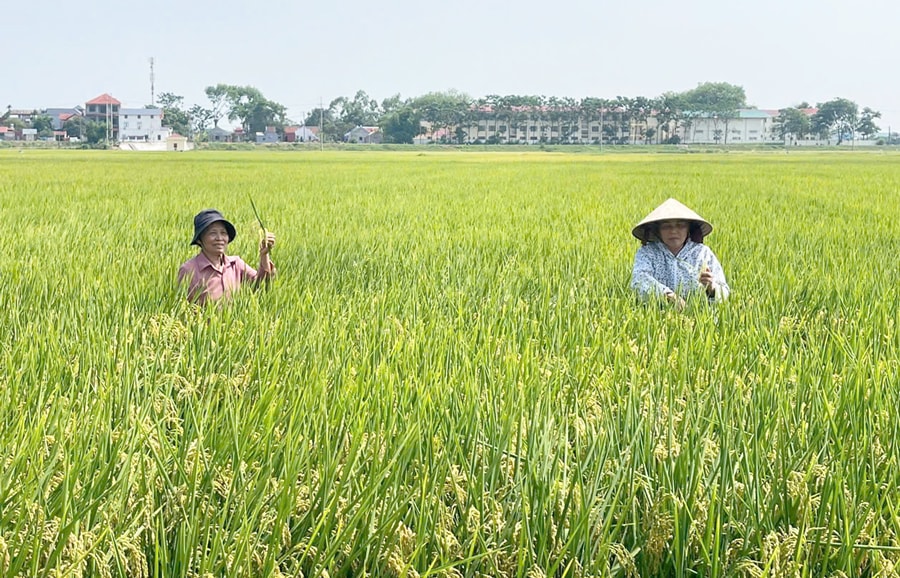
Despite the success, export enterprises still face many difficulties, especially in accessing raw material areas that meet international standards and meeting the requirements of demanding markets regarding organic standards, GlobalGAP, HACCP, ISO 22000:2018. Grasping information, tastes, and food safety requirements of markets such as Europe, the US, Japan, or China is still limited.
General Director of Bao Minh Agricultural Processing Trading Joint Stock Company (Dinh Cong Ward) Bui Thi Hanh Hieu said that to effectively export rice, localities need to organize production in large fields, have policies to encourage links between businesses and farmers. Building growing areas that meet international standards, associated with growing area codes, and traceability will help improve the reputation and quality of Vietnamese agricultural products.
Deputy Director of the Hanoi Department of Agriculture and Environment Ta Van Tuong said that the city is coordinating with localities to promote free trade agreements, market barriers, as well as regulations on quality and food safety. At the same time, the industry supports the construction of linkage chains and brands for key agricultural products, in order to increase product value and ensure export standards. In addition, Hanoi will select key products to build a production roadmap associated with export processing. At the same time, the city also focuses on investing in upgrading wholesale markets and logistics centers to collect raw materials from provinces and cities, preserve, process, serve domestic consumption and export; provide fair and exhibition services and train human resources...
Thanks to the synchronization from building raw material areas, improving product quality to developing linkage chains, Hanoi is gradually becoming a model for sustainable agricultural exports. Enterprises and cooperatives are supported to access technology, markets and human resources, developing products that not only have economic value but also bring cultural values and Vietnamese brands to the world.
Source: https://hanoimoi.vn/ket-noi-chuoi-nguyen-lieu-nong-san-nen-tang-vung-chac-cho-xuat-khau-726231.html
![[Photo] Closing Ceremony of the 10th Session of the 15th National Assembly](/_next/image?url=https%3A%2F%2Fvphoto.vietnam.vn%2Fthumb%2F1200x675%2Fvietnam%2Fresource%2FIMAGE%2F2025%2F12%2F11%2F1765448959967_image-1437-jpg.webp&w=3840&q=75)



![[Photo] Prime Minister Pham Minh Chinh holds a phone call with the CEO of Russia's Rosatom Corporation.](/_next/image?url=https%3A%2F%2Fvphoto.vietnam.vn%2Fthumb%2F1200x675%2Fvietnam%2Fresource%2FIMAGE%2F2025%2F12%2F11%2F1765464552365_dsc-5295-jpg.webp&w=3840&q=75)










































![[OFFICIAL] MISA GROUP ANNOUNCES ITS PIONEERING BRAND POSITIONING IN BUILDING AGENTIC AI FOR BUSINESSES, HOUSEHOLDS, AND THE GOVERNMENT](https://vphoto.vietnam.vn/thumb/402x226/vietnam/resource/IMAGE/2025/12/11/1765444754256_agentic-ai_postfb-scaled.png)










































Comment (0)