

Nestled amidst the distinctive basalt landscape of the Central Highlands, C9 cave in Nam Da commune, Krong No district (Lam Dong province) is becoming a popular destination for tourists seeking to explore fascinating natural wonders.
This is one of nearly 50 lava caves belonging to the Nam Blang volcanic system - a complex formed from eruptions millions of years ago, leaving behind many geological traces of special scientific and tourism value.
From the foot of the Nam Blang volcano, visitors can walk for about 20-30 minutes along a 1.5 km trail to reach the entrance of cave C9. The journey crosses red basalt slopes, patches of dipterocarp forest interspersed with wild grasses, creating the feeling of stepping into a pristine, unexplored land. As you get closer to the cave entrance, the terrain changes dramatically, revealing exposed basalt rock layers and natural rock arches curving along the flow of lava that cooled millions of years ago.
Cave C9 is nearly 217 meters long and about 20 meters deep, with a structure consisting of two relatively distinct natural entrances. The northern entrance is a sinkhole about 35-40 meters wide and 7-8 meters deep, creating a spectacular entrance like a giant funnel leading down into the earth. Meanwhile, the southern entrance is smaller, with a diameter of about 25 meters and a depth of 3-4 meters, allowing visitors easier access and a clear sense of the cave's gradual expansion from south to north.
Belonging to a group of lava caves formed near the eruption site, Cave C9 boasts a wide, high interior with a relatively complete circular cross-section. The natural, winding patterns on the rock walls resemble suddenly frozen streams, strongly reflecting the geological processes that occurred in the past. The deeper one goes inside, the cooler and quieter the space becomes, and the light from the cave entrance gradually spreads, creating a scene that is both mysterious and captivating.
The basalt layers, fractured over time, the scattered dark lava blocks, and especially the countless "volcanic bombs"—pieces of lava compressed and ejected during eruptions—have contributed to the unique beauty of Cave C9. These vivid traces serve as "open source material" for geologists to study the eruption history of the Central Highlands volcanic system.
Beyond its scientific value, Cave C9 also makes a strong impression on those who love exploration with its rare, pristine landscape. Each step reveals a layer of history lying dormant in the shadows; each rock formation serves as evidence of the power and constant movement of nature over time. Especially on sunny days, the light shining from the sinkhole in the north down into the cave creates a spectacular visual spectacle, like a beam of light piercing through a "skylight" in the heart of the forest.
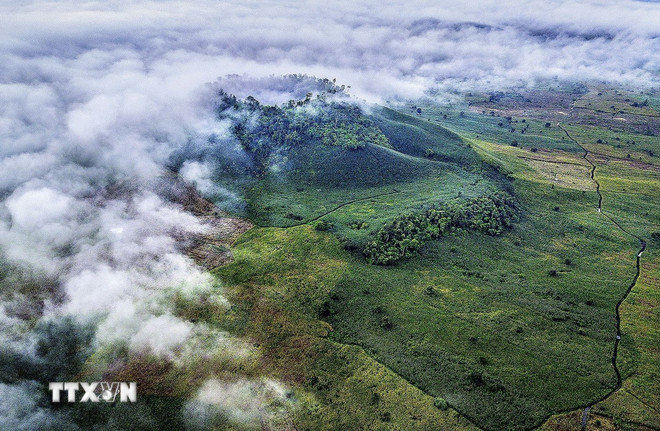
In recent years, Lam Dong and other provinces in the Central Highlands have been focusing on developing sustainable tourism related to volcanic craters and lava caves. Cave C9, along with the C3, C7, C8 cave systems, is gradually being surveyed, assessed, and infrastructure is being developed to serve tourists, aiming to become a unique adventure-geological tourism product of the region.
With its pristine beauty, immense geological value, and challenging exploration journey, C9 Cave is an ideal choice for those seeking a unique experience in the Lam Dong plateau. Amidst the tranquil space of a dormant volcano, visitors can clearly feel the breath of time and the grandeur of nature – values that make C9 a worthwhile destination to explore on a journey to conquer the Central Highlands.
On December 27, 2024, the People's Committee of Krong No District, Dak Nong Province, held a ceremony to receive the National Monument Ranking Certificate for the scenic landscape of Nam B'Lang volcano (also known as Chu R'luh volcano), located in Buon Choah and Nam Da communes, Krong No District, Dak Nong Province.
Source: https://www.vietnamplus.vn/kham-pha-ve-dep-hoang-so-cua-hang-dong-c9-giua-long-nui-lua-nam-blang-post1081810.vnp

![[Photo] General Secretary and President To Lam presides over a meeting with the Central Organizing Committee.](https://vphoto.vietnam.vn/thumb/1200x675/vietnam/resource/IMAGE/2026/06/03/1780482764658_a1-bnd-4741-3342-jpg.webp)

![[Photo] First session of the 14th Congress of the Vietnam Trade Union](https://vphoto.vietnam.vn/thumb/1200x675/vietnam/resource/IMAGE/2026/06/03/1780465947883_ndo_br_img-3852-jpg.webp)
![[Photo] Secretary of the National Assembly Party Committee, Chairman of the National Assembly presides over the meeting of the Standing Committee and Executive Committee of the National Assembly Party Committee.](https://vphoto.vietnam.vn/thumb/1200x675/vietnam/resource/IMAGE/2026/06/03/1780480353201_ndo_br_bnd-2585-jpg.webp)









































![[Video] Sunset at Lap An Lagoon – Where the sun sets over the fishing nets](https://vphoto.vietnam.vn/thumb/1200x675/vietnam/resource/IMAGE/2026/05/31/1780192137701_beach-landscape-sea-water-nature-grass-745871-pxhere-com.jpeg)



































Comment (0)