

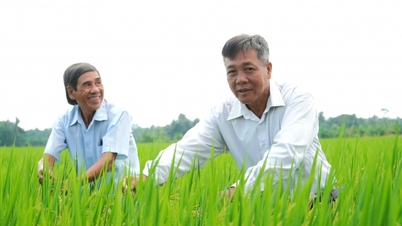
These days, the veteran farmers of the Cay Trom Agricultural Service and Trade Cooperative in Hung Dien A commune (Vinh Hung district, Long An province) are preparing plans to participate in the Ministry of Agriculture and Rural Development's project to produce 1 million hectares of high-quality rice.
According to Mr. Bui Van Tuan, Director of the Cooperative, from the initial 7 members, the cooperative now has 63 members and 103 affiliated members with a production area of over 500 hectares.
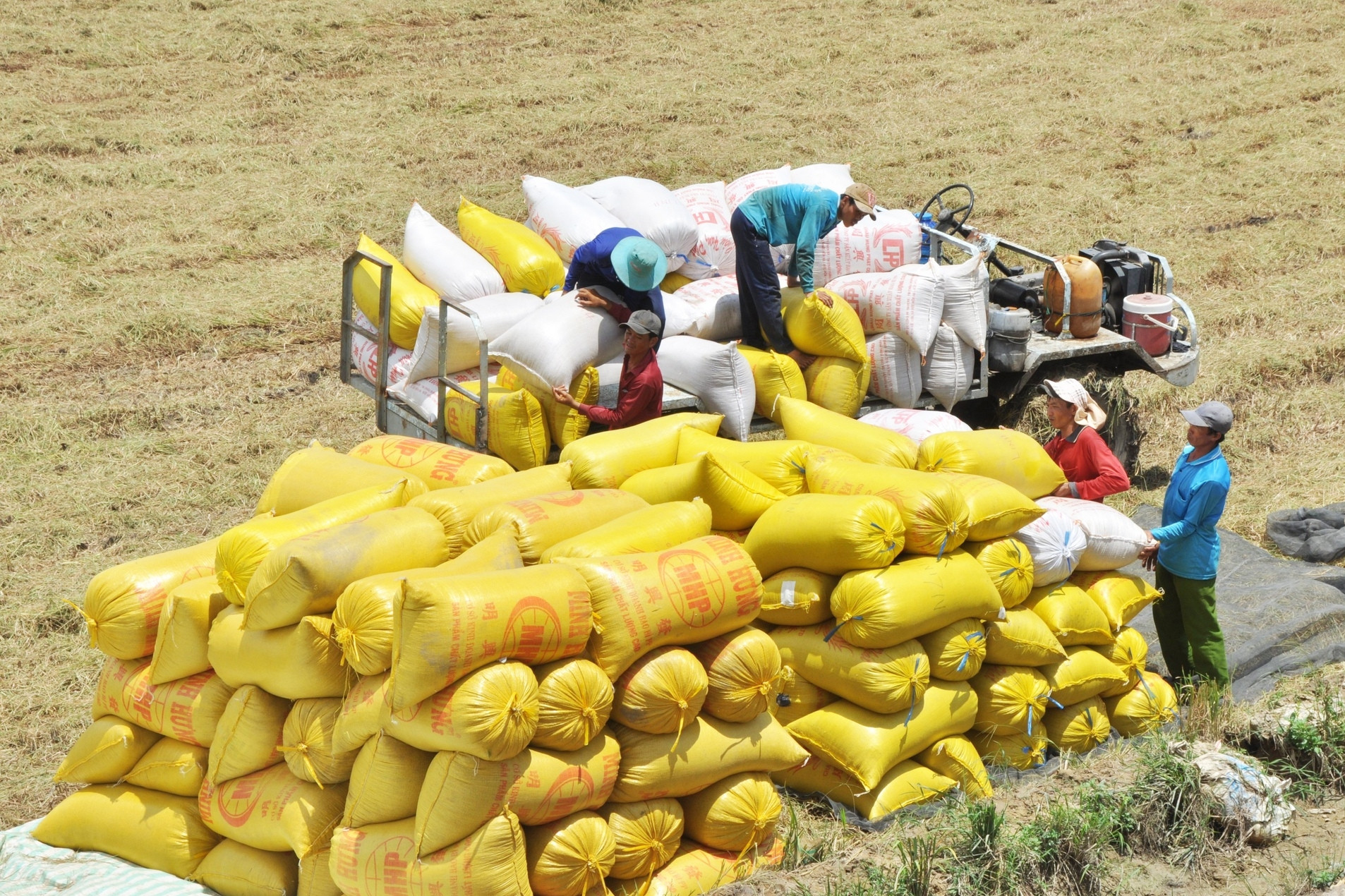
In recent years, households that are members of the cooperative only need to invest in production according to the correct procedures, reducing the amount of fertilizer and pesticides, to receive an additional purchase price of 50-300 VND/kg of rice according to the cooperative's evaluation scale. As a result, 80% of the cooperative's rice area is produced according to the plan and orders of businesses for export to the European market.
In 2022, the cooperative's revenue from rice cultivation alone reached 17 billion VND. With stable and high rice prices, producing three rice crops per hectare can yield a profit of approximately 90-100 million VND per year.
Going forward, the cooperative will shift to low-emission rice production under the 1 million hectare high-quality rice project. Accordingly, in addition to carefully controlling the amount of seeds, fertilizers, pesticides, etc., water use must also be strictly managed, applying advanced technical processes to reduce greenhouse gas emissions.
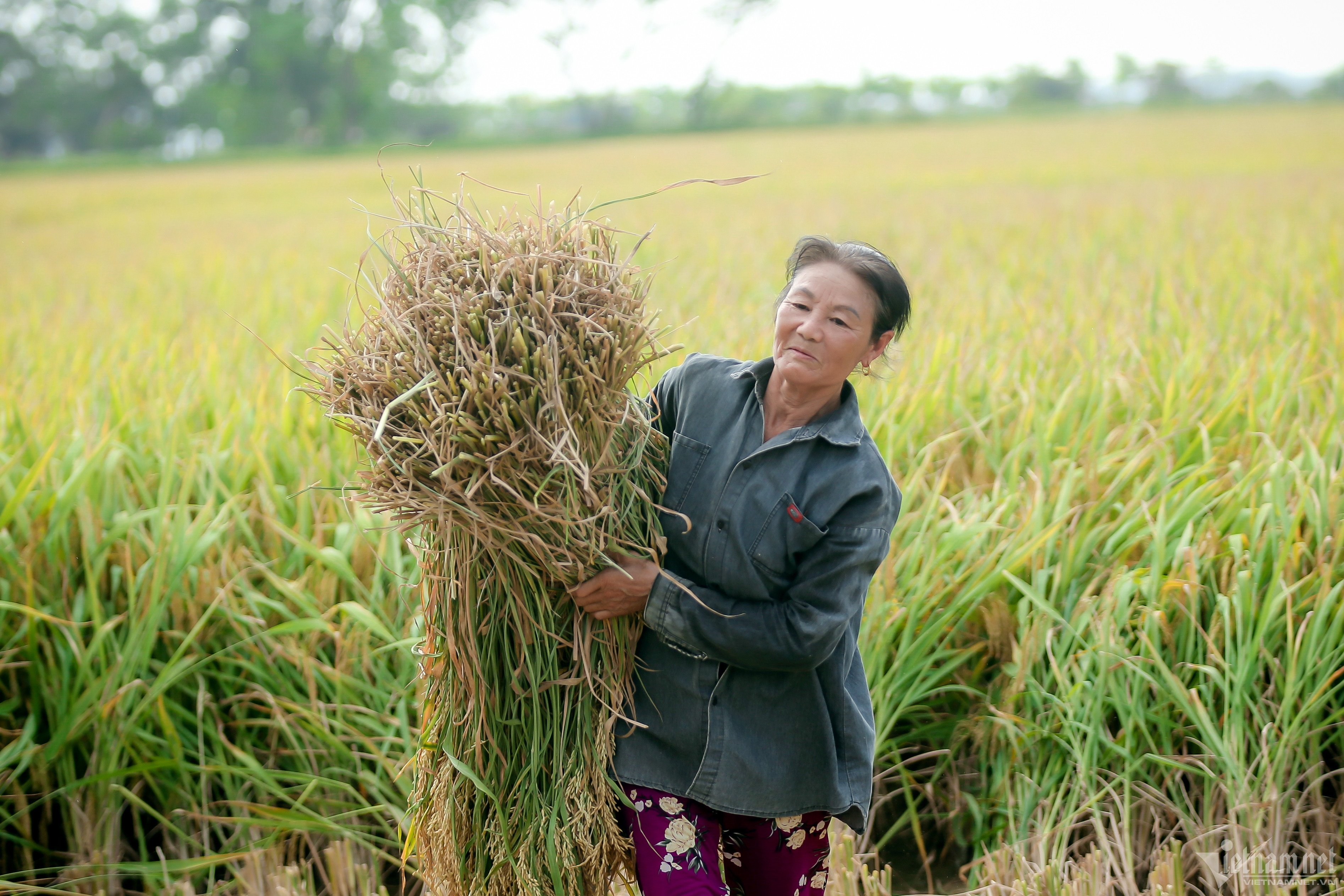
“The cooperative aims for a ‘1 must, 6 reductions’ model. That is, in addition to reducing seeds, fertilizers, pesticides, water, etc., it must also reduce emissions,” Mr. Tuan said. Compared to other crops, he affirmed that income from rice is not high. But if production follows new standards, carbon credits can be sold, and the added value of rice grains is increased, then rice farming will certainly not be inferior to other crops.
Recently, Dong Thap province registered with the Ministry of Agriculture and Rural Development an area of over 51,900 hectares of rice production that guarantees carbon credit payments in 2024.
To date, 12 localities in the Mekong Delta have registered to participate, with a total area of over 1 million hectares of high-quality rice.
The establishment of 1 million hectares of high-quality specialized rice cultivation areas is linked to the reorganization of the production system along the value chain, the application of sustainable farming practices, and the improvement of income and living standards for rice farmers, ensuring food security; enhancing the quality and reputation of Vietnamese rice products and moving towards a transparent, responsible, and sustainable rice industry. In particular, sustainable farming practices will contribute to reducing carbon emissions in the face of ongoing global climate change challenges.
The Ministry of Agriculture and Rural Development announced that approximately 180,000 hectares will be dedicated to high-quality, low-emission rice cultivation starting from the 2023-2024 Winter-Spring crop season. This will be expanded to 300,000-500,000 hectares by 2025. In the 2026-2030 period, an additional 100,000 hectares will be cultivated annually to reach 1 million hectares of specialized high-quality, low-emission rice cultivation in the Mekong Delta.
According to industry experts, this specialized rice-growing area can be considered a model for reduced-emission rice production, a model that Vietnam is the first country in the world to implement.
This project introduces technical packages aimed at promoting water management through rotational weed irrigation and optimizing rice production inputs by using certified seeds, reducing seed usage, water usage, fertilizer use, pesticide use, and post-harvest losses.
Mr. Nguyen Duy Thuan, General Director of Loc Troi Group JSC, said that when Vietnam announced the project, the world immediately calculated that these 1 million hectares would yield approximately 9 million tons of high-quality rice for export in a year.
This source of high-quality rice will contribute to enhancing our country's competitiveness in the international market. Because, to gain market share, Vietnamese rice must compete on price, quality, food safety and hygiene, brand, and reputation.
From an economic perspective, according to Mr. Le Thanh Tung, Deputy Director of the Department of Crop Production (Ministry of Agriculture and Rural Development), the proposed 1 million hectares will reduce production costs by approximately 20%, equivalent to about 9,500 billion VND per year. If sustainable farming practices are applied, the selling price of rice could increase by about 10%, generating over 7,000 billion VND per year.
Thus, the rice industry gains an additional 16,000 billion VND per year, equivalent to 500 million USD. This does not include the added value factors in the process of building a brand for low-emission rice, he said.
Significantly, farmers not only harvest rice but also have the opportunity to sell carbon credits through the production of high-quality, low-emission rice, contributing to Vietnam's commitment to achieving net-zero emissions by 2050.
Experts explain that each country, organization, or individual has a certain carbon emission quota. If they do not use up their allocated quota, they can sell the excess emissions to a country or organization that exceeds their permitted quota.
The World Bank estimates that the establishment of a 1 million-hectare high-quality rice cultivation area in the Mekong Delta could reduce carbon emissions by 10 million tons, generating approximately $100 million per year.
According to Deputy Minister of Agriculture and Rural Development Tran Thanh Nam, the main solution to ensure farmers' profits reach over 40% by 2025 and over 50% by 2030 is to sell carbon credits from low-emission rice production. The World Bank has committed to purchasing carbon credits at $10 per ton. This means that one hectare of rice could potentially generate $100 from selling carbon credits.
Therefore, building a brand for Vietnamese rice that reduces emissions will bring many benefits to rice farmers. At the same time, promoting the exploitation and use of by-products from rice cultivation will increase their economic value and efficiency, Deputy Minister Nam emphasized.
Source
































































Comment (0)