

Last year, the fossil of a 15-meter-long serpent caused a sensation when it surfaced in India, dethroning the giant Titanoboa.
Snakes and pythons remain extremely fearsome creatures to all other species to this day. Fortunately, the most terrifying representatives of this lineage have become extinct.
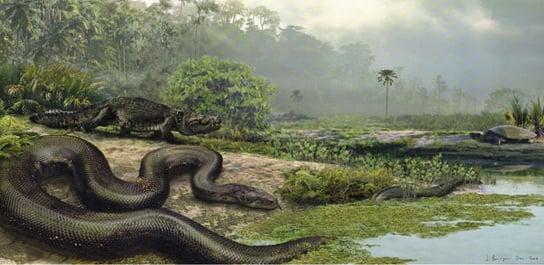
Graphic illustration depicting the serpent Titanoboa cerrejonensis - Photo: SCITECH DAILY
1. The world's largest "monster snake," Vasuki indicus.
In 2024, Indian paleontologists announced a remarkable discovery at the Panandhro lignite mine in the Kutch salt marsh desert region of Gujarat state: a "monster serpent" that could be up to 15 meters long.
It was named Vasuki Indicus, after the divine serpent that coils around the neck of Shiva – the supreme deity symbolizing destruction and creation in Hinduism.
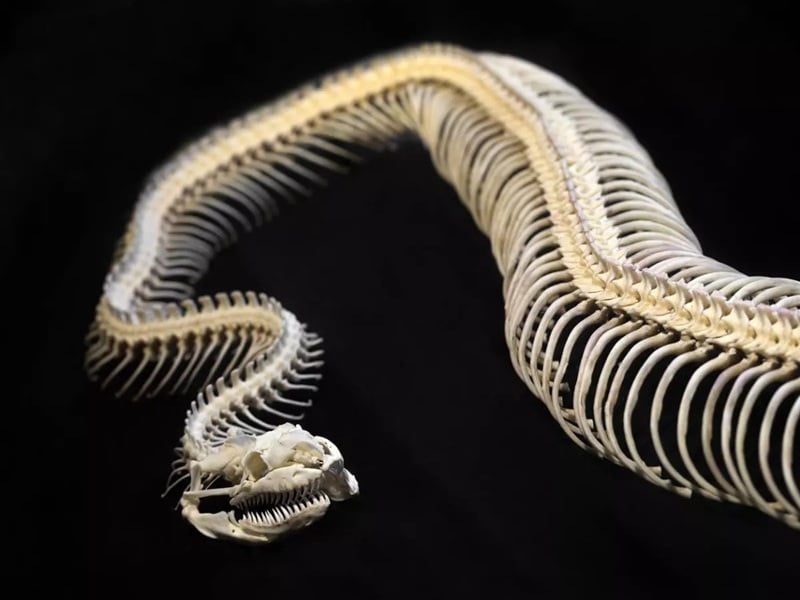
3D reconstruction of the skeleton of the Vasuki indicus serpent - Photo: ROORKEE INSTITUTE OF TECHNOLOGY, INDIAN
This fearsome snake has also been identified as a member of the Madtsoiidae, a lineage of extinct giant snakes and pythons that originated on the southern supercontinent of Gondwana 100 million years ago.
India was originally part of Gondwana. During the last continental redivision, this subcontinent drifted northward to merge with a portion of the northern supercontinent Laurasia, forming modern-day Asia.
2. Brazilian Four-legged Snake
The creature, named Tetrapodophis plentyctus, was unearthed in Brazil a few years before the Indian "sacred snake." Its genus name – Tetrapodophis – means "four-legged snake" in Greek, according to Science.
Meanwhile, the species name plentyctus, derived from Latin, means "to embrace" and alludes to the creature's flexibility and its ability to tightly wrap around its prey.
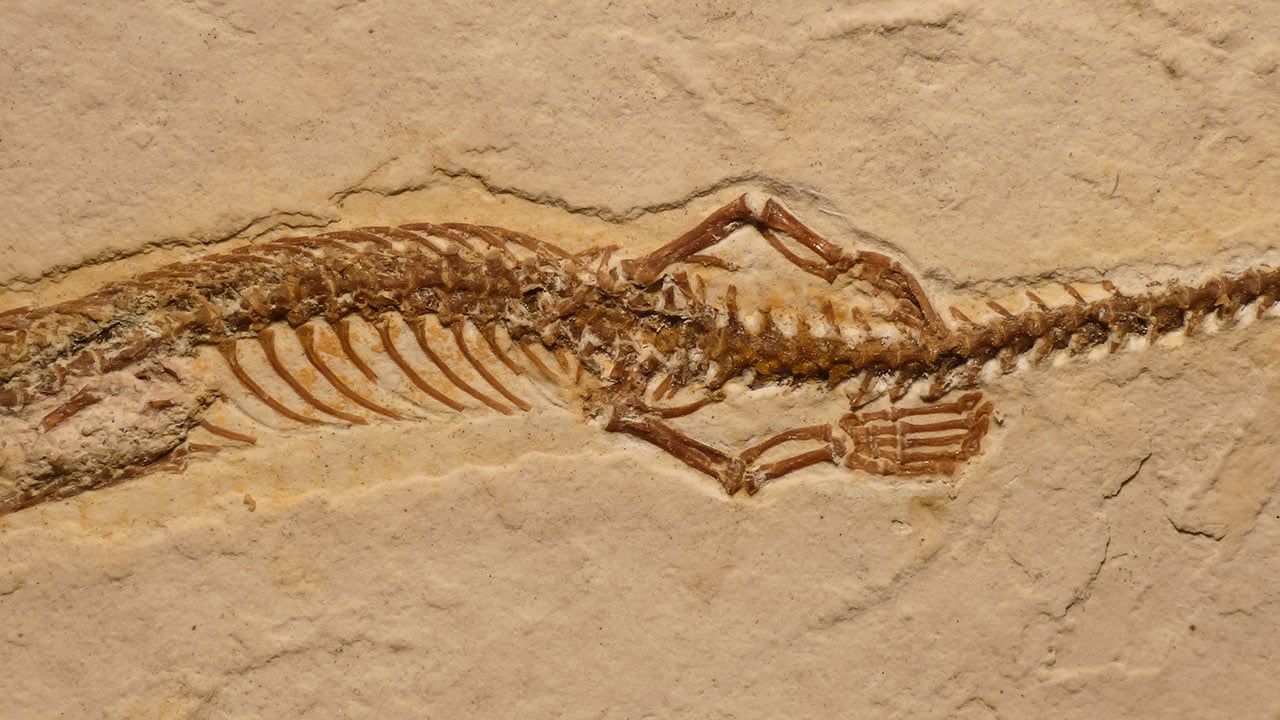
The bizarre skeleton of a four-legged snake - Photo: SCIENCE
This snake is only 20 cm long, but what makes it special is its age of 120 million years.
This also makes it one of the oldest known snake species.
Meanwhile, the four tiny limbs represent an incomplete evolution from their four-legged reptilian ancestors.
Besides its tiny limbs, this specimen also has a skull the size of a human fingernail, 160 vertebrae in the spine, and 112 vertebrae in the tail.
3. Titanoboa cerrejonensis (Giant Python)
Titanoboa cerrejonensis once held the crown among the world's giant snakes when its description was first published in 2012.
It was about 12 meters long when alive and weighed about 1 ton, and was discovered at the Cerrejón fossil mine in the tropical lowlands of northern Colombia, 96 km off the Caribbean coast.
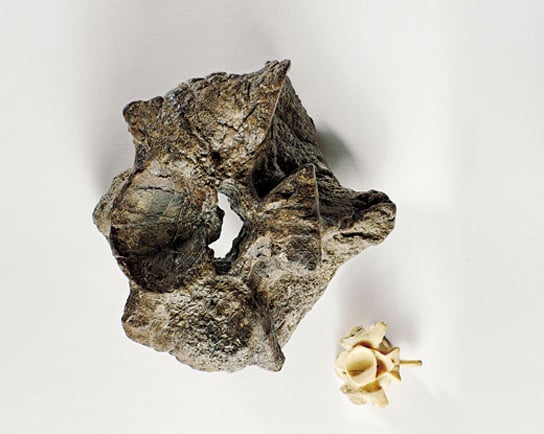
The vertebrae of Titanoboa cerrejonensis were enormous compared to the vertebrae of the modern Anaconda - Photo: SCITECH DAILY
This serpent lived approximately 58-60 million years ago and had a favorite diet of crocodiles, fish, and turtles.
Reptiles can grow larger in warmer climates, allowing cold-blooded animals like Titanoboa to maintain the metabolic rate necessary to sustain their enormous mass.
Source: https://giadinh.suckhoedoisong.vn/kinh-hai-3-quai-xa-da-tuyet-chung-hang-trieu-nam-truoc-17225020207392932.htm




![[Video] Hue and Quang Ninh mark strong tourism growth](https://vphoto.vietnam.vn/thumb/402x226/vietnam/resource/IMAGE/2025/12/12/1765555481742_dung00-22-16-02still007-jpg.webp)
































































Comment (0)