

Deposit interest rates hit a new low of 6% per year.
Since the end of 2022, the downward trend in interest rates has become increasingly evident. From a general rate of 9% per year for a 12-month term, this rate is now only 6%.
Specifically, currently, the Big4 group (comprising state-owned banks: Vietnam Foreign Trade Commercial Bank – Vietcombank, Vietnam Industrial and Commercial Bank – VietinBank, Vietnam Investment and Development Bank – BIDV, and Vietnam Agricultural and Rural Development Bank – Agribank ) all offer the lowest interest rates in the market.
Within this group, the highest rate is only 5.5%/year, applicable to terms from 12 months to 36 months. For 6-month and 9-month terms, the interest rate is 4.5%/year. A rate of 3.5%/year is applied to some terms under 6 months.

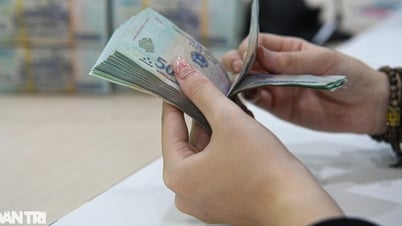
Deposit interest rates continued to fall sharply and reached a new low, but the flow of money into the stock market unexpectedly slowed down and continued to flow strongly into banks. (Illustrative image)
At joint-stock commercial banks, the average interest rate for long-term deposits is 6% per year. Very few institutions list interest rates above 7% per year. Some examples include DongA Bank (7% per year).
Furthermore, deposit interest rates are projected to continue falling.
This has led many to worry that money will "flow" from low-yield channels (bank deposits) to riskier investment channels such as stocks, real estate, gold, cryptocurrencies, etc.
The money is still going into the bank.
Following the continuous decline in deposit interest rates and the setting of new lows, the trend of capital flows has become quite clear. Real estate is not the preferred investment channel for investors, as property prices are considered still high and have significant room for further declines. Therefore, real estate investors are not in a hurry to "put down money" to buy houses.
Ms. Duong Thanh Binh, an investor, shared her perspective on money management: “When interest rates fall, I withdraw some money from my savings accounts to find new investment opportunities. In my assessment, the real estate market will continue to decline as developers still face many difficulties. Besides, although the flow of funds from banks and bonds for real estate has eased somewhat, the outlook is still not very bright. Therefore, the earliest time to buy a house is at the end of 2024, or at the latest in 2025.”
Regarding gold, Ms. Binh explained that about 10 years ago, gold was always part of her investment portfolio. However, in recent years, due to the significant difference between the price of SJC gold and the world gold price, the risk for buyers has been very high. Therefore, she no longer chooses gold.
Over the past period, Ms. Thanh Binh has chosen the stock market as a safe haven for her money. In fact, she has earned a 24% profit in the past six months by taking profits from stocks.
Many people share Ms. Thanh Binh's opinion that the number of new securities accounts being opened is constantly reaching new records.
This data shows that the flow of money into the banking system is under pressure. However, the figures indicate that money is still "flowing" into banks.
According to the latest report from the General Statistics Office, as of September 20, 2023, total means of payment increased by 4.75% compared to the end of 2022. Capital mobilization by credit institutions increased by 5.8%, while credit growth in the economy only reached 5.73%.
This is not the first time the deposit mobilization indicator has shown positive growth. Previously, data from the State Bank of Vietnam showed that total deposits mobilized by the credit institution system increased by 4.6% by the end of June 2023 compared to the beginning of the year.
Thus, from July until now, the banking system's capital mobilization has continued to grow positively, despite deposit interest rates falling to record lows.
Money puts the brakes on the stock market.
The massive influx of capital into the stock market has created billion-dollar trading sessions; in some sessions, the trading value on the HOSE alone exceeded 30,000 billion VND. This is a record high for the Vietnamese stock market.
However, in the last days of September 2023, the flow of money into the stock market unexpectedly slowed down. Trading volume tended to drop sharply.
Specifically, on September 28th, the trading volume (including both order matching and negotiated transactions) was only 525 million shares, equivalent to 13,804 billion VND. Previously, the Ho Chi Minh City Stock Exchange regularly had trading volumes exceeding 1 billion shares.
Source
![[Photo] Closing Ceremony of the 10th Session of the 15th National Assembly](/_next/image?url=https%3A%2F%2Fvphoto.vietnam.vn%2Fthumb%2F1200x675%2Fvietnam%2Fresource%2FIMAGE%2F2025%2F12%2F11%2F1765448959967_image-1437-jpg.webp&w=3840&q=75)
![[Photo] Prime Minister Pham Minh Chinh holds a phone call with the CEO of Russia's Rosatom Corporation.](/_next/image?url=https%3A%2F%2Fvphoto.vietnam.vn%2Fthumb%2F1200x675%2Fvietnam%2Fresource%2FIMAGE%2F2025%2F12%2F11%2F1765464552365_dsc-5295-jpg.webp&w=3840&q=75)













































![[OFFICIAL] MISA GROUP ANNOUNCES ITS PIONEERING BRAND POSITIONING IN BUILDING AGENTIC AI FOR BUSINESSES, HOUSEHOLDS, AND THE GOVERNMENT](https://vphoto.vietnam.vn/thumb/402x226/vietnam/resource/IMAGE/2025/12/11/1765444754256_agentic-ai_postfb-scaled.png)






























![[Infographic] Preventing students from making their own firecrackers: 7 things parents need to know](https://vphoto.vietnam.vn/thumb/402x226/vietnam/resource/IMAGE/2025/12/11/1765466656703_img_0320_20251211183542.jpeg)





















Comment (0)