

Before a special livestream for Amazon's Prime Day event, Andrew Martin, a British streamer, switched on a warm yellow light, transforming his bedroom into a makeshift studio. For an hour, he demonstrated the recording capabilities of his wireless microphone, leisurely moving from his desk to the sofa next to his cat shelf.
"I think livestreaming from this chair is perfectly fine," Martin joked to his viewers watching him on screen. "Who needs that computer? Give me a can of soda, I'm just sitting here chatting."
Audiences turn to Martin not only to hunt for bargain electronics, but also to chat, interact, and find a genuine connection. He is just one of thousands of pieces that make up the booming commercial livestreaming landscape in the US.
But on the other side of the globe, in China, stories like Martin's have been unfolding for a decade, on a scale and intensity unimaginable to the West. It's no longer just casual conversations for extra income; it's a massive sales machine, a multi-billion dollar industry operating nonstop, 24 hours a day, 7 days a week.
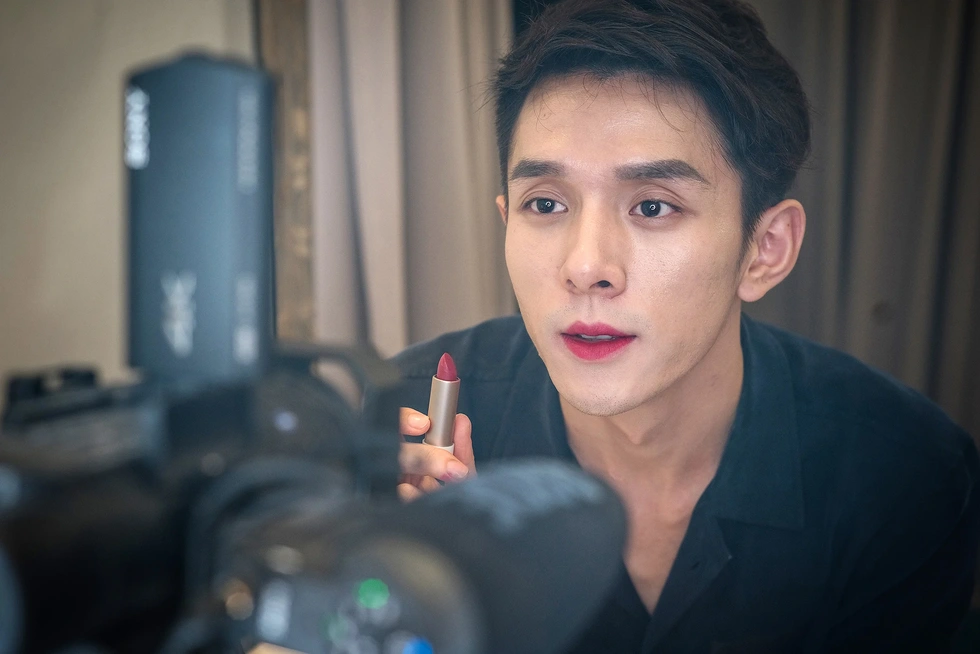
Beauty blogger Li Jiaqi, also known as the "lipstick queen," is trying out lipsticks while livestreaming on the e-commerce platform Taobao in October 2018 in Shanghai, China (Photo: Getty Images).
When shopping becomes a "feast for the senses"
In 2018, at an Alibaba event, Jack Ma challenged Li Jiaqi, a relatively new beauty blogger, to see who could sell more lipsticks on Taobao Live. The result was that the future "lipstick queen" sold 15,000 lipsticks in just 5 minutes. That moment officially ushered in a new era for China's retail industry.
Today, a livestream by Li Jiaqi with over 35 million followers on Douyin (the domestic version of TikTok) is a true "feast for the senses." Flashing advertising banners, constant promotional pop-ups, and hundreds of products are showcased one after another. On one occasion, he tried 380 different lipstick shades in a 7-hour broadcast.
According to Jacob Cooke, CEO of consulting firm WPIC, the success of this model lies in the perfect combination of three elements: entertainment, discovery , and real-time transactions. “It creates a shared social moment where millions of people watch, comment, and ask questions together. That’s something static product pages on traditional e-commerce platforms can never achieve,” Cooke explained.
The Covid-19 pandemic, with its strict "zero-Covid" policies, further acted as a catalyst, transforming livestreaming into a relief from feelings of confinement and recreating the experience of "shopping at a mall" right from home.
Brands and streamers have turned shopping into an addictive game. Tactics like flash sales, countdown timers, and exclusive discount codes are constantly being released, stimulating FOMO (fear of missing out), causing viewers to make quicker decisions and spend more.
On Taobao, this machine never stops. At 10:30 AM on any given day, a series of live sessions are still underway, selling everything from hair clips and fake nails to umbrellas.
Livestreaming has solved one of the hardest problems in e-commerce: trust. The host acts as a selector, a trusted friend, explaining complex technical specifications, trying on a shirt, or testing a layer of foundation.
This is particularly effective for industries that need to stimulate emotions and build trust, such as cosmetics, fashion , skincare, and small electronics.
USA: The rising star is accelerating.
While China is a mature giant, the US is a promising new player. Over the past two years, commercial livestreaming has heated up in this market, driven by two main factors: the rise of TikTok and the collectibles craze.
The numbers don't lie. During Black Friday and Cyber Monday in 2024, TikTok Shop sales in the US surged 165% year-over-year, reaching $100 million. The platform even surpassed major players like Shein and Sephora in sales in 2024.
Whatnot, a livestreaming app specializing in collectibles, successfully raised $265 million in its Series E funding round in January 2025, bringing the company's valuation to nearly $5 billion. A VTEX survey revealed that 45% of American consumers had watched or purchased items via livestream in 2024.
The explosion of "kidults" culture (adults who are passionate about childhood hobbies like Pokémon trading cards and blind box toys) has further fueled the market. Live-streamed unboxing sessions, where sellers demonstrate the authenticity of products in front of the camera, have become a popular form of entertainment.
On eBay Live, a streamer in Utah can attract 50 viewers simultaneously simply by opening a new deck of Pokémon cards. The lively background music, the crisp sound of tearing the plastic wrappers, the brief commentary on each card, and the constant stream of hearts on the screen… all create an exciting community atmosphere. Jamie Iannone, CEO of eBay, asserts that livestreaming is the future of the platform, as the collectibles segment alone brings them $10 billion annually.
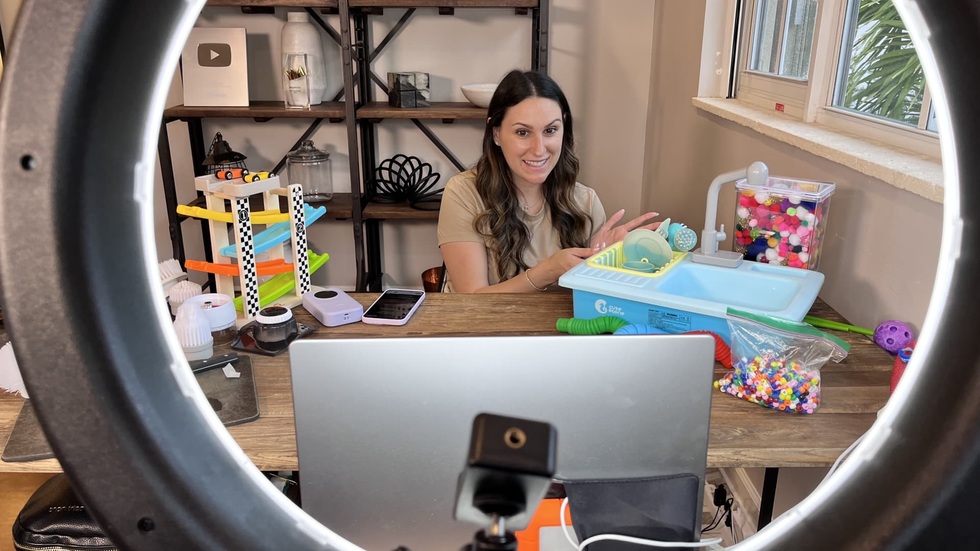
Over the past two years, commercial livestreaming has started to "heat up" in the US (Photo: Getty).
Livestreaming profession: The dream of money and the harsh reality
The appeal of livestreaming lies in its flexibility, the ability to work from home, and the chance to turn passion into money. Caleb Wessels, 34, used to be a makeup artist. When the pandemic caused him to lose his job, Amazon offered him a position as a content creator on their Amazon Live platform.
"Anyone can get started. All you need is an iPhone," Wessels shared. He doesn't have a fixed broadcast schedule, only going live when he feels like it, sharing makeup tips, trying out new products, and chatting about his personal life with close followers.
However, behind the glitz and glamour lies a harsh reality of business. Both Wessels and Martin admit that the commissions from livestreaming aren't enough to make ends meet. "More and more people are livestreaming at the same time, which is fragmenting the audience," Wessels says. "I used to get 100,000 viewers for a single session; now that number is much smaller." To survive, he has to take on a part-time job training AI.
Martin is facing a similar situation. He says his current income is "not much" and he's shifting his focus to making videos for YouTube, where content can have a longer lifespan. "As long as I can pay the rent and feed my cats, I'm happy," he says.
Their story reflects a harsh reality: the livestreaming market in the West, while growing, is also becoming increasingly crowded and competitive. Audience fragmentation makes it increasingly difficult for small-scale streamers to make a living, a stark contrast to the model of concentrated power in the hands of a few "superstars" like Li Jiaqi in China.
Market saturation or the "new normal"?
Comparing China and the US is comparing a mature market to a market in its rapid growth phase.
In China, signs of saturation are becoming increasingly evident. After a period of rapid growth (196% in 2020), the growth rate of the livestreaming market has slowed significantly, to around 27-29% in 2022-2023. Although the size is still expected to exceed $1 trillion by 2026, the market is no longer expanding as quickly as before.
New challenges are emerging:
Fierce competition: The surge in the number of streamers and providers has led to a decrease in income for many.
Weak economy: Consumers tighten their spending.
The rise of AI: Virtual influencers that can replace humans at a lower cost are gradually emerging.
Tighter regulations: Platforms like Douyin are beginning to implement stricter regulations to protect consumers from counterfeit goods, substandard products, and misinformation.
Meanwhile, the US is a land of opportunity. Although livestreaming currently accounts for only about 5% of total e-commerce revenue (compared to 60% in China), its growth rate is projected to be the fastest in the world. ARK Investment Management predicts the US market will grow at an average rate of 47% per year, reaching $680 billion by 2030.
Gen Z, the generation that grew up with social media and short videos, is the core driver of this growth. For them, shopping is not just a transaction, but also a form of entertainment and self-expression.

The livestreaming sales market in China has reached maturity, while in the US it is in a period of rapid growth (Photo: Cam Ha).
In 1977, a Florida radio station sold out 112 electronic can openers live on air. This marked the beginning of the Home Shopping Network (HSN) and the era of teleshopping. Nearly half a century later, that spirit is experiencing a powerful resurgence through the mobile phone screen.
The journey from can-opening machines on the radio to million-view livestreams on TikTok has traced a circle of history. Livestream commerce is not just a rebirth of the home shopping model, but a true revolution, redefining how we consume, interact, and connect in a world where the lines between entertainment and commerce are blurring.
This machine may be running at full speed in China, but in the US and the rest of the world, it has only just begun to get going.
Source: https://dantri.com.vn/kinh-doanh/livestream-247-co-may-ty-usd-khong-ngu-cua-trung-quoc-va-canh-bac-cua-my-20251017110741867.htm

![[Photo] Prime Minister Pham Minh Chinh holds a phone call with the CEO of Russia's Rosatom Corporation.](/_next/image?url=https%3A%2F%2Fvphoto.vietnam.vn%2Fthumb%2F1200x675%2Fvietnam%2Fresource%2FIMAGE%2F2025%2F12%2F11%2F1765464552365_dsc-5295-jpg.webp&w=3840&q=75)



![[Photo] Closing Ceremony of the 10th Session of the 15th National Assembly](/_next/image?url=https%3A%2F%2Fvphoto.vietnam.vn%2Fthumb%2F1200x675%2Fvietnam%2Fresource%2FIMAGE%2F2025%2F12%2F11%2F1765448959967_image-1437-jpg.webp&w=3840&q=75)











































![[OFFICIAL] MISA GROUP ANNOUNCES ITS PIONEERING BRAND POSITIONING IN BUILDING AGENTIC AI FOR BUSINESSES, HOUSEHOLDS, AND THE GOVERNMENT](https://vphoto.vietnam.vn/thumb/402x226/vietnam/resource/IMAGE/2025/12/11/1765444754256_agentic-ai_postfb-scaled.png)













































Comment (0)