

(NLĐO) - With its curved teeth and wingspan of up to 4.6 meters, the monster Halikia peterseni was one of the most fearsome predators of the Cretaceous period.
According to Sci-News, the new monster species, Halikia peterseni, was identified thanks to fossils unearthed in what is now Queensland, in northeastern Australia.
It was a giant flying reptile with a crest on its jaw and curved teeth, that lived approximately 100 million years ago. Its wingspan reached up to 4.6 meters, roughly twice that of a large modern eagle.
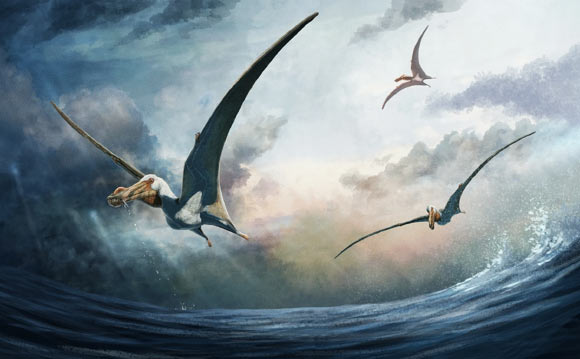
Australia's new flying monster - Photo: Gabriel N. Ugueto
According to paleontologist Adele Pentland from Curtin University (Australia), the lead researcher, Halishia peterseni was perhaps one of the most fearsome species of its time.
During that period, much of central western Queensland was submerged, covered by a vast inland sea.
Fossil remains of Halistia peterseni were discovered in November 2021 by Kevin Petersen, curator of the Kronosaurus Korner Museum, in the Toolebuc Formation of the Eromanga Basin.
The specimen is 22% complete, more than twice as complete as the previous pterosaur skeleton found in Australia. Halikia peterseni is the second flying monster from the dinosaur era to be found across the country.
"The specimen includes the entire lower jaw, the tip of the upper jaw, 43 teeth, vertebrae, ribs, bones from both wings, and part of a leg," the publication in Scientific Reports states.
This new species has also been identified as belonging to the genus Anhanguera, a genus of pterosaurs that lived during the Early Cretaceous period, approximately 145 to 100 million years ago.
This genus is characterized by long, narrow wings, an elongated skull, and sharp teeth. Anhanguera were skilled flyers and are believed to have been carnivorous, hunting fish for survival.
The group of flying monsters called pterosaurs, to which this new creature, as well as all Anhanguera, belong, can be seen as the flying version of dinosaurs. They dominate the skies, but are still reptiles.
Pterosaurs appeared during the late Triassic period (approximately 220 million years ago) and disappeared from the planet at the end of the Cretaceous period (66 million years ago), when the asteroid Chicxulub struck Earth and caused drastic climate change.
Source: https://nld.com.vn/lo-dien-quai-vat-bay-100-trieu-tuoi-sai-canh-gap-doi-dai-bang-196240615082236031.htm


![[Photo] Prime Minister Pham Minh Chinh holds a phone call with the CEO of Russia's Rosatom Corporation.](/_next/image?url=https%3A%2F%2Fvphoto.vietnam.vn%2Fthumb%2F1200x675%2Fvietnam%2Fresource%2FIMAGE%2F2025%2F12%2F11%2F1765464552365_dsc-5295-jpg.webp&w=3840&q=75)












































































Comment (0)