


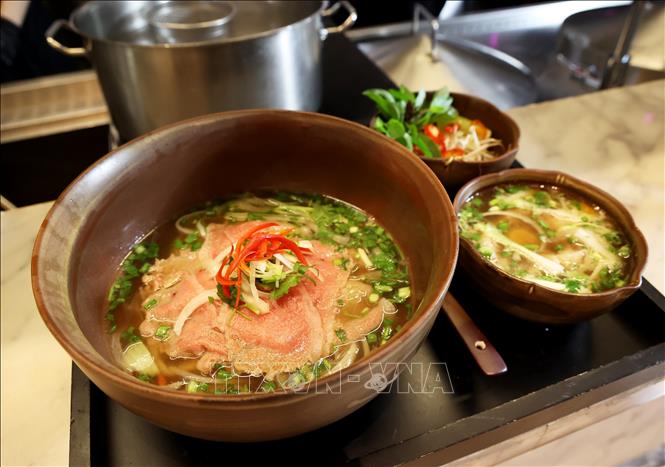
A bowl of rare beef pho with all the seasonings. Photo: Ngoc Lien/TTXVN.
Pho - from a humble dish to a cultural heritage
According to many historical records, pho in Hanoi originated in the early 20th century, when urban life was developing and economic and cultural changes created a unique blend in cuisine. The warm, resonant cry of "pho" echoing in the early morning has become a familiar sound, associated with the rhythm of life in Hanoi for decades. This dish quickly became popular thanks to its convenience, delicious taste, and ability to appeal to a wide range of palates, from laborers to intellectuals.
Over time, pho has not only become a part of daily life but also a cherished memory and a part of the culinary culture of the people of Hanoi. Although many localities throughout the country have their own variations of pho, Hanoi pho still retains its unmistakable characteristics: clear, light broth; soft rice noodles; perfectly sliced meat; and moderate seasoning. Pho is not noisy or ostentatious, but refined and harmonious, just like the character of the people of Thang An (Hanoi).
Because of its subtlety, harmony, and unique character, Hanoi pho has entered literature, with the first essay about pho perhaps belonging to Thach Lam in his book "Hanoi 36 Streets," first published by Doi Nay Publishing House in 1943. In the essay "Hanoi Gifts - Street Food," Thach Lam dedicated a separate section to pho. Later, in 1957, Nguyen Tuan wrote an essay titled "Pho" with many unique insights.
After Nguyen Tuan, Vu Bang, in his essay collection "Delicious Dishes of Hanoi" published in 1960, mentioned pho as the first dish that came to mind through his article "Beef Pho - A Fundamental Gift." More than three decades after Vu Bang, another Hanoian wrote about Hanoi pho: Bang Son. Bang Son's essays on pho can be considered a chronicle of Hanoi pho through the years, through its ups and downs, from the street vendors selling pho while standing to the once-famous pho restaurants.
On August 9, 2024, Hanoi pho was officially inscribed on the National List of Intangible Cultural Heritage under the category of Folk Knowledge.
Not only Hanoi, but Nam Dinh is also considered the birthplace of a famous type of pho - Nam Dinh beef pho. Nam Dinh beef pho stands out for its rich beef broth and the savory taste of fish sauce from the coastal region. People in Nam Dinh even emphasize that without good fish sauce, there cannot be an authentic bowl of Nam Dinh pho.
Along with Hanoi pho, "Nam Dinh Pho Folk Knowledge" has also been inscribed on the National List of Intangible Cultural Heritage. These recognized heritages not only preserve a dish, but also safeguard the story of its history, profession, and regional identity – values that have contributed to the enduring vitality of pho throughout the centuries.
The global reach of Vietnamese pho.

Vietnamese Ambassador to Italy Duong Hai Hung invites guests to enjoy pho. Photo: Truong Duy/VNA correspondent in Italy
Not only has pho captivated Vietnamese people, but it has also become a "cultural ambassador" to the world, spreading strongly over the past several decades. Many tourists recount that their first impression of Vietnam was a steaming bowl of pho on their first morning in Hanoi. In the US, Canada, France, Australia, and many Asian countries, pho is not only found in Vietnamese communities but is also widely loved by local diners.
This widespread popularity is further confirmed by numerous reviews from international culinary organizations and the press. In recent years, pho has repeatedly appeared in prestigious rankings: Top 30 Best Dishes Globally (selected by CNN in 2018); Top 20 Best Soups in the World (CNN, 2021); 50 Most Appealing Street Foods in Asia (CNN, 2022); 100 Most Delicious and Famous Dishes in the World (TasteAtlas, 2022); Top 100 Best Mixed Dishes in the World for Pho Salad (TasteAtlas, 2024). Notably, beef pho is the only Vietnamese representative in the Top 100 Best Dishes in the World 2024 announced by TasteAtlas.
To promote it more widely, Vietnam organizes an annual Pho Festival and dedicates a day – December 12th – to honoring pho. First held in 2017, Pho Day has become an important cultural promotion activity over the past eight years, contributing to elevating Vietnamese pho, fostering connections between artisans, businesses, and localities in the journey to bring pho to the world.
Preserving the essence of traditional pho in the era of globalization.
Skyscraper Pho (Pho Landmark 81) with a portion of poached egg yolk served in a separate bowl. Photo: Hong Dat/TTXVN
Today, pho has many variations: beef pho, chicken pho, pho with wine sauce, vegetarian pho, pho rolls, mixed pho, etc. This richness demonstrates the enduring vitality of pho and its ability to adapt to modern culinary demands. However, as it develops, pho increasingly presents a challenge in balancing traditional values with creative expansion.
The essence of pho lies in its broth, where the cook meticulously adjusts the heat and spices. The rice noodles must be soft but not mushy, chewy but not crumbly; the meat must be thinly sliced; and the herbs and onions must be fresh. This is an art based on centuries of experience, the "pho philosophy" that artisans have preserved through generations.
However, pho cannot stand still. Many young chefs are pursuing new creative directions such as using high-quality ingredients, reducing salt, sugar, and MSG in line with the "healthy eating" trend, or creating innovative pho dishes to suit international tastes. These innovations help pho become more accessible to young people and tourists, while also contributing to integrating Vietnamese cuisine into the cultural industry.
The key is innovation without losing its identity. No matter how it's modified, Vietnamese pho still retains its core principles: harmony, purity, simplicity... elements that make up the essence of a dish that has been associated with the Vietnamese people for over 100 years.
Pho is not just a familiar dish, but a cultural symbol embodying the history, folk knowledge, regional identity, and endless creativity of the Vietnamese people. Honoring pho is honoring Vietnamese values.
Source: https://baoangiang.com.vn/ngay-cua-pho-12-12-viet-nen-di-san-tao-nen-ban-sac-a470113.html
![[Photo] Prime Minister Pham Minh Chinh holds a phone call with the CEO of Russia's Rosatom Corporation.](/_next/image?url=https%3A%2F%2Fvphoto.vietnam.vn%2Fthumb%2F1200x675%2Fvietnam%2Fresource%2FIMAGE%2F2025%2F12%2F11%2F1765464552365_dsc-5295-jpg.webp&w=3840&q=75)






















































Comment (0)