

According to the Vietnam Trade Office in South Korea, the Korean Ministry of Food and Drug Safety (MFDS) recently conducted random checks on imported mango products sold in the Korean market. Among these, mangoes originating from Vietnam and the Philippines were found to have pesticide residue levels of 0.08 and 0.05, respectively, exceeding the PLS system's limit of 0.01 mg/g.
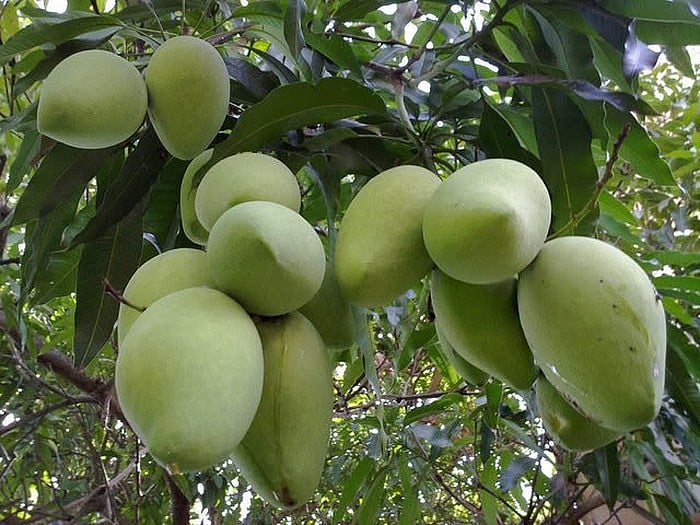 |
| Mangoes originating from Vietnam and the Philippines had pesticide residue levels of 0.08 and 0.05 respectively, exceeding the limits set by the Korean PLS system (0.01 mg/g). |
Vietnamese mangoes packaged in 5kg bags have been found to contain residues of Permethrin – an active ingredient commonly used to control stink bugs, leaf-eating caterpillars, flower-boring insects, and fruit-boring insects. The MFDS (Ministry of Food and Drug Safety) has initiated a recall of Vietnamese mangoes exported to the South Korean market by a Vietnamese company and advised consumers who purchased these Vietnamese export mangoes to return them to the place of purchase.
Following this recall announcement, no further shipments of mangoes originating from Vietnam exceeding the permitted standards have been detected.
The trade deal indicated that mangoes, alongside bananas and pineapples, are a popular tropical fruit in the South Korean market, hence the high demand. Vietnamese tropical fruit products still have significant potential in the South Korean market.
Although Vietnam's mango exports to South Korea increased from US$7.9 million (2022) to US$9.9 million (2023), Vietnamese mango products still do not pay attention to pesticide residue, leading to regrettable violations of technical standards for products imported into the South Korean market.
According to experts, the high likelihood that Vietnamese mangoes exceed permitted levels is due to being grown in areas where pesticides have not been properly cleaned and the scattered planting patterns make it difficult to control the entire process of planting, harvesting, and handling of water vapor. Therefore, Vietnamese authorities need to further strengthen the dissemination of information and provide early warnings to Vietnamese mango exporting businesses.
Previously, in 2023, frozen chili peppers from Vietnam being sold in the South Korean market were also recalled by the MFDS due to the detection of PLS residue exceeding the permissible limit during random testing of frozen chili peppers imported from Vietnam.
If incidents like the above are not prevented in time, they will negatively affect the image of Vietnamese agricultural products. Therefore, the Vietnam Trade Office in South Korea requests that agricultural processing and exporting businesses in general strictly comply with South Korean regulations on pesticide residue levels when exporting agricultural products to this market.
Source: https://congthuong.vn/lo-ngai-nong-san-bi-canh-bao-du-luong-thuoc-bao-ve-thuc-vat-tai-han-quoc-323763.html


![[Image] Close-up of the newly discovered "sacred road" at My Son Sanctuary](/_next/image?url=https%3A%2F%2Fvphoto.vietnam.vn%2Fthumb%2F1200x675%2Fvietnam%2Fresource%2FIMAGE%2F2025%2F12%2F13%2F1765587881240_ndo_br_ms5-jpg.webp&w=3840&q=75)













































































Comment (0)