

But while the aforementioned authors wrote from the perspective of the Vietnamese psyche, Dong Di, in *The Children of Long Bien Bridge* , views the capital city in the context of globalization and modernization in a unique way.
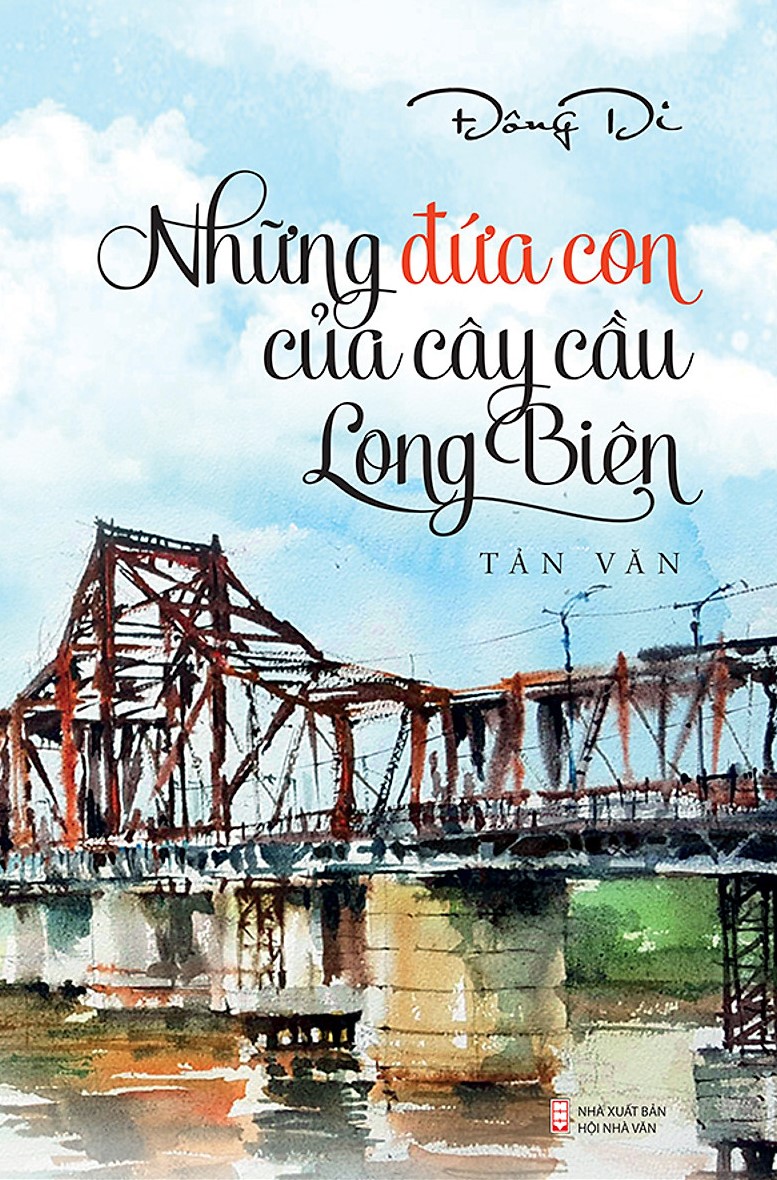
The book was published by Tri Thuc Tre Books and the Vietnam Writers Association Publishing House.
Long Bien Bridge is a place where the author's generation of children have fond memories. It was a "paradise" for playing beneath the bridge, with games like hide-and-seek, jump rope, and hopscotch... It was also a time when we skipped our afternoon naps, went up to the bridge to the sandbank, and sneaked into the corn and potato fields to steal and roast them...
This bridge also serves as a testament to the special connection the author has with a particular person. In this book, while half is dedicated to childhood memories, the other half is about her own life. In her relationship with the foreign man she humorously calls "Western Poison," the grandson of a Frenchman who contributed to the construction of the Long Bien Bridge, she reveals the contrasting perspectives of foreigners on Vietnamese culture and people. This further affirms and clarifies the positive aspects of traditional Tet (Vietnamese New Year), Vietnamese women, hospitality, and respect for religious beliefs. Her writing style is sometimes satirical, sometimes sharp, not only bringing laughter but also prompting readers to constantly reflect.
Beyond memories and personal stories, the Long Bien Bridge also serves as a bridge between the past and the present. There, we see an older generation of fathers and mothers who value tradition and etiquette alongside a younger generation with changing lifestyles, worldviews , and philosophies of life. The book can be said to be more than just an essay about Hanoi; it clearly reflects the differences and changes of the times, from the perspective of a global citizen.
Source: https://thanhnien.vn/long-bien-khong-chi-la-mot-cay-cau-185250203221435067.htm



![[Photo] Prime Minister Pham Minh Chinh holds a phone call with the CEO of Russia's Rosatom Corporation.](/_next/image?url=https%3A%2F%2Fvphoto.vietnam.vn%2Fthumb%2F1200x675%2Fvietnam%2Fresource%2FIMAGE%2F2025%2F12%2F11%2F1765464552365_dsc-5295-jpg.webp&w=3840&q=75)

![[Photo] Closing Ceremony of the 10th Session of the 15th National Assembly](/_next/image?url=https%3A%2F%2Fvphoto.vietnam.vn%2Fthumb%2F1200x675%2Fvietnam%2Fresource%2FIMAGE%2F2025%2F12%2F11%2F1765448959967_image-1437-jpg.webp&w=3840&q=75)



































![[OFFICIAL] MISA GROUP ANNOUNCES ITS PIONEERING BRAND POSITIONING IN BUILDING AGENTIC AI FOR BUSINESSES, HOUSEHOLDS, AND THE GOVERNMENT](https://vphoto.vietnam.vn/thumb/402x226/vietnam/resource/IMAGE/2025/12/11/1765444754256_agentic-ai_postfb-scaled.png)








































Comment (0)