

General Secretary To Lam emphasized the need to study growth policies so that people can benefit from the achievements of economic development; specific policies must be quantified so that people can see and evaluate them…
We need new thinking and groundbreaking new approaches.
On the morning of March 17, at the Government headquarters, General Secretary To Lam worked with the Socio-Economic Subcommittee of the 14th National Congress of the Party.
This is an important working session to finalize the draft report assessing the five-year implementation of the 10-year socio-economic development strategy 2021-2030, and the directions and tasks for socio-economic development for the five-year period 2026-2030, before submitting it to the 11th Central Committee Conference.
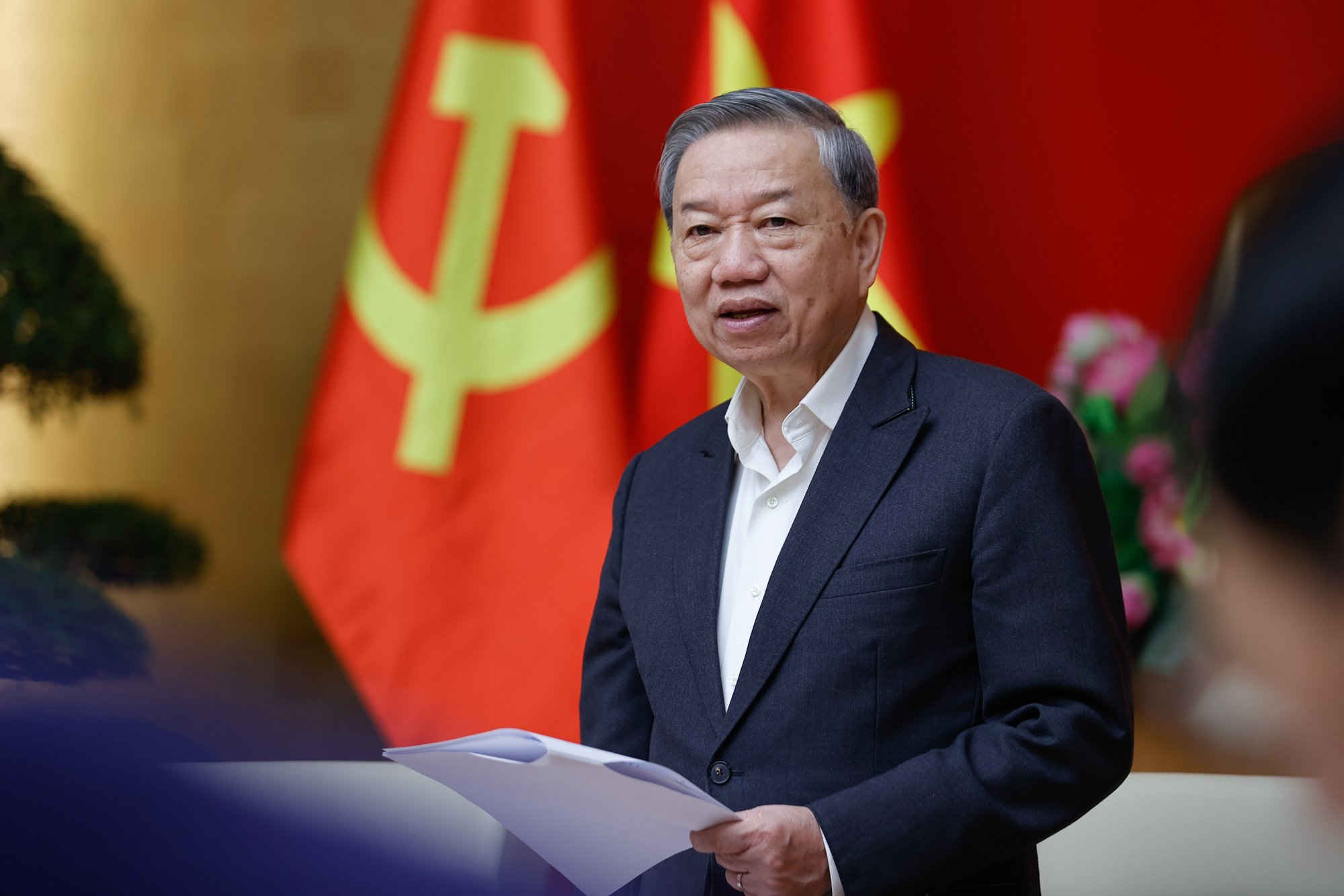
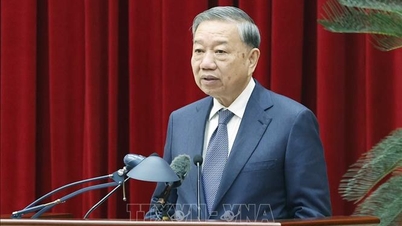
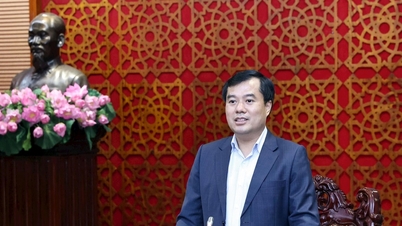
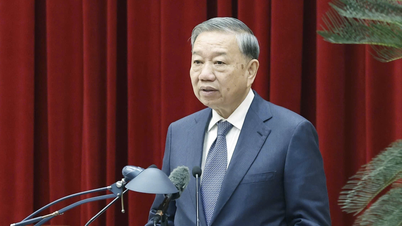
General Secretary To Lam speaks at the session (Photo: VGP).
In his opening remarks, General Secretary To Lam stated that the Party has identified economic development as the central task. Without economic development, it is difficult to achieve other goals. Therefore, the socio-economic report is a very important thematic report, crucial to the realization of the Party's viewpoints and policies to be adopted by the 14th National Congress.
"I understand that the Prime Minister and the members of the Standing Committee of the Socio-Economic Subcommittee have been very responsible, proactive, and expeditious in supplementing and perfecting this important report," said General Secretary To Lam.
He highly appreciated the draft report, noting that it closely adhered to the requirements, was concise and succinct, yet still ensured comprehensive content; it added and emphasized many strong policies and solutions to achieve double-digit growth in the coming period, along with three appendices on the goals to strive for, a list of projects to be implemented, and a list of legal documents that need to be amended.
To guide the discussion at the working session, General Secretary To Lam outlined and suggested four issues.
Firstly, in general, the highest objective of the 14th National Congress is to decide on strategic issues to ensure stability, development, and improve the lives of the people. This is the overarching goal that must be thoroughly understood. The common thread running through the documents is a focus on these three objectives.
It is necessary to fully understand the dialectical relationship between stability for development and development for long-term stability and sustainability. At the same time, the ultimate goal is to improve the people's living standards and better satisfy their ever-increasing needs.
Secondly, we agree on the understanding and must be determined to develop rapidly and sustainably in the coming period, not at a normal pace, without complacency, in order to overcome the risk of falling behind and avoid falling into the middle-income trap.
Therefore, a new mindset and innovative, groundbreaking approach that surpasses our own limitations are necessary to achieve effective results.
Therefore, the socio-economic report must clarify feasible solutions and tasks for Vietnam to become a modern industrialized country with a high-middle income by 2030 and a developed country with a high income by 2045.
The General Secretary requested that the members of the Socio-Economic Subcommittee review whether the solutions presented in the Report were sufficiently convincing. He asked whether these policies and solutions would achieve the objectives, what needed to be added, and what further action was necessary.
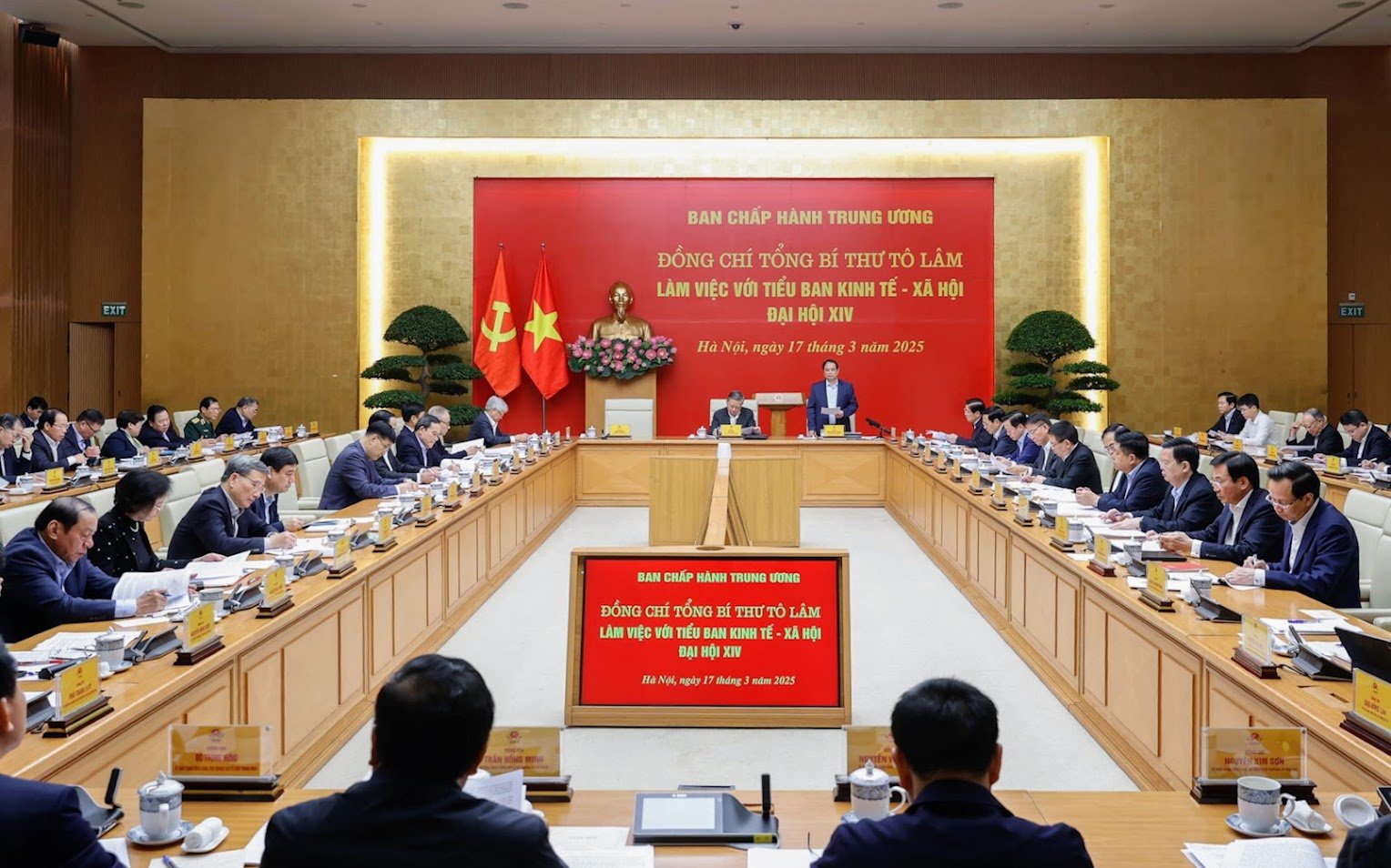
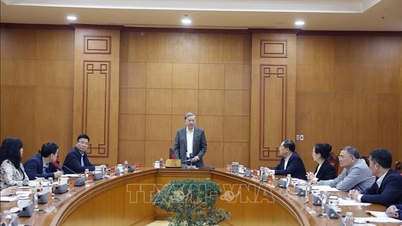
The scene at the meeting (Photo: VGP).
Thirdly, the essence of compiling this Report is to formulate socio-economic development policies for the future, specifically for the period 2026-2030 and with a vision to 2045.
However, it is also important to recognize that policy is continuous and not fragmented; some things must be done now to prepare for the next phase and avoid waste.
The General Secretary cited institutional examples, emphasizing the need to immediately address obstacles related to bidding, land, budgets, public investment, planning, science and technology, and education and training. He stressed the importance of solving the problem of "having money but being unable to spend it."
How can we ensure that public investment funds are disbursed effectively from the beginning of the year, focusing on key and priority issues? How can we help the private sector develop further, creating a new dynamism throughout society, encouraging workers to engage in production and business, and generate material wealth?
Fourth, the highest requirement for the next phase is high-quality development. "So, what does sustainable, high-quality development mean? What are its core contents and what issues are involved? What goals and indicators should be set at what level, and they must be very specific?" the General Secretary questioned.
Transforming institutional bottlenecks into competitive advantages.
Concluding the meeting, General Secretary To Lam stated that socio-economic issues are very broad, very difficult, highly specialized, and rapidly changing, requiring constant updating and supplementation.
If the political report is a torch to light the way, then the socio-economic report is a handbook for action to help us achieve the set goals, the General Secretary emphasized.
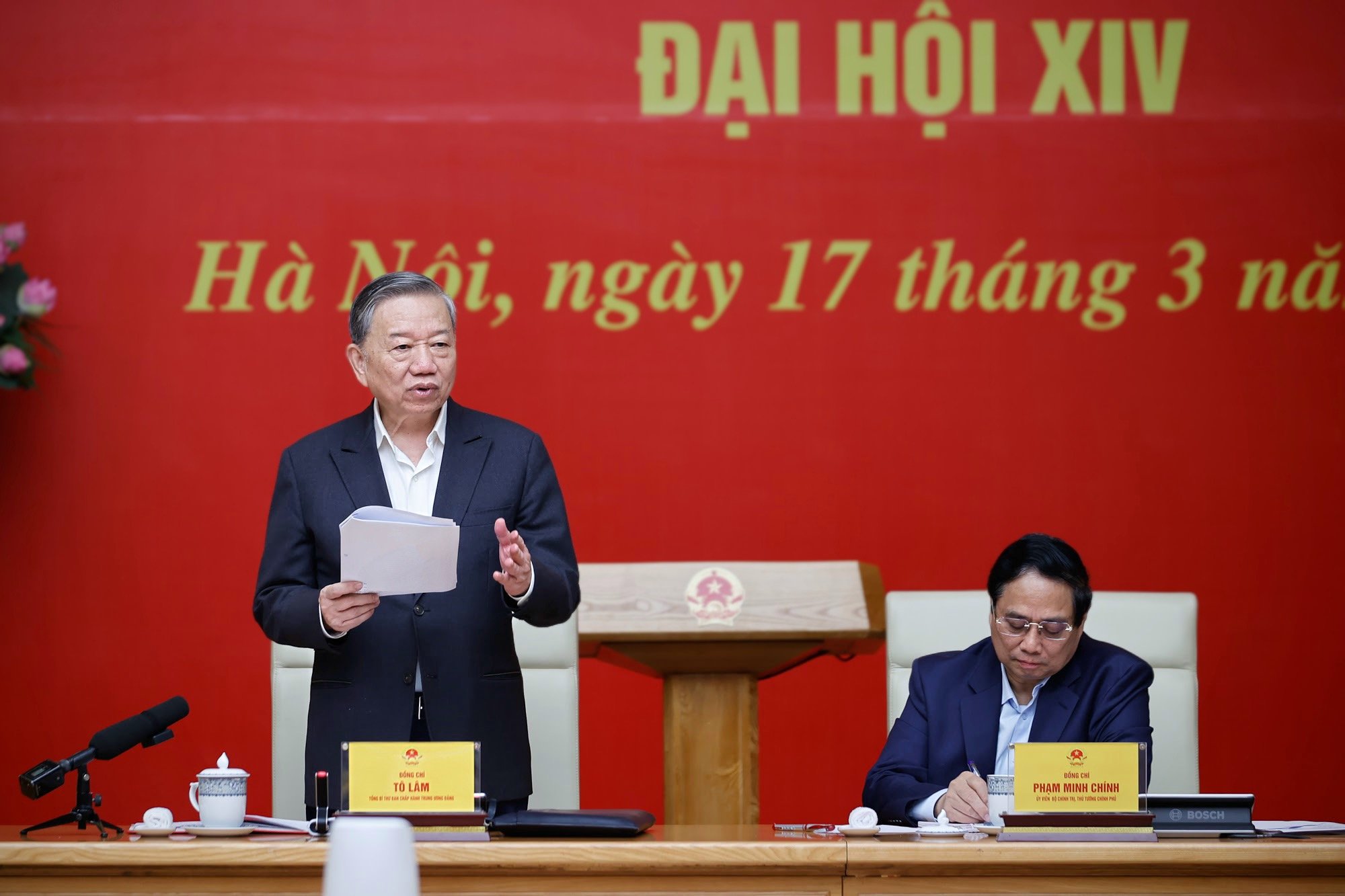
The General Secretary suggested continuing to study new issues in order to implement policies aimed at further streamlining the political system's apparatus (Photo: VGP).
In terms of specific content, this draft Socio-Economic Report has many new points, closely adhering to practical requirements, and demonstrating high actionability and feasibility.
Some aspects have been clarified, but there are still issues that need further research to supplement and refine the task, in the spirit of bold innovation, all for the benefit of the nation and people, continuing to research, update, supplement, refine, and deepen the mission.
The General Secretary suggested continuing to study new issues in order to implement policies aimed at further streamlining the political system's apparatus, merging provinces, eliminating district-level organizations, and merging communes.
This is not simply a matter of adjusting administrative boundaries, but also of adjusting economic space, adjusting the division of labor and decentralization, and adjusting the allocation and combination of economic resources for development. At the same time, it is necessary to reassess national planning, regional planning, and the planning and development orientations of provinces and cities.
Organizational structure is a major issue, impacting many aspects, requiring significant time and effort for thorough research in order to make appropriate adjustments, updates, and additions to the socio-economic report.
Regarding the growth model, the General Secretary suggested updating the new thinking mentioned in the political report. Accordingly, we should shift from "innovating the growth model" to more strongly affirming the definition of a new growth model.
Therefore, it is necessary to supplement and clarify the contents of Vietnam's new growth model, especially the fundamental issues for rapid and sustainable development, high-quality development, and proactive and self-reliant development.
The General Secretary suggested key aspects such as creating new production methods, new approaches and fields of production and business, new quality standards, developing science and technology, innovation, digital transformation, green transformation, and energy transformation, all linked to the development of high-quality human resources… In this new growth model, it is necessary to clearly and correctly define the roles of each economic sector.
We must establish growth zones and poles with specific goals to contribute to the country's overall GDP growth.
Regarding institutions, the General Secretary pointed out that this is a bottleneck; obstacles, difficulties, and institutional impediments are being gradually removed to create a foundation for development. The drafting and promulgation of laws must be based on practical realities, avoiding a situation where laws or mechanisms are delayed, leading to missed opportunities.
Further research is needed to reform the policy-making process more effectively to meet development requirements. A favorable legal environment and a transparent, safe, and low-cost business environment must be built; a revolution in this area is necessary. Vietnam must become a leading nation in administrative reform, innovative entrepreneurship, and a transparent investment and business environment.
Another institutional aspect is the need to pay close attention to policy implementation by the staff. Solutions for synchronized and unified policy implementation from the central to the local level need to be studied.
Building a team of officials with a proactive spirit to serve the people and businesses is crucial. Reorganizing the organizational structure and administrative units at all levels is an opportunity for us to be ready to re-evaluate the workforce and build a team that truly meets the requirements of national development in the coming period. We must transform institutions from bottlenecks into competitive advantages.
We need even more radical innovation in human resource development, especially high-quality human resources. The potential of the Vietnamese people is not inferior to that of any other nation in the world; we need to research and find even more powerful and groundbreaking solutions.
Regarding the mobilization of resources for development, the General Secretary suggested that further research is needed to deepen specific solutions for resource mobilization; to carefully study strategies for attracting FDI and indirect investment in the country's new development phase; and to mobilize capital from the people to participate in business, ensuring the circulation of capital in the economy. The development of autonomous, decentralized, and empowered local economies must ensure fairness and nurture sources of development.
The General Secretary noted that the contents of the Report should be further reviewed to ensure a balance between economic, cultural, and social development.
The ultimate goal is to improve and better meet the material and spiritual needs of the people; it is necessary to study growth policies so that people's living standards correspond to the rate of economic growth and people benefit from the achievements of economic development; specific policies must be quantified so that people can see and evaluate them…
Ensuring a high level of action and combat effectiveness.
Speaking at the meeting, Prime Minister Pham Minh Chinh emphasized that in the past period, the leaders of the Party and State, especially General Secretary To Lam, have paid close attention to and regularly directed the drafting, supplementation, and completion of documents submitted to the 14th Party Congress, including the socio-economic report.
Over the past period, the Socio-Economic Subcommittee has devoted considerable time, effort, and intellect to researching, updating, and urgently finalizing the draft Report amidst a rapidly evolving, complex, and unpredictable global situation, and domestically, the implementation of many important revolutionary and historically significant policies.
The Prime Minister emphasized that the preparation and refinement of the socio-economic report must be regularly reviewed, updated, and supplemented according to the socio-economic development situation of the country, and the new guidelines, policies, mechanisms, and policies of the Party, State, and Government until it is approved by the 14th National Congress.
The draft report ensures the document's validity and coherence with other documents submitted to the 14th National Congress, especially the political report, while also specifying economic and social contents; ensuring high levels of action, combativeness, innovation, feasibility, and effectiveness.
The Socio-Economic Subcommittee seriously absorbed and concretized the directives and orientations of the General Secretary and the opinions expressed by the delegates at the working session to promptly update, supplement, and finalize the draft socio-economic report in order to report to the Politburo and present it to the Central Committee meeting according to the set schedule and plan, ensuring the highest quality.
Source: https://www.baogiaothong.vn/tong-bi-thu-luong-hoa-cac-chu-truong-de-nguoi-dan-nhin-thay-duoc-danh-gia-duoc-192250317171628077.htm

![[Photo] Prime Minister Pham Minh Chinh holds a phone call with the CEO of Russia's Rosatom Corporation.](/_next/image?url=https%3A%2F%2Fvphoto.vietnam.vn%2Fthumb%2F1200x675%2Fvietnam%2Fresource%2FIMAGE%2F2025%2F12%2F11%2F1765464552365_dsc-5295-jpg.webp&w=3840&q=75)
![[Photo] Closing Ceremony of the 10th Session of the 15th National Assembly](/_next/image?url=https%3A%2F%2Fvphoto.vietnam.vn%2Fthumb%2F1200x675%2Fvietnam%2Fresource%2FIMAGE%2F2025%2F12%2F11%2F1765448959967_image-1437-jpg.webp&w=3840&q=75)







































![[OFFICIAL] MISA GROUP ANNOUNCES ITS PIONEERING BRAND POSITIONING IN BUILDING AGENTIC AI FOR BUSINESSES, HOUSEHOLDS, AND THE GOVERNMENT](https://vphoto.vietnam.vn/thumb/402x226/vietnam/resource/IMAGE/2025/12/11/1765444754256_agentic-ai_postfb-scaled.png)







































Comment (0)