

Located along the Red River, the more than 200-hectare vegetable growing area in Dong Cao village, Me Linh commune, has long been considered one of Hanoi 's largest "vegetable granaries". Despite suffering heavy damage from typhoons No. 10 and 11, Dong Cao quickly recovered, bringing green back to the fields in just over a month.
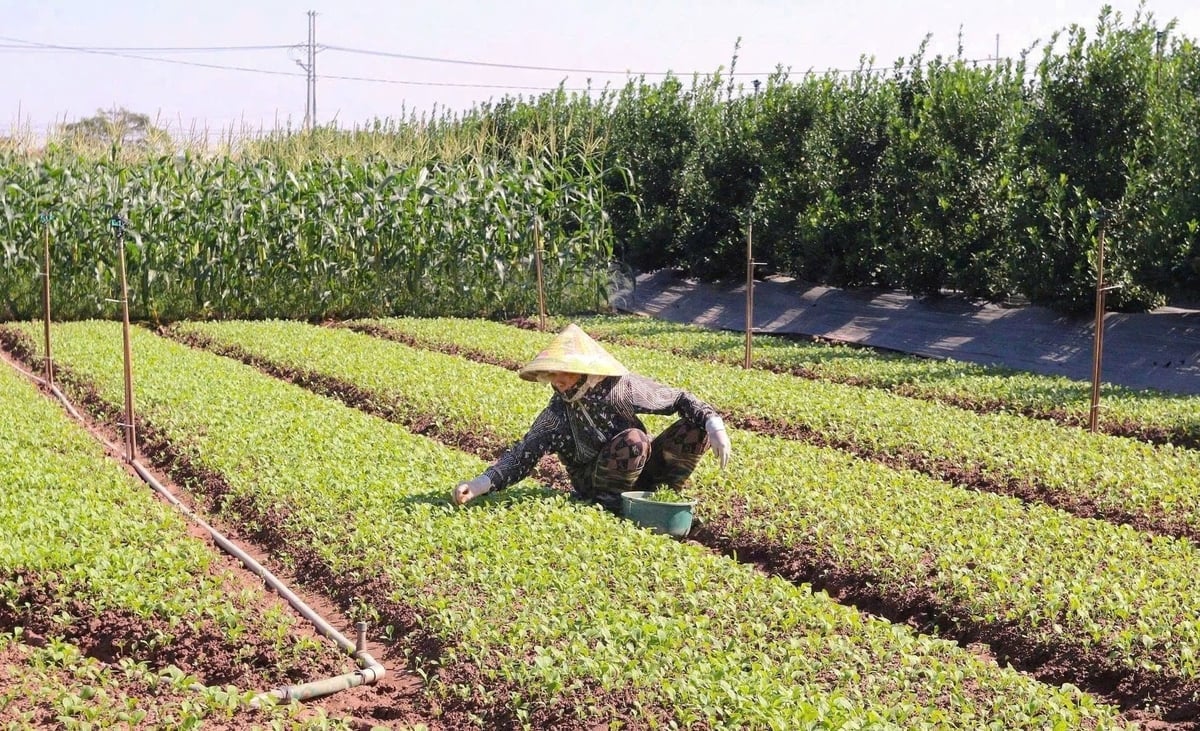
Typhoons No. 10 and 11 have left approximately 40 hectares of low-lying land belonging to the cooperative unable to resume production immediately after the floodwaters receded. Photo: Minh Ha.
In the final days of the year, the harvest atmosphere in Dong Cao is bustling. Cabbage, winter melon, white radishes… cover the fields, signaling a hopeful winter crop. Moreover, the sharp increase in vegetable prices after the storm has further boosted people's spirits. At this time, many types of vegetables are priced almost double compared to before the disaster, helping farmers to partially compensate for their losses.
According to Mr. Dam Van Dua, Director of Dong Cao General Service Cooperative, the cooperative is currently managing 134.68 hectares of safe vegetables, plus 5 hectares of VietGAP-certified production and a linked farming area of approximately 200 hectares. This winter season, the cooperative's daily output to the market averages 150 tons, mainly consumed in Hanoi and neighboring provinces.
Mr. Dua said: “Low-lying areas were severely affected, but the higher areas still retain advantages for vegetable production. We encourage farmers to focus on short-term vegetables such as Chinese cabbage, sweet cabbage, winter cabbage, and leafy vegetables. Favorable weather after the storm has created conditions for vegetables to grow quickly, and current prices are stable around 10,000 - 15,000 VND/kg.”
At the same time, the cooperative has also prepared a plan for the period leading up to the Lunar New Year, a time when demand increases sharply, and is guiding people to adhere to the seasonal schedule and crop types as recommended by the cooperative to avoid mass production that would cause prices to fall.
Mr. Dua added that experience from many years has shown that if farmers follow the cooperative's guidance, especially in the period before Tet (Lunar New Year), the market will be stable and vegetable growers will have good profits. For example, in 2024, thanks to production according to recommendations, the price of vegetables during Tet was very stable. This year, the director of the cooperative also expects to maintain reasonable prices, from 10,000 to 15,000 VND for many key vegetable varieties.
Ms. Hoang Thi Nu, a member of the Dong Cao Cooperative, said her family has 7 sao (approximately 0.7 hectares) of land planted with mustard greens, white radishes, and Chinese cabbage. The recent flooding caused her to lose nearly 3 sao, and it took almost a month to restore production.
“Thanks to the cooperative and the technical guidance from the Sub-Department officials, we were able to replant much faster. The current price of vegetables is around 10,000 - 12,000 VND/kg, and all varieties are fetching good prices, so I'm very happy. I'm confident about the market because the cooperative handles everything from purchasing to selling,” Ms. Nụ shared.

Ms. Luu Thi Hang, Head of the Hanoi Department of Crop Production and Plant Protection, said: Hanoi's agricultural sector is focusing on expanding the area of short-term vegetable crops to quickly supplement supply and stabilize the food market for the 2026 Lunar New Year. Photo: Minh Ha.
The story of restoring production in Dong Cao clearly shows the local efforts to compensate for supply shortages after the storm. From a general management perspective, Ms. Luu Thi Hang, Head of the Hanoi Department of Crop Production and Plant Protection, said that the Department has issued a production plan for the 2025-2026 winter crop, which includes detailed guidance on planting seasons, varieties, and technical measures.
“Hanoi currently has over 33,000 hectares of vegetable production, supplying over 700,000 tons per year, meeting 60-70% of the capital's consumption needs. Therefore, to ensure the supply for Tet 2026, the Sub-Department is directing localities to maximize the planted area, especially for short-term vegetables, to quickly replenish production after the storm,” Ms. Hang said.
According to Ms. Hang, the Sub-Department has intensified investigations, estimations, and forecasts of pests and diseases, providing timely guidance on control measures; at the same time, it has opened training courses and tested new techniques in production to minimize the impact of adverse weather conditions. Inspection of agricultural supplies has been tightened to prevent counterfeit and substandard goods from causing damage to farmers.
In parallel with increasing production within the city, Hanoi continues to maintain consumption links with neighboring provinces to supplement the remaining 30% of the shortfall, ensuring a stable supply during peak periods.
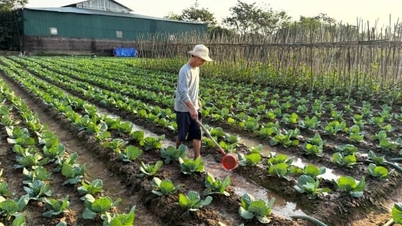
Currently, in the fields of Dong Cao, the rows of vegetables are growing evenly, with a lush green color covering the fields. The people believe that this year's winter crop will be a successful recovery, providing a plentiful supply of safe vegetables for the Hanoi market during the Lunar New Year, and laying the foundation for a smooth start to production in 2026.
Source: https://nongnghiepmoitruong.vn/me-linh-thu-lai-cao-tu-vu-dong-som-chu-dong-nguon-rau-tet-d788579.html

![[Photo] Prime Minister Pham Minh Chinh holds a phone call with the CEO of Russia's Rosatom Corporation.](/_next/image?url=https%3A%2F%2Fvphoto.vietnam.vn%2Fthumb%2F1200x675%2Fvietnam%2Fresource%2FIMAGE%2F2025%2F12%2F11%2F1765464552365_dsc-5295-jpg.webp&w=3840&q=75)
![[Photo] Closing Ceremony of the 10th Session of the 15th National Assembly](/_next/image?url=https%3A%2F%2Fvphoto.vietnam.vn%2Fthumb%2F1200x675%2Fvietnam%2Fresource%2FIMAGE%2F2025%2F12%2F11%2F1765448959967_image-1437-jpg.webp&w=3840&q=75)



































![[OFFICIAL] MISA GROUP ANNOUNCES ITS PIONEERING BRAND POSITIONING IN BUILDING AGENTIC AI FOR BUSINESSES, HOUSEHOLDS, AND THE GOVERNMENT](https://vphoto.vietnam.vn/thumb/402x226/vietnam/resource/IMAGE/2025/12/11/1765444754256_agentic-ai_postfb-scaled.png)










































Comment (0)