

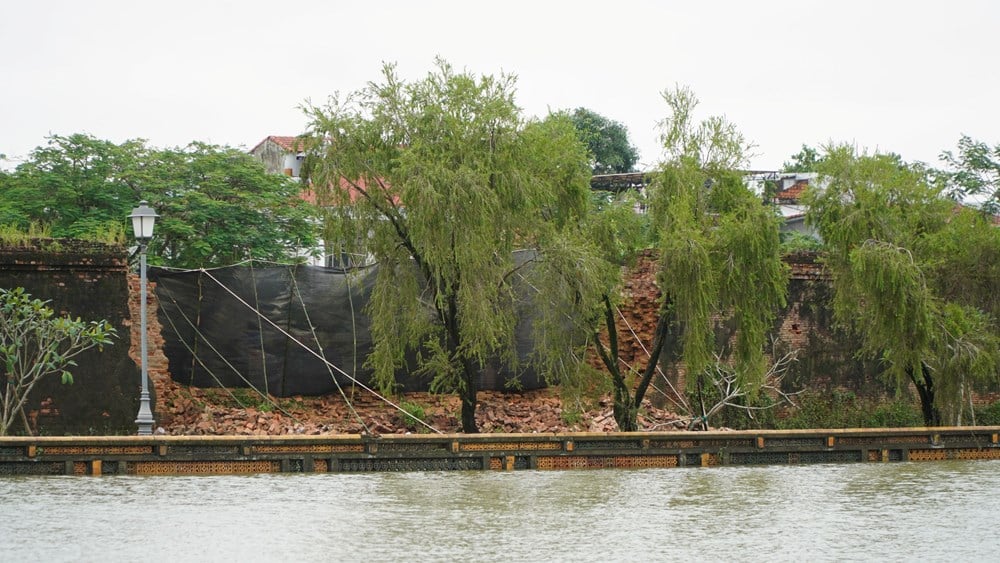
On November 4th, according to observations by a reporter from the Culture Newspaper, the section of the wall on the northern side of the Hue Imperial Citadel (towards Dang Thai Than Street, Phu Xuan Ward) is being covered with tarpaulins to ensure safety.
The pathways in this area have also been fenced off by the Hue Imperial City Relics Conservation Center to ensure the safety of residents, tourists, and the historical site.
According to Mr. Le Cong Son, Deputy Director of the Hue Imperial City Relics Conservation Center, at nearly 7 PM on November 2nd, the unit's on-duty team discovered a section of the city wall had collapsed. This section of wall is 15 meters long and is about 50 meters from the Hoa Binh Gate.
The center erected warning barriers, documented the incident, and reported it to the Hue City People's Committee. Subsequently, the Department of Construction conducted a survey and assessment of the incident.
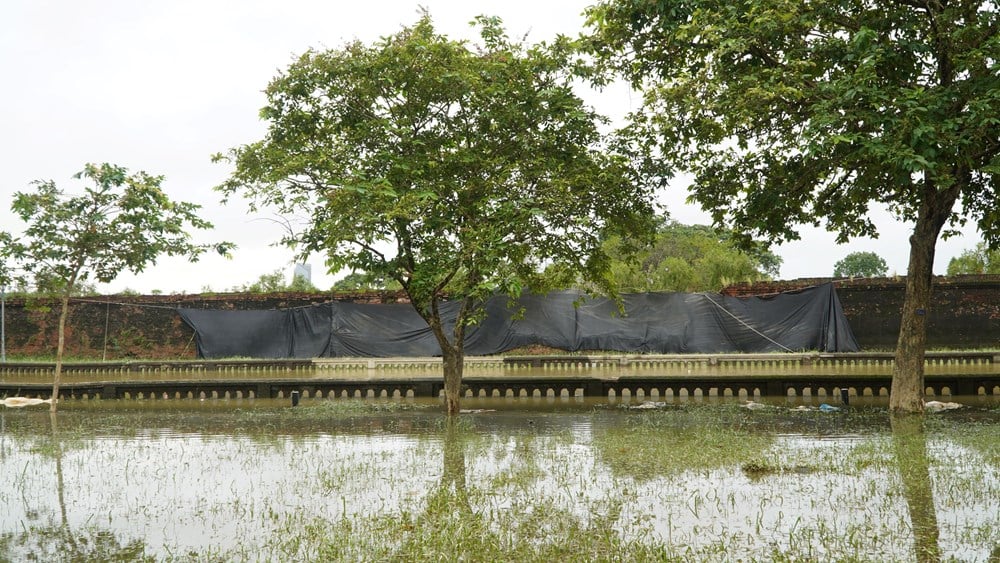
During the flood on November 3rd, several historical sites within the Hue Imperial Citadel complex were also affected. In the Hue Imperial Citadel area, water levels reached over 0.3 meters. Additionally, the Gia Long, Minh Mang, Dong Khanh, and Thieu Tri tombs were also deeply submerged, affecting access routes.
The heavy rains and floods from October 26th to the present have caused water to inundate several historical sites, including: Dien Tho Palace, Khai Tuong Lau (An Dinh Palace), Tang Tho Pavilion, and the long corridor next to the two Right/Left Pavilions connecting to Dai Cung Mon Gate…
The wooden columns in the Grand Palace Gate corridor are submerged in water (approximately 40cm high), posing a risk to the quality and lifespan of the structure.
Source: https://baovanhoa.vn/van-hoa/mua-lon-gay-sap-tuong-hoang-thanh-hue-179027.html
![[Photo] The General Secretary, President and his wife begin their state visit to the Philippines.](https://vphoto.vietnam.vn/thumb/1200x675/vietnam/resource/IMAGE/2026/05/31/1780230559452_anh-man-hinh-2026-05-31-luc-19-28-11.png)

![[Photo] Admire the coral "masterpiece" amidst the million-year-old heritage of Dak Lak province.](https://vphoto.vietnam.vn/thumb/1200x675/vietnam/resource/IMAGE/2026/05/31/1780221235105_anh-man-hinh-2026-05-31-luc-16-53-27.png)

![[Photo] Solemn bathing ceremony and Buddha procession in Hue](https://vphoto.vietnam.vn/thumb/1200x675/vietnam/resource/IMAGE/2026/05/31/1780228263543_1-jpg.webp)











![[Video] Weather forecast for tonight and tomorrow, June 1st, 2026: Northern Vietnam experiences rising temperatures, Southern Vietnam continues to have thunderstorms.](https://vphoto.vietnam.vn/thumb/402x226/vietnam/resource/IMAGE/2026/05/31/1780232471628_thumb-toi-3105-png.webp)








![[Video] Sunset at Lap An Lagoon – Where the sun sets over the fishing nets](https://vphoto.vietnam.vn/thumb/340x192/vietnam/resource/IMAGE/2026/05/31/1780192137701_beach-landscape-sea-water-nature-grass-745871-pxhere-com.jpeg)


































![[Photo] Admire the coral "masterpiece" amidst the million-year-old heritage of Dak Lak province.](https://vphoto.vietnam.vn/thumb/402x226/vietnam/resource/IMAGE/2026/05/31/1780221235105_anh-man-hinh-2026-05-31-luc-16-53-27.png)

































Comment (0)