

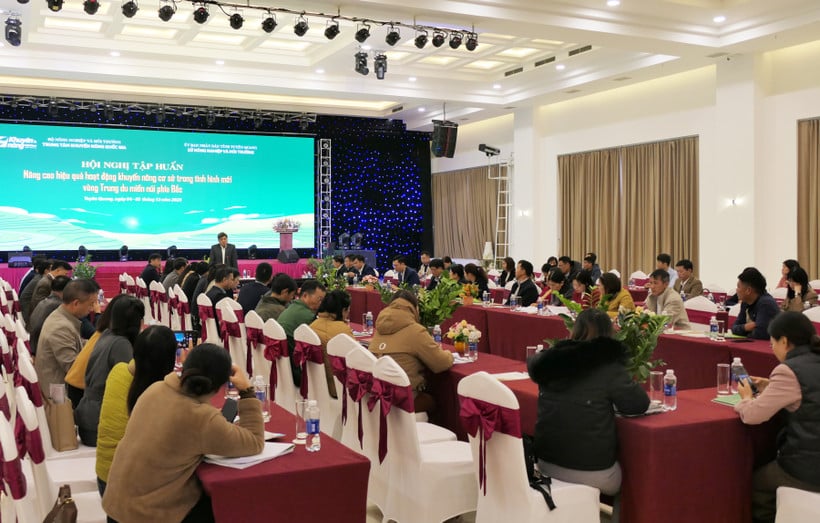
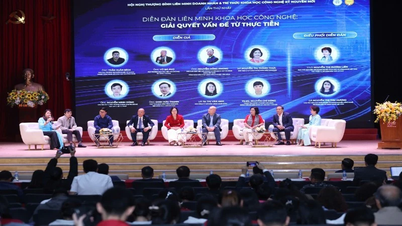
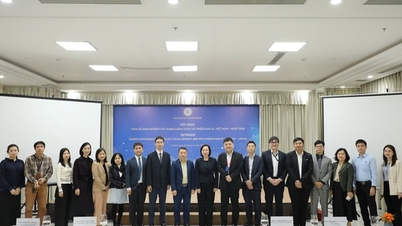
Attending were leaders of the Ministry of Agriculture and Environment ; leaders and agricultural extension officers of Tuyen Quang, Lao Cai, Lai Chau, Thai Nguyen, Phu Tho, Cao Bang provinces.
After implementing the two-tier local government model, the agricultural extension system faces the need to reorganize to adapt to the new organizational structure and tasks, and to improve capacity and accompany farmers.
In response to that request, the Ministry of Agriculture and Environment coordinated with the Ministry of Home Affairs and the Government Party Committee to issue Circular 60/2025/TT-BNNMT approving the Agricultural Extension Development Strategy to 2030, with a vision to 2050, with the goal of innovating agricultural extension activities in the new situation.
According to the circular, the agricultural extension system is organized into two levels: provincial agricultural extension and commune agricultural extension.
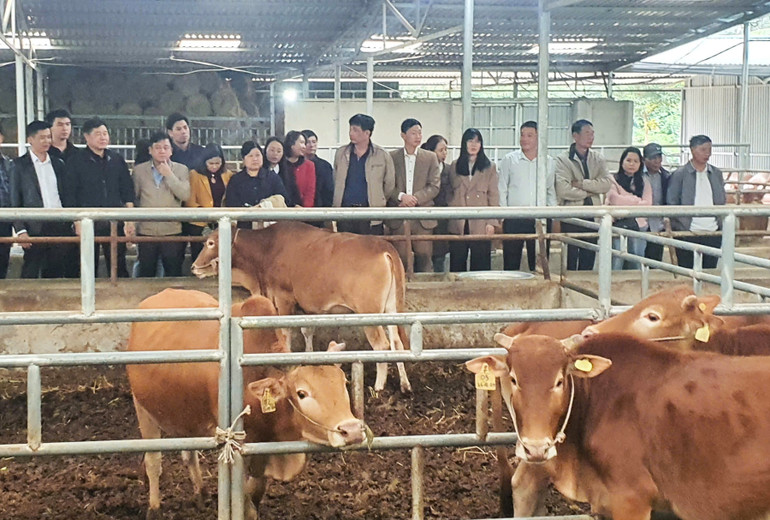
Provincial agricultural extension is a public service unit under the Department of Agriculture and Environment. Its core tasks are to develop and implement local agricultural extension programs and plans; organize training, coaching, fostering, and information and propaganda to improve the capacity of commune-level agricultural extension staff, agricultural extension collaborators, and farmers.
Along with that, build demonstration models to apply technical and technological advances in agricultural production and transfer them widely; carry out tasks of developing agriculture, farmers, rural areas, protecting the environment, serving local political goals.
For the commune-level agricultural extension system, it is a public service unit under the People's Committee of the commune, ward, and special zone levels, assigned to perform agricultural extension tasks.
The core task of the commune agricultural extension is to support farmers in developing agricultural production, building new rural areas, developing communities, rural tourism, and OCOP products; orienting, organizing, and operating the activities of agricultural extension collaborators and community agricultural extension teams to support local people, bringing agricultural knowledge to the fields and ponds.
In addition, the commune agricultural extension service is responsible for informing and propagating policies, scientific and technological advances, market needs, and good production models; organizing training, coaching, and vocational training for farmers.
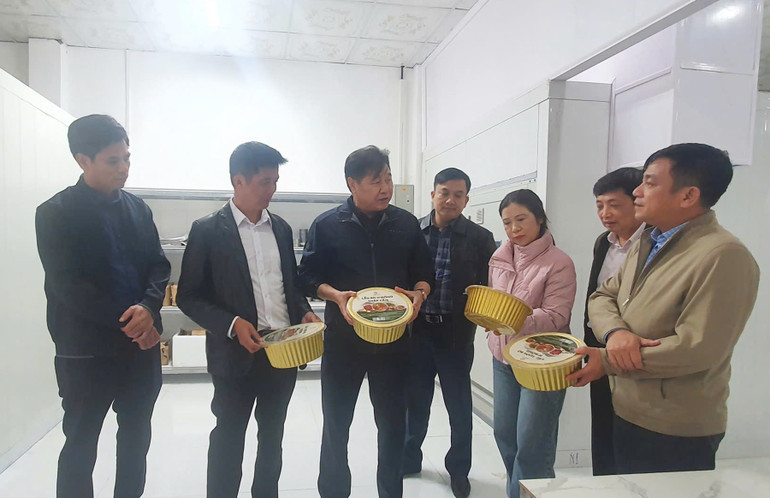
During the training, delegates were informed of the following topics: new requirements for grassroots agricultural extension in the two-level local government model; functions and tasks of agricultural extension officers at all levels when implementing the two-level local government model; action plan to implement the agricultural extension development strategy to 2030, with a vision to 2050; organization and operation of community agricultural extension teams in the two-level local government model.
The team of agricultural extension officers from the provinces also exchanged and discussed, focusing on contents such as organizing the grassroots agricultural extension network in the context of perfecting administrative units; consolidating the system of agricultural extension workers and collaborators at the commune level according to the new model; digital transformation, online training, agricultural extension according to the value chain; experience from localities in building effective agricultural extension models.
Source: https://nhandan.vn/nang-cao-hieu-qua-hoat-dong-khuyen-nong-co-so-trong-tinh-hinh-moi-post928153.html


![[Photo] 60th Anniversary of the Founding of the Vietnam Association of Photographic Artists](/_next/image?url=https%3A%2F%2Fvphoto.vietnam.vn%2Fthumb%2F1200x675%2Fvietnam%2Fresource%2FIMAGE%2F2025%2F12%2F05%2F1764935864512_a1-bnd-0841-9740-jpg.webp&w=3840&q=75)
![[Photo] National Assembly Chairman Tran Thanh Man attends the VinFuture 2025 Award Ceremony](/_next/image?url=https%3A%2F%2Fvphoto.vietnam.vn%2Fthumb%2F1200x675%2Fvietnam%2Fresource%2FIMAGE%2F2025%2F12%2F05%2F1764951162416_2628509768338816493-6995-jpg.webp&w=3840&q=75)






![[Photo] National Assembly Chairman Tran Thanh Man attends the VinFuture 2025 Award Ceremony](https://vphoto.vietnam.vn/thumb/402x226/vietnam/resource/IMAGE/2025/12/05/1764951162416_2628509768338816493-6995-jpg.webp)
![[Infographic] Air pollution and recommendations from the Ministry of Health](https://vphoto.vietnam.vn/thumb/402x226/vietnam/resource/IMAGE/2025/12/05/1764950568593_screen-shot-2025-12-05-at-222015-png.webp)


















































Comment (0)