

1. The road from Hanoi to Tan Thai commune, Dai Tu district, Thai Nguyen province was very convenient, so the car that took us arrived much earlier than planned for the inauguration ceremony. Everyone was eager to admire the scenery and tour the site, going from amazement to joy and exclamations: "It's so beautiful and meaningful!" ... Veteran journalist Ha Dang, at the age of 96, traveled a long distance to be here, and emotionally shared: "Attending this event, I feel extremely moved to see the past - a heroic past of those who work in journalism..."
How moving it is that, 75 years ago, this very land gave birth to the Huynh Thuc Khang School – the first training institution for journalists in the history of revolutionary journalism in our country. Today, on this same land, although the school no longer exists and most of the "old days" have passed away, a magnificent and meaningful project, built with the dedication, intellect, and responsibility of the Vietnam Journalists Association and Thai Nguyen province, seems to have fully and convincingly recreated this special training cradle.
“Time has gradually flowed along with the course of history, and most of the lecturers and students of the Huynh Thuc Khang School of Journalism have passed away. Though late, we are still striving to honor and remember a generation of pioneering resistance journalists who dedicated their lives to the goal of “All for victory,” contributing to the glorious tradition and vitality of our country's revolutionary journalism…” – These words from the Chairman of the Vietnam Journalists Association, Le Quoc Minh, perfectly capture the feelings of countless journalists of today's generation.
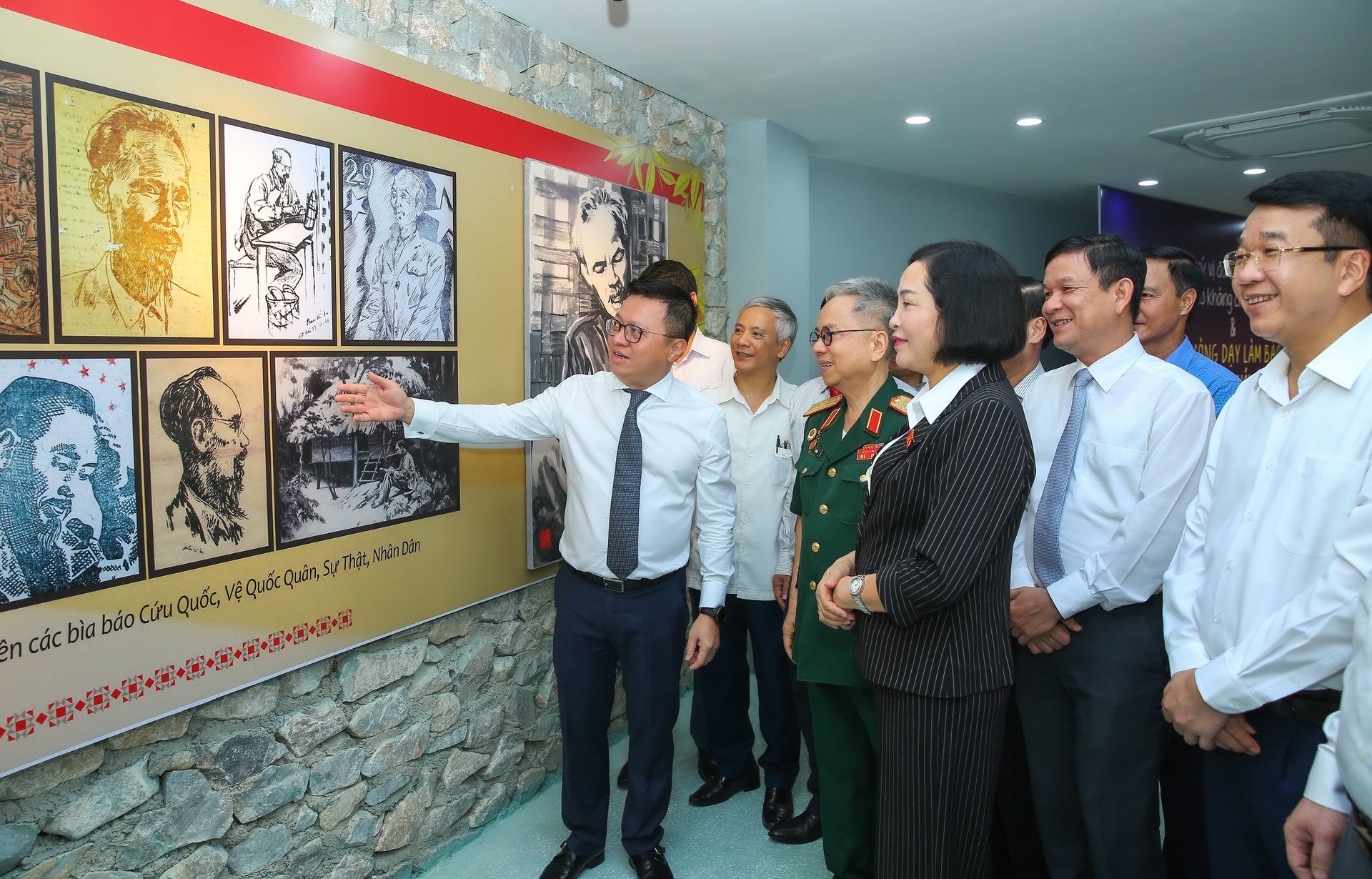
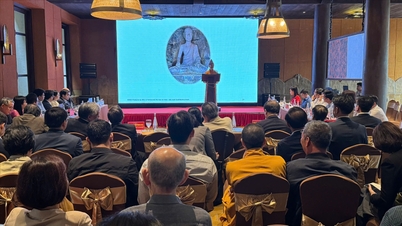
Party and State leaders, leaders of the Vietnam Journalists Association, and delegates shared many stories about the old Huynh Thuc Khang school. Photo: Son Hai
Although belated, it is evident that everything that exists here is the result of significant efforts by today's generation of journalists who wish to honor and express gratitude to their predecessors. The vivid evidence of the Viet Bac war zone press and the Huynh Thuc Khang press at the site has become invaluable educational material on patriotism and the glorious tradition of Vietnamese revolutionary journalism. And it doesn't stop there; a complex of historical and tourist sites is being developed, marking the hope for the preservation and development of the site for generations to come.
2. The Huynh Thuc Khang School of Journalism, after 70 years of being officially recognized as a National Monument, boasts a diverse and vibrant "complex" after 75 years. The excellent recreation of the space of resistance journalism and Huynh Thuc Khang journalism over more than seven decades, while simultaneously providing an overall overview of a period and exploring the depth of a school that only existed for three months, is a commendable effort by the Vietnam Journalism Museum – the investor of this project.
“For us, this is quite advantageous because the Vietnam Press Museum already has regular and thematic exhibitions on journalism in the Viet Bac war zone with many valuable documents. In addition to the existing documents and artifacts, we have researched, supplemented, and exploited some more suitable materials so that visitors will not only see the wood, roof, columns… but more importantly, will see the atmosphere of journalists, the atmosphere of the resistance war, and more proud images and stories about the first cradle of journalism training in the country…” – journalist Tran Thi Kim Hoa - Director of the Vietnam Press Museum shared.
Indeed, upon arriving here, we not only saw the wood, roof, and pillars, and understood more about the Huynh Thuc Khang School of Journalism, but also gained a deeper understanding of the magnificent resistance war, a historical context far broader than the scope of a school... We were moved when we entered the 80-square-meter stilt house with its numerous windows, where all the walls were maximized for display, and which included display cabinets, large artifacts, and a rotating roller with a capacity for storing more materials related to resistance journalism and Huynh Thuc Khang journalism.
Stepping into the exhibition hall is like entering a historically significant space, witnessing the glorious past of the resistance war where journalists wielded both guns and pens, experiencing the vibrant atmosphere of wartime journalism, the determination to "compete with the enemy with their pens," and seeing generations of ancestors during those days of "meals of rice with salt, burdened by the weight of revenge," and "stones may wear away, but the spirit remains unwavering... " (Two lines from the poet Tố Hữu). Another impressive feature is the exhibition area on the Việt Bắc War Zone Press 1946-1954, which displays a map marking the locations of major newspapers and printing houses that converged in the former war zone...
The stilt house, the exhibition hall, is not simply an architectural structure but seems to have infused it with the spirit and values of journalism, a space for journalistic culture, and a vibrant corner of life during the resistance war, reflecting the investor's vision of a miniature "museum" of journalism in the Viet Bac war zone.
We were all captivated by the magnificent bas-relief standing prominently in the grounds, featuring 48 portraits of the school's Board of Directors, faculty, and students, sketched by artist Ngo Xuan Khoi and sculpted by sculptor Pham Sinh and his students. Then there was an auditorium nestled in the hillside, designed for conferences, seminars, and other activities, with a capacity of over 150 people; and a 200-square-meter "mini-square" that could be used for events and cultural performances...
Many media leaders and journalists were immediately impressed and suggested that in the coming months they would bring their agencies, journalists, and members here for meetings, card awarding ceremonies, conferences, and seminars on journalism, as well as events to reminisce about the history of revolutionary Vietnamese journalism. This demonstrates the success of a project that immediately touches the emotions of viewers, truly being both beautiful and possessing cultural and historical value.
3. Perhaps the most striking aspect was the presence of the families of former faculty and students of the school, gathered here in a deeply moving and solemn atmosphere. Arriving very early, the woman who wept aloud in front of the bas-relief was Ms. Do Hong Lang, the daughter of journalist Do Duc Duc. She choked back tears as she told us that her father's eyes seemed to be etched into the bas-relief; she couldn't hold back her tears because just looking at it made her heart ache with longing for him…
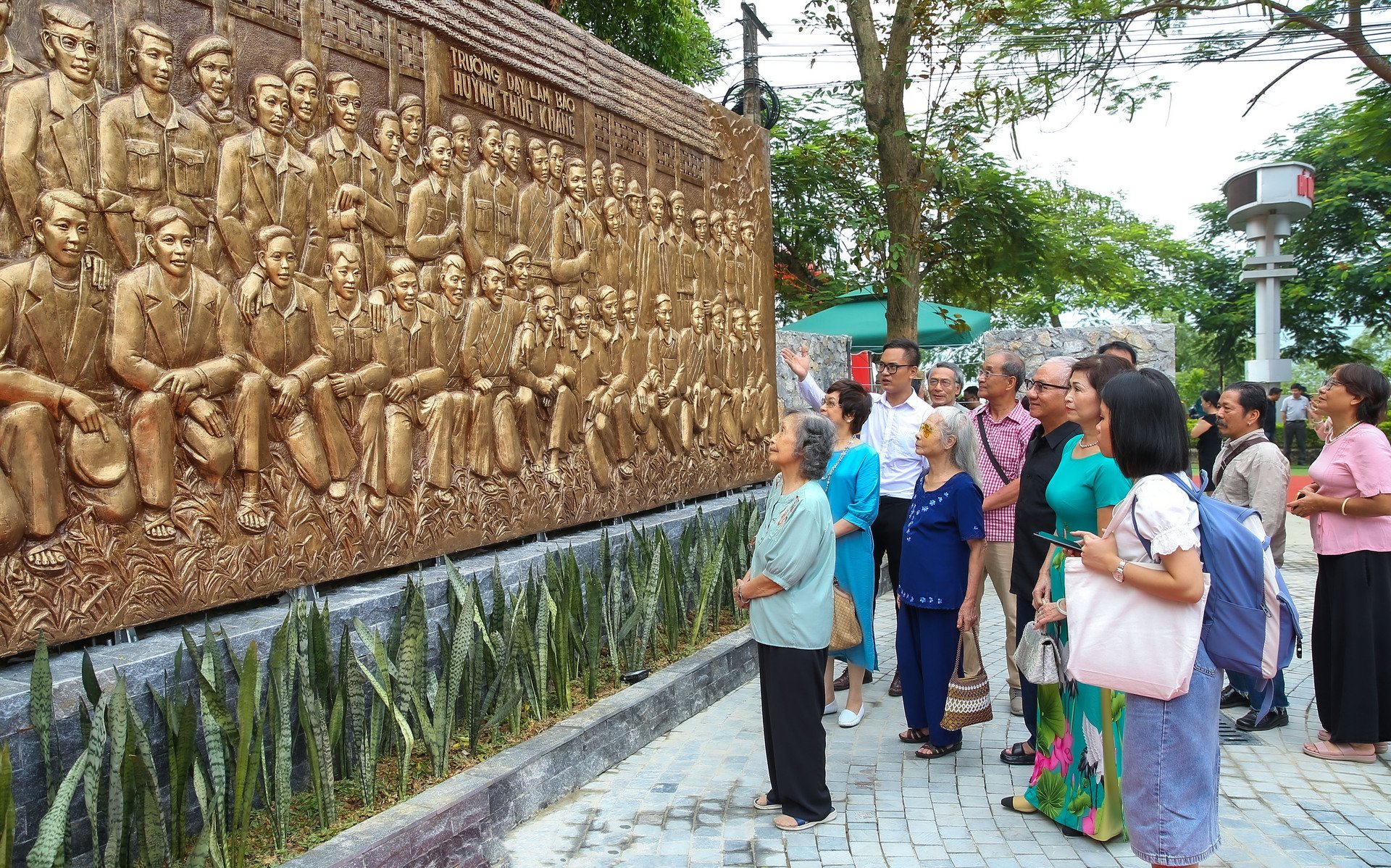
Relatives of the lecturers and students gathered here, moved by the bas-relief at the historical site. Photo: Son Hai
Nguyen Huy Thang, the son of writer Nguyen Huy Tuong, shared with emotion: "Seventy-five years ago, my father, writer Nguyen Huy Tuong, taught here. As he briefly wrote in his diary on April 24, 1949, 'Teaching drama in the journalism class.' And in his notes the day after, he confided: 'I became acquainted with the 'Huynh Thuc Khang' journalism class through a commemoration of the veteran patriot and Mr. Hoang Huu Nam, and I am very happy to have contributed a small part to training young journalists.'... How could I not be moved when, many decades later, I was invited back to witness this historical event and to honor the ancestors who once built the first generation of journalists amidst the flames of the resistance war." It's understandable that an event like this would be attended by many levels of authority, including the highest levels from the central government, province, and district... What I appreciate and respect is that the organizing committee did not forget to invite the relatives of the teaching staff and journalists who have contributed to the school. That's why some people from the South flew in to attend, some families even had fathers and sons, brothers, or husbands and wives.
It's a pity that journalist Ly Thi Trung, one of more than forty students in the class (and also one of the three rare female students in the course), and one of the two remaining witnesses from that time, is now unable to travel the distance between Hanoi and Dai Tu to attend the ceremony due to health reasons. However, perhaps the absent person is the one most frequently mentioned, in stories or simply in greetings among those involved – I mean those who knew about the Journalism School named after the patriot Huynh Thuc Khang… From Mr. Nguyen Huy Thang's sharing, suddenly somewhere the poem by student Ly Thi Trung resonated: “Oh, Bo Ra, Bo Ra/The map no longer has a name… But in my heart, it remains intact. Memories of Bo Ra!...”
Ha Van
Source: https://www.congluan.vn/neo-ve-nguon-coi-post307764.html
![[Photo] The Prime Ministers of Vietnam and Russia witness the signing ceremony on cooperation in building a nuclear power plant.](https://vphoto.vietnam.vn/thumb/1200x675/vietnam/resource/IMAGE/2026/03/23/1774278492322_vna-potal-hai-thu-tuong-viet-nam-va-nga-chung-kien-le-ky-ket-hiep-dinh-ve-hop-tac-xay-dung-nha-may-dien-hat-nhan-8658380-jpg.webp)
![[Photo] Young people of the Dong Thap Border Guard actively participate in "March Border Month" activities.](https://vphoto.vietnam.vn/thumb/1200x675/vietnam/resource/IMAGE/2026/03/23/1774248483508_ndo_tl_dt3-jpg.webp)

















































Comment (0)