

If fertilizers are subject to a 5% value-added tax, all three parties involved will benefit.
Imposing value-added tax on fertilizers will, in the long term, benefit the government, producers, and farmers alike.
Fertilizers are responsible for 40-60% of the world's food production. In Vietnam, fertilizers are a crucial part of agricultural production.
Statistics from the Plant Protection Department ( Ministry of Agriculture and Rural Development ) show that the demand for fertilizers in Vietnam is approximately 10.5 - 11 million tons of various types. Between 2018 and 2023, Vietnam imported between 1 and 1.6 billion USD worth of fertilizers annually, and in the first six months of 2024 alone, this figure reached 838 million USD.
The upcoming 8th Session of the 15th National Assembly , scheduled for October 21, 2024, will decide whether fertilizers are subject to a 5% value-added tax or remain exempt from it as they are currently. This decision will have a significant impact on the agricultural sector and its stakeholders.
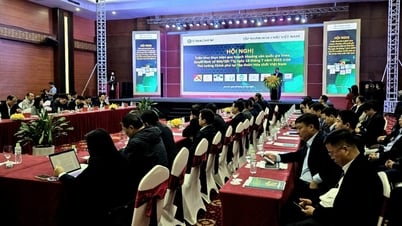
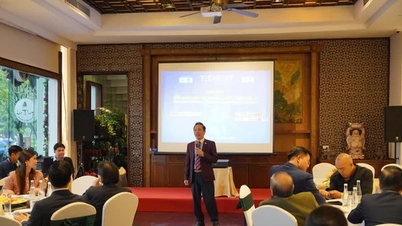
"Since 2015, when Law 71 on Taxation came into effect, the Association has persistently petitioned for fertilizers to be transferred from a tax-exempt item to a 5% value-added tax," Dr. Phung Ha, Chairman of the Vietnam Fertilizer Association, shared at the "Consultation Seminar on the Impact of Applying a 5% Value-Added Tax to the Fertilizer Industry," held on the afternoon of October 17th.
Mr. Ha analyzed Law No. 71/2014/QH13 on Taxation, which stipulates that fertilizers, machinery and equipment specifically used for agricultural production, etc., are items not subject to value-added tax.
Fertilizer manufacturers are not allowed to deduct or claim refunds on value-added tax (VAT) on purchased goods and services, including VAT on goods purchased or imported to create fixed assets used in fertilizer production. This not only reduces business profits but also hinders investment in new generation fertilizer technologies, aiming for green and sustainable production.
More importantly, under Law 71, imported fertilizers are exempt from value-added tax. This benefits foreign manufacturers exporting fertilizers to Vietnam and severely impacts domestic businesses.
Therefore, Mr. Ha proposed changing fertilizers from a VAT-exempt item to a VAT-taxable item with a tax rate of 5%.
"Regardless of the policy in general, and taxation in particular, it is difficult for any policy to benefit all parties at once, based on long-term interests, overall benefits, and the ability of regulatory agencies to reconcile the interests of all relevant parties," emphasized Dr. Phung Ha.
 |
| Many opinions currently support the proposal to impose a 5% value-added tax on fertilizers. |
Farmers benefit in the long term.
On June 17, 2024, the National Assembly heard a presentation on amendments to the Value Added Tax Law, delivered by the Minister of Finance on behalf of the Government. According to the presentation, the Government proposed including fertilizers under the Value Added Tax scheme at a rate of 5%.
This is one of the issues that has attracted great attention from the community, fertilizer manufacturing and trading businesses, as well as farmers nationwide.
Currently, there are two opposing viewpoints. One side argues that amending the value-added tax on fertilizers is absolutely necessary. The other side says that the amendment will only benefit businesses, while farmers will suffer losses.
However, according to Dr. Nguyen Tri Ngoc, Vice President and General Secretary of the Vietnam General Association of Agriculture and Rural Development, in the short term, fertilizer prices will increase, and farmers will suffer a little loss due to having to spend more money on fertilizer. But in the long term, farmers will benefit from the 5% value-added tax policy on fertilizers.
Mr. Ngoc pointed out three practical reasons why farmers benefit from this policy.
Firstly, fertilizer manufacturers are eligible for input tax deductions, which reduces investment costs and consequently lowers production costs.
Secondly, businesses are motivated to invest in research, technological innovation, and the production of high-tech, next-generation fertilizers, thereby increasing productivity and improving product quality, thus sustainably enhancing the efficiency of crop cultivation.
Thirdly, the State collects a tax on fertilizers, which provides additional resources for increased spending on scientific research... This will enable farmers to improve production efficiency per unit area and enhance the competitiveness of domestic agricultural products.
"Subjecting value-added tax on fertilizers will harmonize the interests of all three parties: the State, manufacturing enterprises, and farmers," affirmed a representative of the Vietnam Association of Agriculture and Rural Development.
Source: https://baodautu.vn/neu-phan-bon-duoc-ap-thue-gia-tri-gia-tang-5-ba-nha-se-cung-co-loi-d227758.html

















































































Comment (0)