

Russian precision airstrikes
Over the past few weeks, Russian forces have repeatedly attacked Ukrainian army rear areas, re-deploying units and destroying railway links and bridges near the front lines to disrupt Kyiv's logistics. This has created significant difficulties for Ukrainian forces, both on the front lines and in the rear.
Russia launched airstrikes, destroying a strategic bridge in Ukraine. (Source: RT)
Last Sunday, the Russian Ministry of Defense reported an attack on two trains carrying military equipment at a railway station near the town of Barvenkovo, located near the border between the Kharkiv region and the self-proclaimed People's Democratic Republic. The attack resulted in the destruction of two trains, each with at least 20 carriages loaded with military equipment.
Footage of the attack shows a ballistic missile striking a train, with multiple fires breaking out after the impact. Shortly afterward, another missile accurately struck a second train.
According to Moscow's estimates, up to 240 Ukrainian servicemen were killed or wounded in the attack, with more than 60 pieces of military equipment destroyed. Ten Canadian-made Roshel Senator armored personnel carriers and 14 US-made International MaxxPro anti-ambush and anti-mine vehicles were destroyed.
Another video that is also receiving attention shows a Russian missile attack on a bridge over the Oskol River in the town of Kupiansk-Uzlovoy in the Kharkiv region. This year, the bridge has been attacked by Russian forces at least twice and has been repaired for use by Ukrainian troops. The video footage suggests that the bridge was likely struck by a Kh-38 air-to-ground missile. The explosion caused significant damage.
Ukraine's HIMARS systems are being repeatedly destroyed by Russia.
Destroying HIMARS systems supplied by the US to the Ukrainian Armed Forces has long been a priority for Moscow. On Monday, the Russian Ministry of Defense reported the destruction of a HIMARS system in the village of Novopetrovka in the Nikolayev region of Ukraine. The system was detected by a surveillance drone while stored in a hangar and was immediately struck by a ballistic missile launched from an Iskander-M system. The attack destroyed the hangar, followed by a secondary explosion. Images of the attack were captured by a Russian drone and shared publicly.
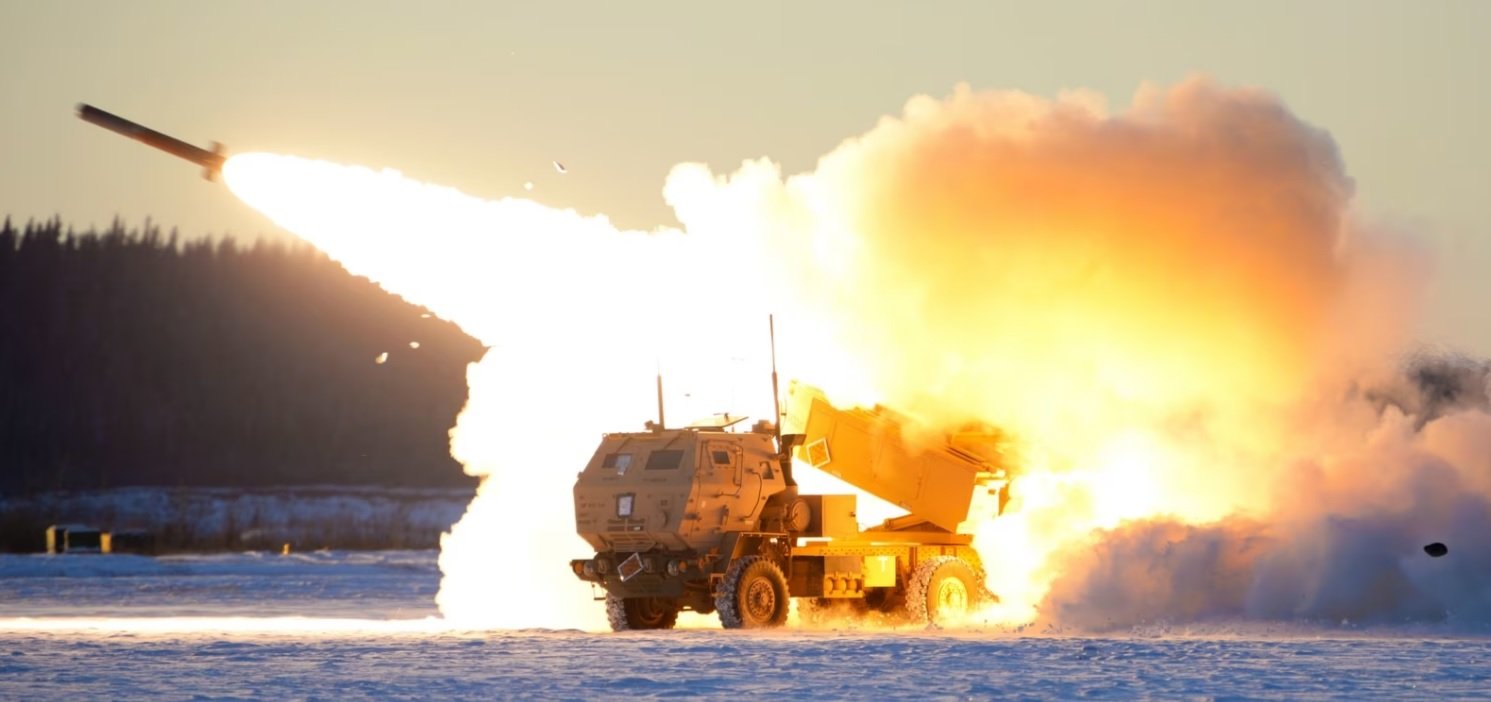
The US HIMARS multiple rocket launcher system fires. Photo: rferl.org
The Russian Defense Ministry also reported the destruction of another HIMARS system on Friday. The HIMARS system, along with other military equipment, was discovered hidden in an industrial area in the city of Kramatorsk (a Ukrainian-controlled region) in the self-proclaimed Donetsk People's Democratic Republic.
Video footage of the attack, shared by the Russian military, shows a massive explosion, with a column of fire and thick smoke rising. In addition to HIMARS, five Soviet-era BM-21 Grad multiple rocket launchers, five tanks, and ten other armored vehicles were destroyed in the attack, according to Moscow's estimates.
Disrupting Kyiv's electronic warfare capabilities.
The Russian military continues its efforts to attack Ukraine's electronic warfare and early warning systems, including active jamming devices, radars, passive detectors, and other equipment. The persistent pursuit of these systems allows Russian forces to operate more effectively, making it difficult for Kyiv's forces to intercept or issue warnings of attack.
On Monday, a video released to the media showed Russian fire destroying an AN/TPQ-50 artillery radar system supplied to Ukraine by the US. According to RT, the system was detected near the town of Kupiansk, Kharkiv province, and was attacked by a Russian Lancet suicide drone.
Russian Lancet suicide drones attack and destroy equipment belonging to the Ukrainian Armed Forces. (Source: RT)
Another video released last week showed a Lancet drone attacking a Ukrainian-made Plastun electronic warfare support station. The Plastun station was spotted deployed in a wooded area alongside a nearby Starlink satellite station. After being detected, it was attacked by a suicide drone. Publicly available footage of the attack appears to show it being destroyed.
A Ukrainian-made NOTA electronic jamming station was also targeted by a Lancet suicide drone. Video recorded by the reconnaissance drone has been made public. The footage shows the NOTA system hidden in a wooded area, with only the antenna protruding. The Lancet suicide drone struck the target directly, and a large fire erupted after the collision.
The Lancet suicide drone was developed by ZALA Aero, a subsidiary of the Russian defense giant Kalashnikov Concern. The company produces two versions of the drone: the Izdeliye-52, with a 30-minute flight time and a one-kilogram warhead, and the larger Izdeliye-51, with a 40-minute flight time and a 3-kilogram warhead.
The Lancet drone will travel to the designated area using an inertial navigation system assisted by GLONASS. Upon reaching the target area, the operator will use the drone's electro-optical systems via a two-way data link to detect, track, and lock onto the target.
The laser rangefinder then controls the detonation of the warhead. Ukraine's attempts to intercept the Lancet drone with anti-aircraft fire, electronic warfare systems, or other countermeasures have so far been unsuccessful.
HOA AN (According to RT)
Source: https://www.nguoiduatin.vn/nga-san-lung-khi-tai-dat-do-ap-luc-de-nang-len-ukraine-204240731084209721.htm

























![[Photo] Prime Minister Pham Minh Chinh holds a phone call with the CEO of Russia's Rosatom Corporation.](/_next/image?url=https%3A%2F%2Fvphoto.vietnam.vn%2Fthumb%2F1200x675%2Fvietnam%2Fresource%2FIMAGE%2F2025%2F12%2F11%2F1765464552365_dsc-5295-jpg.webp&w=3840&q=75)













































Comment (0)