

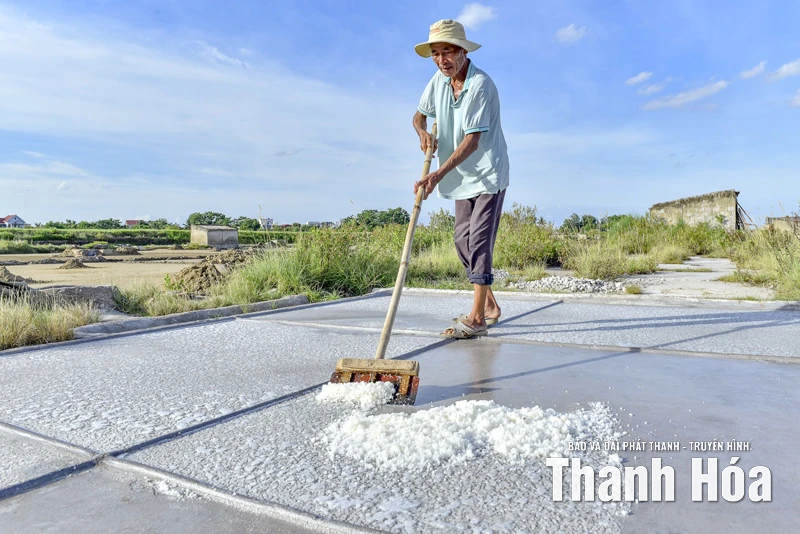
Salt farmers in Hoa Loc toil under the scorching sun harvesting salt. Photo: Hoang Dong
Mr. Le Van Thuan from Hoa Loc commune - a salt farmer with over 40 years of experience in the Tam Hoa agricultural cooperative - shared: "Salt making is very hard work. You have to wake up early in the morning, and you can only get salt when the sun is strong. If it rains, you lose everything."
That's the harsh reality of salt production – a profession entirely dependent on nature. On scorching hot days, when the outdoor temperature can reach over 40 degrees Celsius, people have to wear conical hats, long-sleeved shirts, and cover themselves completely to work in the fields, harvesting salt. The hotter the sun, the faster the salt crystallizes, ensuring a good yield. Mrs. Pham Thi Dinh, 70 years old, from Hoa Loc commune, said: "Those new to the profession often suffer from sunstroke and dizziness, but the villagers are used to it. Some days, the sun is so intense that people become thin and weak, only having the strength to 'crawl' back home."
On the salt fields, salt farmers begin their work at dawn with clearing the crystallization ponds, building embankments, and channeling saltwater from the settling ponds or crystallization fields into the drying yards. Producing salt requires many meticulous steps, demanding strength and perseverance. First is the preparation of the soil. A crucial step in the process is soaking the sand in seawater, known as level 1 salinity water, then drying the soaked sand on compacted soil. Under the sun, tiny salt crystals begin to form on each grain of sand. Next, the seawater is filtered through this layer of sand to produce level 2 salinity water, which is saltier than the initial water. This process is repeated many times: drying the sand, then filtering again with level 2 salinity water to produce level 3 salinity water, which is more saline and suitable for faster salt crystallization. After the soil treatment and water filtration, salt farmers scoop water from the canal and spread it evenly over the surface of the soil to maintain moisture and increase the filtration capacity. Once the soil is dry, continue scooping it up to filter out the saltwater, then pour it onto the prepared drying area. Each crystallization cell, with an area of approximately 15-20 m2, must be thoroughly dried and leveled before water is added.
Under the intense sun for about a day, the saltwater evaporates, and the salt begins to crystallize into grains. The period from 3 PM to 5 PM is when the locals harvest the salt. However, to produce that much salt, the workers have to endure the sun all day, continuously using bamboo rakes, wheelbarrows, and iron shovels to gather the salt and transport it home to dry or take it to the selling point.
Mr. Le Van Loc from Hoa Loc commune said: "Each day, two people working together can produce 100 kg of salt. The hotter the weather, the better the quality of the salt. Therefore, these days, many of us are working in the fields. Some days the sun is so strong that our feet get blisters, but we still have to work, because if we don't work today, we won't have anything to eat tomorrow."
Despite the hard work, income from salt production is unstable. Salt prices depend on the market, sometimes reaching 2,000 VND/kg, other times dropping to only 800-1,200 VND/kg. Many salt-producing families have to take on additional jobs such as fishing, selling goods, and other sideline occupations to make ends meet. Furthermore, climate change, with its unpredictable weather patterns, makes salt production even more precarious. Many young people are abandoning the profession to work in the city, leaving the salt fields to be left with only the elderly.
Ms. Pham Thi Dinh from Hoa Loc commune confided: "Salt alone can't sustain us. We work from morning until late evening, but only earn about 200,000 dong a day. This amount is far too little compared to the labor my husband and I put in. As farmers, we have no choice but to rely on our labor for profit."
This year, right during the peak of the salt-making season, a series of storms hit. Not only did the prolonged storms cause losses in production, but they also forced people to spend extra effort and money to restore the salt fields. Broken fields had to be rebuilt, silted-up filtration tanks had to be dug up, and salt storage facilities were flooded.
Despite the hardships, uncertainties, and risks of extinction, salt production in Hoa Loc quietly persists, just like the salt farmers themselves, diligently living and preserving their craft with all their love and perseverance. Each white grain of salt is not only the crystallization of water and sun, but also a testament to the tireless labor of its people.
To prevent the salt-making craft of Hoa Loc from becoming a memory, practical support policies and new directions that are in line with the times are essential. Because as long as the salt still retains its salty taste in the hands of the salt workers, the belief in a brighter tomorrow in the salt fields will still sparkle in the sun.
Phuong Do
Source: https://baothanhhoa.vn/nghe-muoi-bap-benh-theo-nang-mua-260807.htm



























































































Comment (0)