

Grapes are a unique crop used for fresh consumption or processing, and are highly popular in the market. This fruit brings high economic efficiency to growers and processing businesses in localities in the southern region of Khanh Hoa province.
To develop this distinctive industry, Khanh Hoa's agricultural sector is focusing resources and implementing investment policies for grape-producing areas according to planning; prioritizing areas with geographical indications, forming concentrated growing zones, promoting production linkages, and increasing economic value. This aims to maintain its role as the leading grape-producing region in the country.
Tree of Wealth
The southern localities of Khanh Hoa province have always faced the challenge of insufficient rainfall and lack of sunshine. However, this is precisely an advantage for the development of specialized agriculture, especially crops with regional characteristics and high economic value, such as grapes.
By the end of 2024, the area of grape cultivation in the southern part of the province will exceed 1,100 hectares, supplying the market with 26,000-28,000 tons of fresh grapes annually.
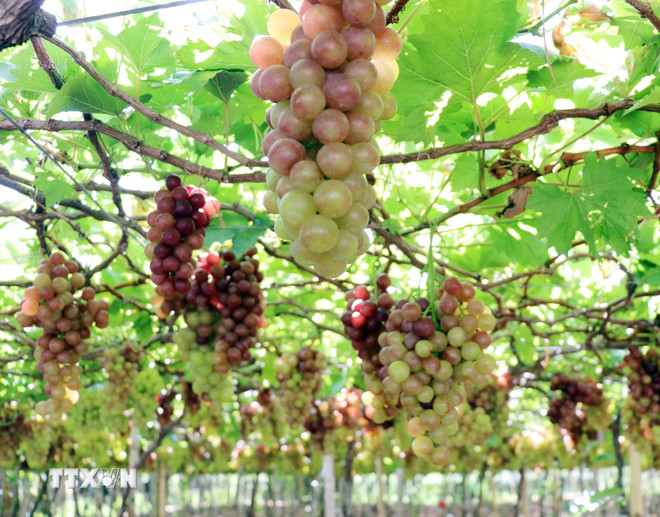
In localities such as Vinh Hai, Ninh Phuoc, Thuan Nam, Thuan Bac, Ninh Son communes, Phan Rang ward, etc., grape cultivation is thriving, especially for fresh grape varieties such as red grapes (Red Cardinal), green grapes (NH01-48), Japanese pink grapes (NH01-152), Black Queen grapes, and wine grape varieties.
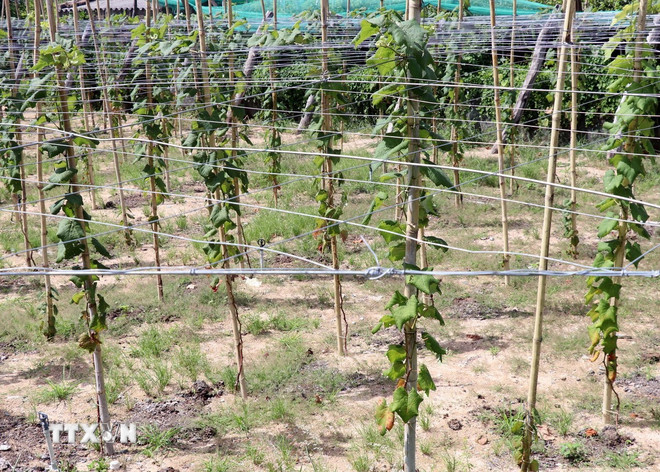
At the same time, several new high-yielding, high-quality grape varieties have been tested and evaluated for adaptability before being widely propagated, such as the peony grape, black grape, and black finger grape. These are new, seedless, high-quality grape varieties with great potential to help grape growers improve their economic efficiency.
Mr. Pham Van Tri (43 years old, residing in Thai An village, Vinh Hai commune) happily stated that 85% of households in the village are engaged in grape cultivation.
His family also cultivates 5 acres of grapes and is currently expanding the area to grow new grape varieties such as candy grapes. Currently, the price of grapes ranges from 50,000 to 250,000 VND/kg depending on the variety.
The good news is that in recent years, grape prices have never dropped because the locals have learned to produce clean grapes. Consumers have more confidence, and the market is growing. As a result, the people here always have a high income from this unique crop.
Mr. Nguyen Khac Phong, Director of Thai An Agricultural Service Cooperative, also stated that grapes are the most economically valuable crop, bringing significant income to farmers.
With the application of technological advancements, the introduction of high technology into production, and a change in production mindset (planting new grape varieties, high-quality seedless grape varieties, growing grapes according to VietGAP standards, growing grapes in greenhouses, using water-saving irrigation systems, using biological products, integrated pest management (IPM)...), grape yields have reached quite high levels, around over 250 tons/ha, resulting in significant economic benefits after harvest, depending on the season.
In recent years, concentrated grape-producing areas have been established in the province on a village and commune scale, such as Thai An village in Vinh Hai commune; Xuan Hai commune; Van Hai village in Phan Rang ward; Nho Lam village in Thuan Nam commune, etc.
The total area certified for production according to VietGAP standards is over 254 hectares; of which over 85 hectares utilize high-tech methods.
These grape-growing villages and regions always attract large numbers of tourists who come to visit and experience them.
According to the leaders of the Khanh Hoa Department of Agriculture and Environment, promoting linkages in the production and consumption of grape products is also a priority. To date, many value chain linkages have been established in the area; at the same time, there are over 10 establishments producing and processing grape products, 30 private enterprises, and about 200 small-scale family-run producers... also participating in processing grape products such as grape syrup, grape wine, grape jam, dried grapes, and grape juice... which are very popular in the market.
Each year, processing facilities supply the market with approximately 75,000-80,000 liters of grape syrup, grape wine, grape juice, and about 8-10 tons of candied grapes, dried grapes, and dried grapes.
Bringing grapes to the open sea.
To ensure the sustainable and large-scale development of the grape industry, continuously improving quality and diversifying products to generate high added value, in addition to attracting investment and expanding production, the agricultural sector also focuses on innovating production organization and promoting vertical and horizontal linkages between the "three stakeholders" (scientists, farmers, and investors, i.e., businesses) in the industry to expand production linked to product consumption.
The agricultural sector in Khanh Hoa province encourages businesses to boldly invest and gradually modernize cultivation, promoting the transfer of scientific and technological advancements to growers for application in high-tech production, starting from production and processing to production management. This will contribute to improving production efficiency and enhancing the competitiveness of grape products in domestic and international markets.
At the same time, scientists and research institutes are encouraged to continue researching and breeding new, high-quality grape varieties; especially taking into account minimizing intermediate costs in the production of seedless grape varieties with high economic value, suitable to the characteristics of the local area.
Dr. Phan Cong Kien, Deputy Director of the Nha Ho Institute of Cotton Research and Agricultural Development (Ministry of Agriculture and Environment), stated that the grape varieties transferred to farmers for production all originated from the Institute.
In the context of the demanding new development phase, the Institute has calculated, researched, and bred new grape varieties to introduce into production, meeting requirements, creating added value for grape products, and bringing high profits to both production and processing.
Currently, the Nha Ho Cotton Research and Agricultural Development Institute is maintaining 230 new grape varieties in the fields, all of which are high-yielding and resistant to adverse weather conditions and diseases. Notable varieties include NH01-48, NH01-93, NH01-96, NH01-152, NH01-26, NH01-16, NH01-205, NH02-90, NH02-97, NH04-102, etc., which have been recognized and released into production, yielding high productivity and being favored by the market.
From the diversity of grape varieties, the agricultural sector will research and select 4-5 new seedless grape varieties from the seed group. By the end of 2025, large-scale trial production of these new seedless table grape varieties will be launched. These varieties will have high yield, high quality, distinctive fruit color and flavor to suit consumer tastes, and higher resistance to certain pests than currently cultivated varieties.
Based on this, by 2030, the model of producing new seedless grape varieties in a concentrated and intensive manner will be expanded to cover 20-30% of the grape growing area in the region.
To ensure efficient production, Khanh Hoa province continues to implement the agricultural restructuring plan, expanding production scale, forming several specialized areas for fruit trees and short-term industrial crops; including grapes, and prioritizing the development of programs and plans for processing grape products that meet export requirements.
In addition to the previously cultivated area, the agricultural sector will expand the area of grape production according to VietGAP, GlobalGAP, and organic standards to approximately over 1,000 hectares, with an estimated production of about 27,900 tons.
By 2030, the target is to develop a grape cultivation area of approximately 2,000 hectares, with a production of over 51,000 tons; of which, the area of grapes produced according to standards will reach over 1,500 hectares, with an estimated production of over 40,000 tons.
According to Trinh Minh Hoang, Vice Chairman of the People's Committee of Khanh Hoa province, in order for grapes to always be at the forefront compared to other crops and for grape products to always be in a dominant position in the market, research, transfer, and application of scientific and technological advancements, mechanization in production stages, and linkages in production and processing to ensure food safety and hygiene are very important.
Therefore, the agricultural sector must carefully plan its implementation to achieve higher economic efficiency than before.
Khanh Hoa province will strengthen support for investment and expand the scale and area of grape cultivation according to VietGAP, GlobalGAP, and organic standards to over 60% of the total cultivation area of the entire province; in accordance with planning and market demand, ensuring quality and food safety.
The province also directed the agricultural sector to continue innovating production organization towards close cooperation and linkage along the value chain from production to consumption between farmers, cooperatives, and production groups with businesses; in which, businesses play a core role, especially in concentrated production areas, in order to create products with uniform quality based on uniform varieties and production technology.
Based on these positive results, the province aims to replicate the effective forms of production organization and value chains that have been established and are suitable for the local agricultural development reality.
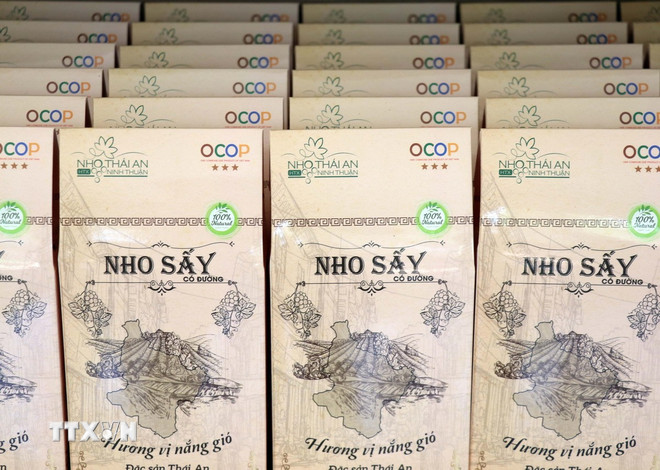
Simultaneously, we need to strengthen promotion, brand building, packaging design, and expand the market for our products; and quickly bring fresh grapes and processed grape products to the global market.
Source: https://www.vietnamplus.vn/nghien-cuu-230-giong-nho-moi-khanh-hoa-mo-rong-dien-tich-nho-chat-luong-cao-post1048652.vnp





















































































Comment (0)