

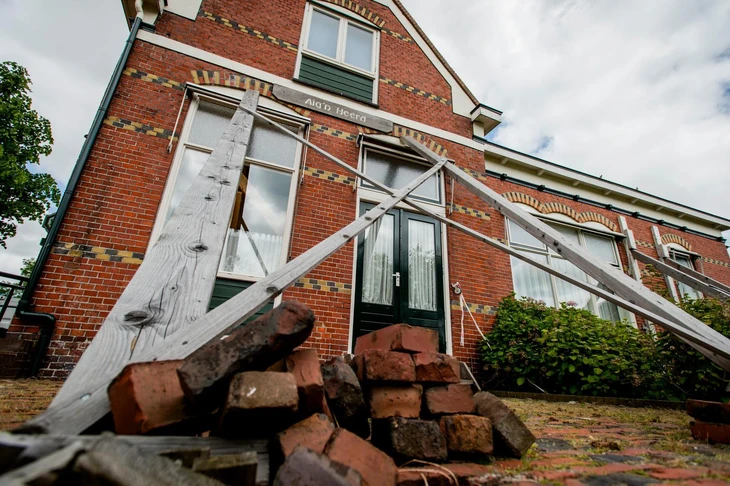
The earthquake in villages near Huizinge (Netherlands) forced many houses to be reinforced afterward. Notably, this is an area considered to have virtually no natural earthquakes - Photo: ANP
For decades, world earthquake risk maps have largely ignored places like the Netherlands, India's Deccan Plateau, or Oklahoma (USA).
These areas are far from tectonic plate boundaries, have no history of strong seismic activity, and are considered absolutely safe zones.
But a new series of studies is forcing scientists to reconsider how humans are triggering earthquakes, and that the most stable areas are sometimes the most vulnerable to fracturing.
When a fault that had been dormant for millions of years suddenly "bursts open," causing an earthquake.
On August 16, 2012, the small village of Huizinge in the Netherlands was suddenly shaken by a 3.6 magnitude earthquake. The residents were astonished: "There are no earthquakes here!"
But the answer lay right at their feet: the gas extraction project at Groningen, one of the world's largest gas fields. This activity altered subsurface pressure and triggered a shallow fault that had been dormant for millions of years.
Groningen is no exception. From India to the United States, regions that were once thought to be "earthquake-free" have recorded tremors directly related to human activities such as mining, oil and gas extraction, dam construction, liquid pumping, and geothermal energy extraction.
Why are stable regions more vulnerable?
The answer lies in a little-known process called "frictional healing."
In a recent paper published in Nature Communications , a team led by seismologist Ylona van Dinther (Utrecht University, Netherlands) discovered that shallow faults in stable regions become stronger the longer they remain stable without sliding.
"In the Netherlands, the faults haven't moved for millions of years," van Dinther said. "When they get stuck, the contact area between the two rock surfaces increases, causing them to grip more tightly. We call that frictional healing."
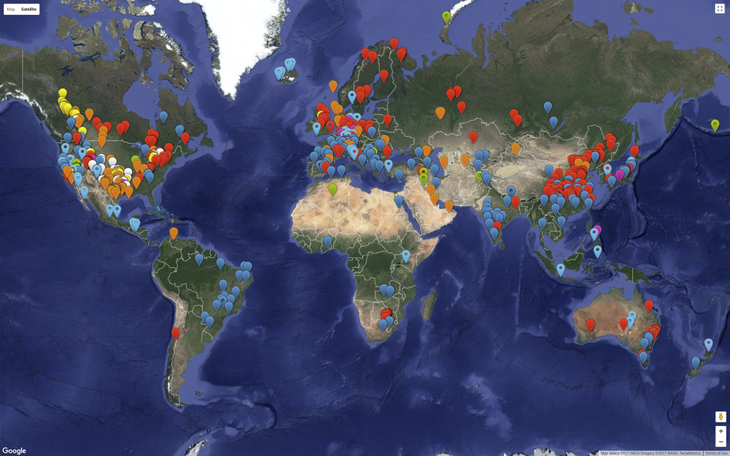
Map of earthquake-prone areas, where red indicates earthquakes caused by mining activities, dark blue by reservoir activities, and orange by oil and gas extraction - Photo: HIQUAKE
At first glance, a stronger fault might seem like a good thing. But in reality, it is precisely this that makes even a small change from human activity enough to disrupt the balance , releasing all the accumulated energy in a single slip.
Computer simulations by the Utrecht team show that when subsurface pressure changes, for example due to gas extraction or fluid injection, shallow faults will begin to experience additional loads.
In just about 35 years , that pressure could overcome the frictional restoring force that has accumulated over millions of years, causing the fault to "bounce" and create an unusually strong earthquake.
Once the energy is released, the fault will return to a dormant state and it takes millions of years to accumulate again. But the problem is that there are more than a thousand faults of this type in the world , meaning the risk of earthquake triggering could occur in many places.
Concerns that infrastructure is not designed to withstand vibrations.
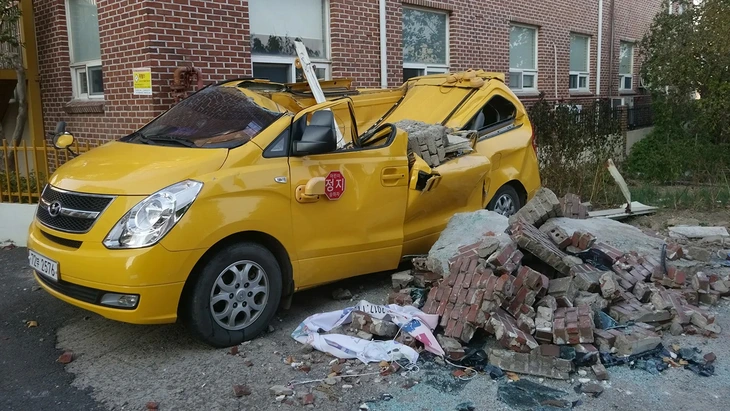
The unexpected 5.4 magnitude earthquake in Pohang, South Korea, in 2017 was determined to be man-made - Photo: SIM1992
What worries experts is not just the earthquake itself, but also the surface impact .
Shallow faults lie close to the surface, so when they slide, the energy is transferred directly to the surface, causing stronger tremors compared to the deep faults commonly found in Japan or Türkiye.
"Infrastructure in stable areas is not built to withstand earthquakes," warns geophysicist Daniel Faulkner (University of Liverpool, UK).
He cited the prime example of the 5.4 magnitude earthquake in 2017 in Pohang, South Korea, where a geothermal project was identified as contributing to the tremors, forcing authorities to shut it down. The city was unprepared for an earthquake.
Van Dinther suggests that there are still solutions to reduce the risk. These include controlling the amount and speed of fluid being pumped into the ground, starting slowly, gradually increasing the pressure, or pumping in cycles to avoid sudden pressure surges.
Several previous studies in the journal Geophysical Research Letters ( 2021) also showed that cyclic pumping methods can limit the intensity of triggered earthquakes.
However, she emphasized: "No matter how cautious they are, businesses must clearly communicate that earthquakes can occur. In risk assessments, we must take into account the healing and strengthening processes of faults."
Source: https://tuoitre.vn/nhieu-noi-an-toan-nhat-bong-bi-dong-dat-co-chuyen-gi-20251205140808307.htm
![[Image] Close-up view of the interchange connecting the two expressways and Long Thanh Airport.](https://vphoto.vietnam.vn/thumb/1200x675/vietnam/resource/IMAGE/2026/05/25/1779703378210_ndo_br_z7863716673926-224453a31600126cce10622af6290afd-4549-jpg.webp)




![[Image] Hanoi's urban life under the challenge of a "scorching hot" environment](https://vphoto.vietnam.vn/thumb/1200x675/vietnam/resource/IMAGE/2026/05/25/1779706979265_nang-nong-t5-2026-minh-duy-7-4636-jpg.webp)





















































































Comment (0)