

Farmers are rushing to clear the fields.
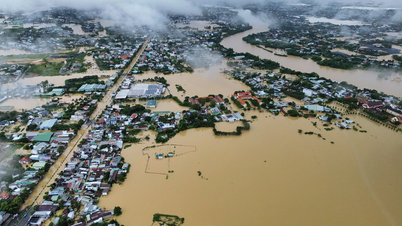
According to reports, the fields in Tuy Phuoc Dong and Tuy Phuoc Bac communes, along with some communes and wards along the Ha Thanh River such as Tuy Phuoc Tay and Quy Nhon Bac, have been severely affected by siltation and erosion.
In Tuy Phuoc Dong commune, Chairman of the People's Committee Duong Minh Tan said that the major flood caused siltation and water damage to 18.5 hectares of rice fields in the villages of My Trung, My Cang, Loc Thuong, Xuan Phuong, Huu Thanh, Kim Dong and Kim Xuyen…
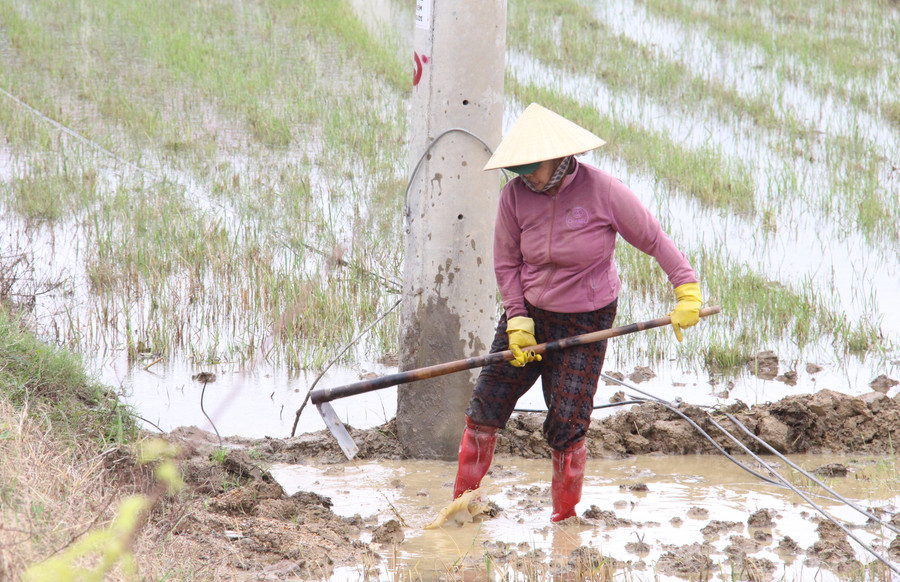
Taking advantage of the receding water, Ms. Nguyen Thi Dao (Phung Son village, Tuy Phuoc Dong commune) went to the fields to clear weeds, build embankments, and level deep holes in the rice paddies. She said: "This year's Winter-Spring crop will be sown simultaneously starting from December 15th. Therefore, farmers are taking advantage of the time to prepare the land and run the plows a few days in advance to eliminate diseases and weeds."
For the 2025-2026 Winter-Spring crop season, Ms. Dao's family will continue to participate in a large-scale rice seed production and distribution project with a seed company in Hanoi . Accordingly, she will sow ADI seeds on 1.6 acres (8,000 m²) and DV108 seeds on 5 sao (2,500 m²). Currently, the seed supply is fully prepared.
In Tuy Phuoc Bac commune, the floods also caused siltation in about 10 hectares of rice fields, with many areas buried under 25-30 cm of sand. The commune's People's Committee hired excavators and dump trucks to clear the debris, unblock waterways, and assist residents in overcoming the damage caused by heavy siltation; residents cleaned up the less affected areas themselves.
Mr. Doan Van Diep, Permanent Vice Chairman of the Tuy Phuoc Bac Commune People's Committee, said: "The rice fields in Team 9 (Dinh Thien Dong village) and the area along the Tranh River dike are the most heavily affected by siltation. Therefore, the local government has proactively hired machinery to level the land for the people so that they can sow their crops according to the seasonal schedule."
Mr. Tran Van Bac (Dinh Thien Dong village) said: "My 4 sao (approximately 0.4 hectares) of rice fields were buried under nearly 30 cm of sand. Human strength was insufficient, so the villagers had to ask the commune to mobilize machinery to help level the land and restore the fields to their original state."

Along with leveling the land, people are also busy clearing weeds and building embankments. Mr. Le Dinh Chau (Tuan Le village, Tuy Phuoc Bac commune) said: "The planting schedule is expected to be December 20th, but people are still monitoring the weather to adjust accordingly because the fields are low-lying and easily flooded."
This season, his family sowed the DV108 rice variety. The recent flood left behind a thick layer of silt, making the soil more fertile. The villagers expect the rice to grow well and yield high productivity.
Proactive seasonal planning and flexible crop structure.
According to the Department of Agriculture and Environment, localities are accelerating land preparation to ensure timely sowing.
According to Kieu Van Cang, Deputy Head of the Department of Crop Production and Plant Protection: The Department has issued a planting schedule and crop varieties suitable to the climate, water resources, and upcoming weather developments. For wet rice, the sowing schedule is divided according to each region.
In the eastern region, rice paddies with three crops per year will be sown from November 25th to December 5th; rice paddies with two crops per year will be sown from December 15th to December 25th, and low-lying areas may have more flexibility until the end of January 2026.
In the western region, rice paddies with controlled water supply should sow from December 5th to December 31st; areas experiencing water shortages at the end of the season are advised to sow early, finishing before December 10th. Areas frequently affected by floods should sow later, from December 20th, 2025 to January 10th, 2026.

Specific guidelines for crop varieties were also provided. In the eastern region, priority was given to rice varieties such as DV108, VNR20, Dai Thom 8, and An Sinh 1399; supplemented with Khang Dan mutant, DB6, and other short-, medium-, and long-day varieties depending on conditions. Several promising varieties such as DB18, TBT132, QC03, and HG12 were encouraged for testing.
In the western part of the province, the main varieties used are TBR97, DT100, Dai Thom 8, Huong Thom No. 1, Nhi Uu 838; along with OM5451, ST25, TBR225, and HG12.
Mr. Vo Duy Tin, Chairman of the People's Committee of An Hao commune, said: "The people cultivate two rice crops a year and are urgently preparing the land. If the weather is stable, the entire commune will sow rice simultaneously on December 20th, with priority varieties being DV108, Khang Dan mutant, and Dai Thom 8."
Along with seasonal guidance, the Department of Agriculture and Environment is implementing various solutions such as: closely monitoring weather developments to flexibly adjust planting schedules; prioritizing short-day varieties; reducing costs by decreasing the amount of seeds sown, chemical fertilizers, and pesticides; and restructuring crop patterns in less efficient areas, linked to the development of raw material zones to serve processing and consumption along the value chain.
Quality control of seeds and agricultural supplies; monitoring of pesticide residues; and management of planting area codes, especially for export-oriented areas, are also required to be carried out regularly and rigorously to ensure output quality and enhance the value of local agricultural production.
Source: https://baogialai.com.vn/nong-dan-gia-lai-khan-truong-khoi-phuc-dong-ruong-de-kip-vu-dong-xuan-post574569.html
























![[Video] The craft of making Dong Ho folk paintings has been inscribed by UNESCO on the List of Crafts in Need of Urgent Safeguarding.](https://vphoto.vietnam.vn/thumb/402x226/vietnam/resource/IMAGE/2025/12/10/1765350246533_tranh-dong-ho-734-jpg.webp)





















































Comment (0)