

Taking advantage of favorable weather conditions, farmers in localities across Ha Tinh province are focusing on restoring winter crops that were affected by floods and heavy rains.
Huong Khe was the locality most severely affected by the recent floods. As the floodwaters recede, farmers in this mountainous district are gradually reorganizing and stabilizing their lives; at the same time, they are taking advantage of the sunny days to go back to the fields to organize production and restart the winter crop.
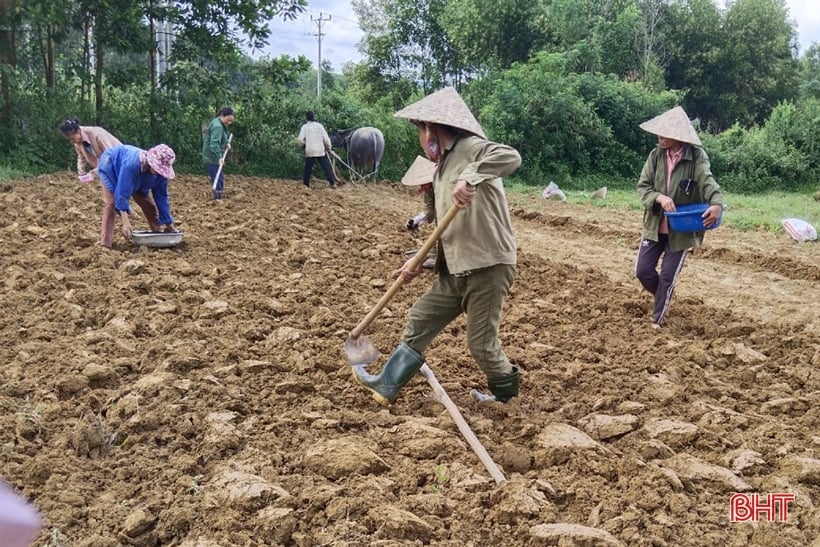
Farmers in Huong Binh commune (Huong Khe district) resume winter crop production after the floods.
Huong Binh (Huong Khe) is a low-lying commune where 100% of the villages were deeply flooded during the recent heavy rains, disrupting lives and severely affecting agricultural production.
Mr. Dang Quoc Bao, Chairman of the People's Committee of Huong Binh commune, said: "The floods have damaged more than 5 hectares of newly planted corn, 4 hectares of grain and biomass corn that were in the growth stage were flattened, and many areas of vegetable crops in household gardens were submerged. Currently, the weather is sunny and dry, and the local government is encouraging people to actively work in the fields, improve the soil, fertilize, and plant, trying not to miss the planting schedule."
Along with Huong Binh, other localities in Huong Khe district are also "speeding up" to restore production after the floods. Mr. Nguyen Tri Dong, Head of the Agriculture and Rural Development Department of Huong Khe district, said: "Widespread flooding damaged nearly 170 hectares of corn, sweet potatoes, and various vegetables. Currently, the floodwaters have receded, and the local authorities are encouraging people to start planting again for the winter crop. We hope the province will consider policies to support seeds and fertilizers so that people can quickly restore production and stabilize their lives."
Taking advantage of favorable weather, farmers in Can Loc district are also quickly reorganizing production. In recent days, from early morning, Mrs. Nguyen Thi Xoan's family (Long Long village, Thuan Thien commune, Can Loc) has been rushing to the fields to "rescue" their shallots after the rain.
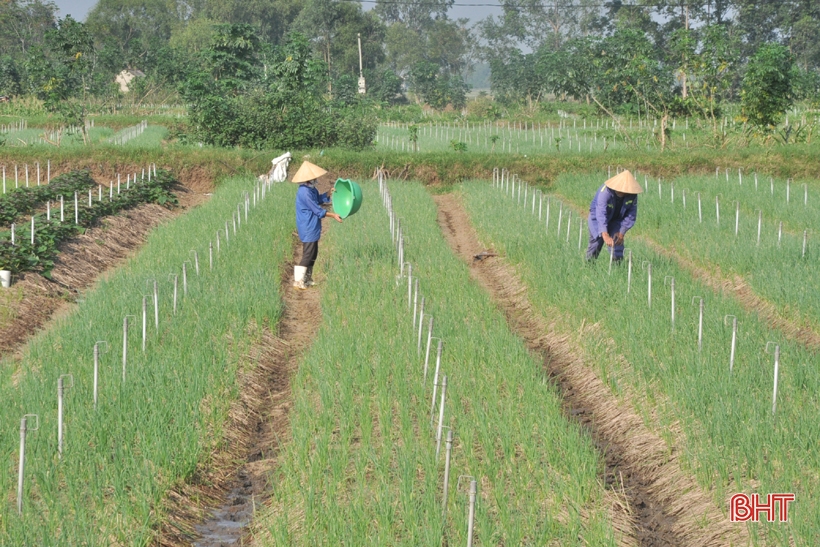
The family of Ms. Nguyen Thi Xoan (Thuan Thien commune, Can Loc district) is tending to their shallots after the heavy rains.
Ms. Xoan lamented: “The newly planted area, which was flooded nearly 10 days ago, suffered root rot from the sun, posing a risk of mass die-off, so we had to uproot it and replant 100%. As for the area of shallots that were almost ready for harvest but were submerged in water, the leaves are now turning yellow. After draining the water from the fields, my husband and I are now tilling the soil to make it dry and loose, and investing in manure, phosphorus, and potassium fertilizers… to increase the plants' resistance.”
Currently, households in Thuan Thien commune are working hard to restore the areas of shallots and spring onions damaged by floods. Mr. Nguyen Nam Vu, Vice Chairman of the People's Committee of Thuan Thien commune, said: "This winter season, the locality planted 55 hectares of spring onions and 5 hectares of shallots. Heavy rains caused about 50% of the crops to suffer reduced yield and quality. In some areas in low-lying villages such as Phuc Son and Lien Son, the crops were completely lost due to prolonged waterlogging. Taking advantage of the sunny weather, the local government is mobilizing people to intensify their efforts in the fields and implement measures to care for and control pests and diseases."
Reportedly, besides Thuan Thien, the communes of Thien Loc and Vuong Loc (Can Loc district) have also proactively implemented the production of winter vegetables, ensuring the completion of the planned area of 195 hectares. Along with restoring the area damaged by floods, the district also directed localities in the mountainous tea-growing region of Can Loc to continue closely monitoring weather developments and encourage people to plant various types of corn according to the plan.
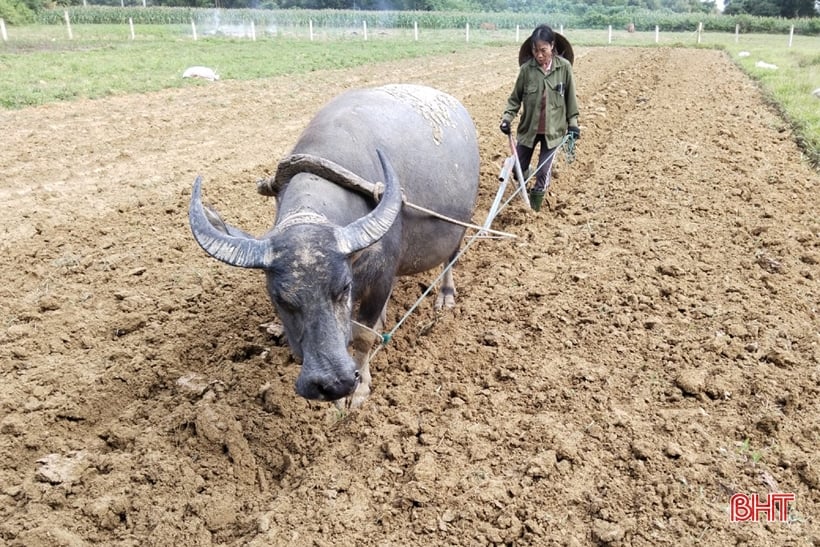
According to the plan, in the winter crop season of 2023, the entire province will produce 11,890 hectares of corn, vegetables, and sweet potatoes.
According to the Department of Crop Production and Plant Protection of Ha Tinh province, as of November 6, 2023, the planted area of winter crops throughout the province reached 5,676/11,890 hectares (47.7% of the plan). Specifically: grain corn 1,614 ha/4,259 ha (37.9% of the plan); biomass corn 95 ha/1,649 ha (5.8% of the plan); various vegetables 2,991 ha/4,524 ha (66.1% of the plan); sweet potatoes 976 ha/1,458 ha (66.9% of the plan).
Mr. Phan Van Huan, Head of the Crop Production Department of the Ha Tinh Provincial Department of Crop Production and Plant Protection, said: "From October 28 to 31, 2023, heavy rains affected crop production. According to initial statistics, about 56 hectares of corn were flooded and flattened throughout the province; 46 hectares of various vegetables were damaged... To restore crops after the floods and continue organizing the 2023 winter crop, localities need to urge farmers to take advantage of favorable weather conditions and focus on directing production according to the set plan."
Localities should prioritize the production of short-term vegetables, utilizing available land to grow biomass corn for livestock feed during the rainy and cold season. In addition, they should proactively conduct thorough investigations, detection, and timely and accurate forecasting of pests and diseases affecting crops, such as fall armyworm affecting corn, leaf-eating insects, flea beetles, and aphids damaging vegetables, in order to implement timely and effective control measures.
Thu Phuong
Source






















![[Photo] Prime Minister Pham Minh Chinh holds a phone call with the CEO of Russia's Rosatom Corporation.](/_next/image?url=https%3A%2F%2Fvphoto.vietnam.vn%2Fthumb%2F1200x675%2Fvietnam%2Fresource%2FIMAGE%2F2025%2F12%2F11%2F1765464552365_dsc-5295-jpg.webp&w=3840&q=75)















































Comment (0)