

FOCUS ON SEEDING
In the eastern part of Dong Thap province, after harvesting the autumn-winter crop, many farmers are urgently preparing the land to sow the winter-spring rice crop.
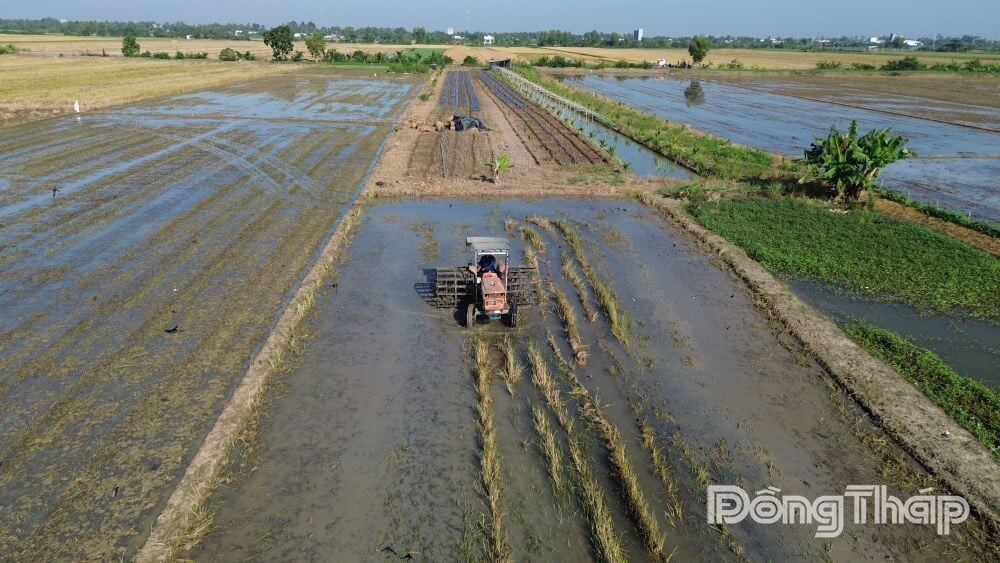
When we arrived, Mr. Nguyen Thanh Lam (Hoa Phu hamlet, Long Binh commune, Dong Thap province) was watching the tractor plowing his family's rice field. According to Mr. Lam, during the recent autumn-winter crop season, nearly 2 hectares of his family's rice fields were sown with the Dai Thom 8 rice variety.
The rice was purchased by traders at a price of 5,500 VND/kg. On average, his family earned 28 million VND per hectare.
Since most of the land was rented, after deducting expenses, he lost about 300,000 VND per hectare last season, not including his own labor. After the harvest, in order to ensure water supply for production during the upcoming dry season, Mr. Lam urgently burned the straw and hired a machine to plow the land.
According to Le Chi Thien, Deputy Director of the Department of Agriculture and Environment of Dong Thap province: "To ensure a successful winter-spring crop, the agricultural sector has developed a concentrated and simultaneous planting schedule to avoid pests, based on the results of light trap monitoring, meteorological and hydrological conditions, and actual production in each locality, ensuring uniformity in each area." In addition, the sector arranges a rational cropping structure, suitable to the soil conditions, ecology, water resources and weather patterns; limiting the overlapping of rice varieties that cause pest outbreaks or conflicts in water use and dike systems. The agricultural sector also coordinates with local authorities in reviewing, strengthening, and operating irrigation works, proactively serving concentrated planting, pest management, rational irrigation and drainage, and protecting safe production. Areas with controlled flood discharge need to proactively schedule discharge times, pump out water promptly, ensure timely planting of the winter-spring crop, avoid pests, and effectively utilize early-season water resources…”. |
“This winter-spring season, my family continues to sow the Dai Thom 8 rice variety. This is a rice variety that many farmers here sow because of its high yield. With the current rice price, farmers are not at ease. The price of rice needs to be at least 7,000 VND/kg for farmers to make a profit, because all input costs have increased,” Mr. Lam lamented.
Also in Long Binh commune, this year's winter-spring crop saw Mr. Nguyen Van Bui's family (Thanh Loi hamlet) sow 1.3 hectares of OM 4218 rice, which was planted 3 days ago. According to Mr. Bui, in the past autumn-winter crop, his family sowed OM 4218 rice and sold it at 5,500 VND/kg, earning a profit of only about 300,000 VND per hectare after deducting expenses.
Mr. Bui expressed: "Rice farmers rely solely on this winter-spring crop. We farmers hope that in 2026, rice prices will rise again so we can make a profit and have more motivation to stay on the farm."
Meanwhile, in border communes and wards, farmers are also urgently sowing the winter-spring rice crop. Having just finished sowing 5 acres of OM18 rice, Mr. Nguyen Van Ben (from Tan Hong commune) said: “Right after harvesting the autumn-winter rice crop, I proceeded to prepare the land and clean the fields, opening the fields to bring floodwater in to kill pests and diseases and replenish the soil with silt. I sowed the rice using a seed sprayer, which saved time and costs compared to sowing by hand before.”
Also in Tan Hong commune, in recent days, Mr. Le Van Nguyen has been urgently sowing the winter-spring rice crop. Mr. Nguyen shared: “The autumn-winter rice crop was harvested right during the rainy season, so I couldn't remove the straw from the field. Therefore, I cleaned the field, harrowed and buried the straw, used Trichoderma fungus, and applied phosphorus fertilizer to limit golden apple snail egg laying, which is a source of pest spread and organic poisoning for the winter-spring rice crop.”
According to the Department of Agriculture and Environment (DARD) of Dong Thap province, the province plans to sow over 227,000 hectares of rice during the 2025-2026 winter-spring crop season. Of this, high-quality rice will account for 85% of the sown area; the area using row sowing and sparse sowing will account for 75%; and the area using certified rice seeds will reach 90%. To enhance production value, the DARD has developed a planting schedule. Accordingly, the first phase, from October 10th to 30th, 2025, includes communes in the Dong Thap Muoi area (Truong Xuan, Doc Binh Kieu, My Qui, Thanh My, Thap Muoi, Ba Sao, Phuong Thinh, Phong My, etc.), with an estimated area of approximately 60,000 hectares; the second phase, from November 7th to 27th, 2025, is estimated at approximately 116,255 hectares. Phase 3, from December 7th to 31st, 2025, is estimated to cover an area of approximately 44,300 hectares. Some areas with delayed planting will complete sowing before January 10th, 2026.
The Department of Agriculture and Environment also developed a structure of key rice varieties including: OM18, Dai Thom 8, OM5451, OM6976, OM4900, IR50404, Jasmine 85…; supplementary varieties include OM576, OM7347, Nang Hoa 9, VD20, OM6162, RVT, OM9582…
Priority should be given to short-duration, high-quality varieties that are moderately tolerant to acidic and saline soils, and suitable for each ecological zone. Simultaneously, certified, disease-free, and purebred varieties should be used to ensure yield and quality; variety diversity in the same field should be limited to facilitate pest management and simultaneous harvesting…
FOCUS ON LINKS
In reality, with rice prices currently very low, farmers are facing many difficulties. Therefore, to increase their income, many farmers have proactively participated in cooperatives for rice production and consumption.
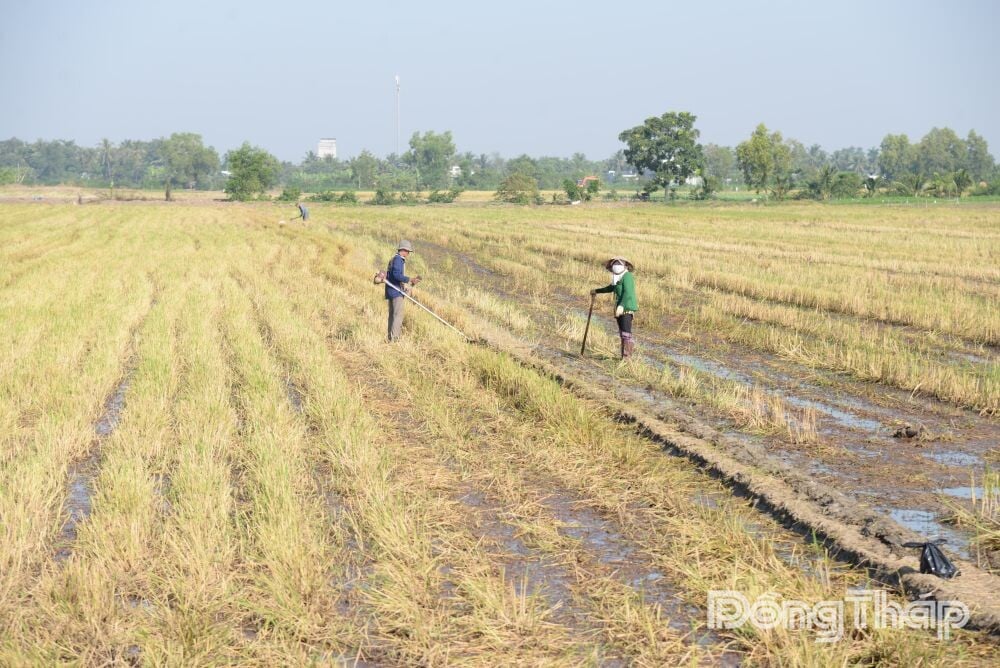
For the 2025-2026 winter-spring crop season, Binh Thanh Agricultural Service Cooperative (Lap Vo commune, Dong Thap province) plans to plant 950 hectares with key rice varieties such as Dai Thom 8 and OM 18.
Mr. Nguyen Van Doi, Chairman of the Board of Directors and Director of Binh Thanh Agricultural Service Cooperative, said: "This year, the cooperative continues to guarantee the purchase of rice products from its members at stable prices compared to the market."
Thanks to guaranteed output, farmers can cultivate with peace of mind. Implementing the value chain production linkage model over the years has brought many benefits to the cooperative.
As for Hoa Thanh General Agricultural Cooperative (Long Binh commune), building on the positive results from the autumn-winter crop, this year's winter-spring crop will see the cooperative continue to collaborate with businesses to produce according to a high-quality, emission-reducing model.
Mr. Nguyen Thanh Quang, Director of Hoa Thanh General Agricultural Cooperative, said that in the recent autumn-winter crop season, the cooperative collaborated with a business to cultivate 50 hectares of ST25 rice using a high-quality, low-emission model. The business guaranteed the purchase of all the rice produced.
Rice yields in the model were also very high, with fewer diseases and reduced use of fertilizers and chemical pesticides, so farmers were very pleased.
According to Mr. Quang, given the benefits of the model, many farmers are now continuing to register to participate in producing high-quality rice and reducing emissions during the winter-spring crop season.
"Thanks to the production of ST25 rice seeds, farmers are able to sell their rice at a higher price. Cooperative members also receive seeds from the company at a price about 2,000 VND/kg cheaper than the market price," Mr. Quang added.
NAM PHONG - T. DAT
Source: https://baodongthap.vn/nong-dan-khan-truong-xuong-giong-vu-lua-dong-xuan-a233841.html
![[Photo] Closing Ceremony of the 10th Session of the 15th National Assembly](/_next/image?url=https%3A%2F%2Fvphoto.vietnam.vn%2Fthumb%2F1200x675%2Fvietnam%2Fresource%2FIMAGE%2F2025%2F12%2F11%2F1765448959967_image-1437-jpg.webp&w=3840&q=75)

![[Photo] Prime Minister Pham Minh Chinh holds a phone call with the CEO of Russia's Rosatom Corporation.](/_next/image?url=https%3A%2F%2Fvphoto.vietnam.vn%2Fthumb%2F1200x675%2Fvietnam%2Fresource%2FIMAGE%2F2025%2F12%2F11%2F1765464552365_dsc-5295-jpg.webp&w=3840&q=75)












![[Infographic] Many activities at the 96th anniversary commemoration of the death of Deputy Scholar Nguyen Sinh Sac](https://vphoto.vietnam.vn/thumb/402x226/vietnam/resource/IMAGE/2025/12/11/1765441454787_infographic-nhieu-hoat-dong-tai-le-gio-lan-thu-96-cua-cu-pho-bang-nguyen-sinh-sac20251211010322.webp)






















![[OFFICIAL] MISA GROUP ANNOUNCES ITS PIONEERING BRAND POSITIONING IN BUILDING AGENTIC AI FOR BUSINESSES, HOUSEHOLDS, AND THE GOVERNMENT](https://vphoto.vietnam.vn/thumb/402x226/vietnam/resource/IMAGE/2025/12/11/1765444754256_agentic-ai_postfb-scaled.png)



































Comment (0)