

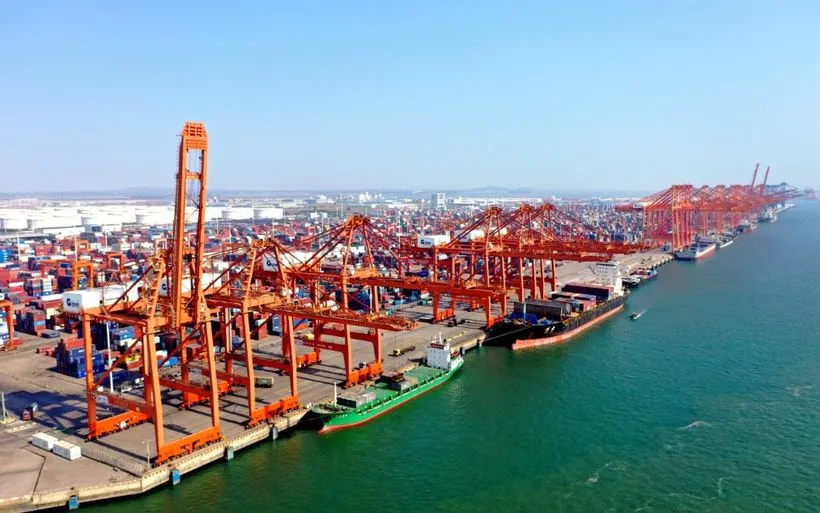
View of Qinzhou port in Guangxi province (China). (Photo: THX/TTXVN)
In its latest World Economic Outlook report released on December 2, the Organization for Economic Cooperation and Development (OECD) raised its growth forecast for major economies, especially the US and the Eurozone, saying the world economy is "surprisingly resilient" despite facing adverse factors this year.
The organization said the world economy is on track to grow 3.2% in 2025, down from 3.3% in 2024, before slowing to 2.9% in 2026 and rebounding in 2027, with growth of 3.1%.
New trade barriers, political uncertainty and slowing investment have held back growth, but demand has remained surprisingly robust, according to the OECD. The organization pointed to factors such as more favorable global financial conditions, supportive macroeconomic policies, real income growth and strong demand for new AI-related investments, particularly in the US, as boosting demand.
The OECD forecasts the US economy to grow 2% in 2025, 0.2 percentage points higher than the estimate given in September 2025. For the Eurozone, the OECD now sees growth reaching 1.3%, up 0.1 percentage points from the previous forecast.
US GDP growth is expected to slow to 1.7% next year, while the eurozone could reach 1%. Both estimates are better than the OECD's September forecast.
China's economy is expected to grow 5% in 2025, 0.1 percentage point higher than estimated in September.
However, global economic growth is expected to slow in the second half of this year, as higher tariffs mean higher costs for businesses and consumers, and rising geopolitical and policy uncertainty continue to weigh on domestic demand.
Global economic growth is expected to recover in 2026, supported by a reduced impact of tariffs, favorable financial conditions, accommodative macroeconomic policies, and lower inflation. Emerging market economies in Asia continue to be a major driver of global growth.
However, the OECD warned that the outlook for the global economy “remains fragile”. Further increases in trade barriers, especially around key production goods, could have significant impacts on global supply chains and output.
High asset valuations based on optimistic expectations for AI-driven corporate profits risk a sudden correction, the OECD warned, adding that financial vulnerabilities could push long-term government bond yields higher, tightening financial conditions and hampering growth.
Source: https://vtv.vn/oecd-kinh-te-toan-cau-dung-vung-giua-nhung-yeu-to-bat-loi-10025120219555211.htm
![[Photo] Parade to celebrate the 50th anniversary of Laos' National Day](/_next/image?url=https%3A%2F%2Fvphoto.vietnam.vn%2Fthumb%2F1200x675%2Fvietnam%2Fresource%2FIMAGE%2F2025%2F12%2F02%2F1764691918289_ndo_br_0-jpg.webp&w=3840&q=75)


![[Photo] Worshiping the Tuyet Son statue - a nearly 400-year-old treasure at Keo Pagoda](/_next/image?url=https%3A%2F%2Fvphoto.vietnam.vn%2Fthumb%2F1200x675%2Fvietnam%2Fresource%2FIMAGE%2F2025%2F12%2F02%2F1764679323086_ndo_br_tempimageomw0hi-4884-jpg.webp&w=3840&q=75)































































































Comment (0)