

 |
| Master Vo Thi Ngoc Lam, Deputy Director of Dong Nai Province Department of Health . Photo: Hanh Dung |
After the administrative boundary merger, Dong Nai faces many opportunities but also many challenges in population management and distribution. Regarding this issue, Dong Nai Newspaper, Radio and Television reporters had an interview with Master VO THI NGOC LAM, Deputy Director of Dong Nai Provincial Department of Health.
UNEQUAL POPULATION DISTRIBUTION
* Madam, what are the notable changes in the current population picture of Dong Nai province? What is the difference in population distribution between regions?
- After the merger, Dong Nai province has a population of about 4.49 million people, belonging to the group of 5 provinces and cities with the largest population in the country. The difference in population distribution between regions is very clear. Urban areas, especially central wards such as Tran Bien, Tam Hiep, Long Binh, areas with many industrial parks such as Trang Bom, Nhon Trach have very high population density. Tran Bien ward alone has a density of more than 6 thousand people/km².
Meanwhile, border communes and mountainous areas such as Dak O, Loc Ninh, Bu Gia Map... have very low population density, only about 79 people/km², sparse and scattered population.
* How does the high population concentration in urban areas and industrial zones affect the socio -economic development and social security system of the province, madam?
- The high concentration of population in urban areas and industrial zones is both positive and poses many challenges. Abundant labor force helps promote industrial and service growth, increasing GRDP per capita. This is also an important condition for the province to invest more in transport infrastructure, health care, education, social welfare, etc., contributing to improving people's lives.
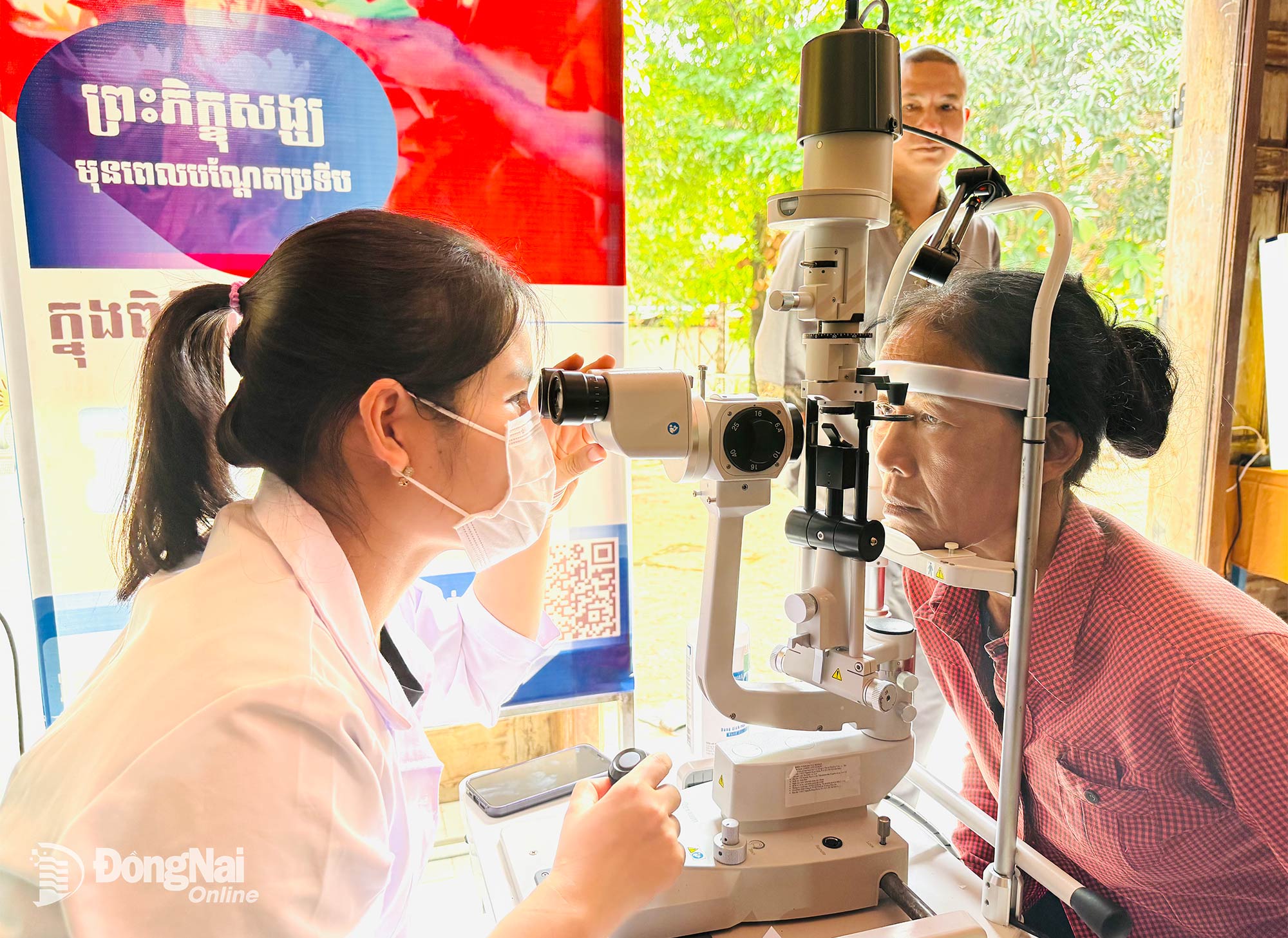 |
| People in difficult circumstances in Loc Hung commune, Dong Nai province, received free eye examinations from doctors at Hanoi - Dong Nai Eye Hospital. Photo: Hanh Dung |
However, the rapid increase in population also puts pressure on housing, schools, hospitals, transportation, clean water and the environment. Rapid but unsynchronized urbanization leads to the risk of imbalance in development; the quality of life between urban and rural areas is significantly different. In many industrial areas, traffic jams during rush hours, cramped dormitories, overloaded schools, and hospitals operating at full capacity are common.
In addition, the large number of immigrants brings pressure on social management, security and order and the need for primary health care. The environmental ecosystem is also strongly affected by the rapid increase in waste, more motor vehicles and higher demand for clean water.
APPLYING DIGITAL TECHNOLOGY TO POPULATION MANAGEMENT
* So what solutions does Dong Nai province have to manage population in the coming time, madam?
- Dong Nai is strongly implementing digital transformation on all 3 pillars: digital government - digital economy - digital society. In population management, the province has applied the VNeID electronic identification application with level 2 identification, digital signature, integrating many utilities related to online administrative procedures, personal document management, assets... to help manage residence more scientifically and modernly.
In the healthcare sector, we deploy medical examination and treatment management software, MIS population statistics software to support monitoring population changes, birth, death, migration and health care needs. This is an important foundation for building a comprehensive population database, serving policy planning and more accurate population forecasting.
The biggest goal of a reasonable population distribution is to ensure social security and improve the quality of life for all people. When the population is distributed harmoniously, people everywhere can enjoy good education and health services, live in a safe, clean environment, and have stable jobs.
* According to you, what solutions does Dong Nai need to implement to move towards reasonable population distribution?
- Reasonable population distribution is a comprehensive problem, requiring coordination between planning, economic development, infrastructure investment and social security policy.
I think, first of all, the province needs to expand industrial zones and clusters in a reasonable dispersion direction, not concentrating in a few areas. Inter-regional transport infrastructure must be completed to create a smooth connection between residence and workplace. When traffic is convenient, people do not necessarily have to live near industrial zones. Next, it is necessary to develop satellite towns and new residential areas. Satellite towns need to be planned synchronously including: schools, hospitals, markets, commercial centers, culture, green spaces... The formation of attractive urban areas with suitable housing prices will create a force to attract people away from overloaded hotspots.
In addition, public services in rural and mountainous areas need to be strengthened. In order for people to “settle down”, localities must have good schools, health stations, satellite hospitals, and adequate cultural and sports services. Investing in the development of high-tech agriculture and local industries will create sustainable jobs and limit the flow of spontaneous migration to urban areas.
In particular, it is necessary to focus on developing social housing, worker housing, and allocating social housing areas reasonably instead of concentrating them in one area... This is a solution to reduce population density while still being convenient for workers.
* Thank you very much!
Hanh Dung (performed)
Source: https://baodongnai.com.vn/xa-hoi/y-te/202512/phan-bo-dan-so-hop-ly-de-phat-trien-ben-vung-07a3aeb/
















![[Infographic] 3 timelines of the "Quang Trung Campaign"](https://vphoto.vietnam.vn/thumb/402x226/vietnam/resource/IMAGE/2025/12/04/1764800248456_fb_ava-2.jpeg)





![[Photo] Parade to celebrate the 50th anniversary of Laos' National Day](/_next/image?url=https%3A%2F%2Fvphoto.vietnam.vn%2Fthumb%2F1200x675%2Fvietnam%2Fresource%2FIMAGE%2F2025%2F12%2F02%2F1764691918289_ndo_br_0-jpg.webp&w=3840&q=75)































































Comment (0)