

(NLDO) - 10,000-year-old pottery pieces from the Shangshan culture on the banks of the Yangtze River have retained traces of an ancient wine.
A multinational research team led by Professor Leping Jiang from the Zhejiang Provincial Institute of Cultural Relics and Archaeology (China) has discovered a very ancient type of rice wine.
According to Sci-News, they analyzed artifacts from the early stages of the Shangshan culture site, which existed in the middle and lower reaches of the Yangtze River in China.
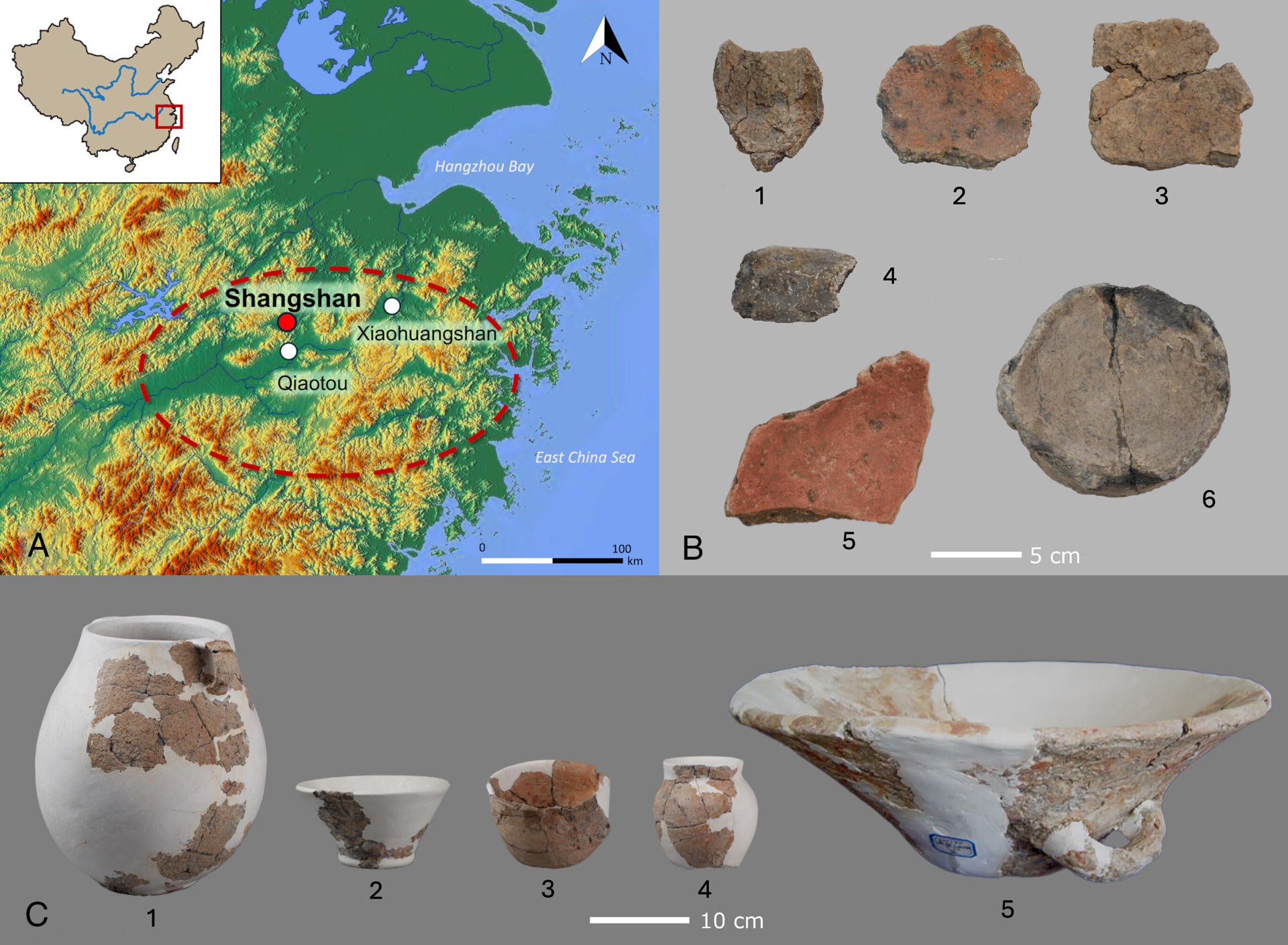
Shangshan culture artifacts contain evidence of an ancient wine - Photo: STANFORD UNIVERSITY
Artifacts dating back 9,000-10,000 years from the Shangshan people have revealed traces of phytoliths (tiny minerals found in plant tissue), starch granules, and yeast.
These starch granules are derived from rice, chestnuts, dogwood, a type of wheat, acorns, and lilies.
Many starch granules—most notably rice starch—show signs of enzymatic degradation and gelatinization, which are characteristic of fermentation.
Scientists also discovered numerous fungal components, including Monascus mold and yeast cells, some of which exhibited developmental stages characteristic of the fermentation process.
These types of mushrooms are closely related to those used in traditional Chinese brewing methods, such as the one used to produce hongqujiu, or red yeast rice wine.
Therefore, in their paper published in the scientific journal Proceedings of the National Academy of Sciences, the researchers concluded that this was evidence of the production of an alcoholic beverage.
"These fragments are related to various types of containers, including those used for fermentation, serving, storage, cooking, and processing," Professor Jiang added.
The ancient Shangshan culture is closely linked to the domestication of rice during a period of warm and humid climate in the region.
These findings suggest that the people there utilized the very things they had to produce alcohol. The pottery used in the production process itself contained rice husks, highlighting the crucial role of rice in early East Asian civilizations.
Professor Li Liu from Stanford University (USA), co-author, explains: "Dominated rice provides a stable resource for the fermentation process, while favorable climatic conditions support the development of technology based on the growth of filamentous fungi."
These alcoholic beverages may have played an important role in Neolithic ritual feasts on the banks of the Yangtze River.
Evidence from the Shangshan people's rice wine fermentation process also suggests that this technology was among the earliest to appear in East Asia.
Previously, the earliest evidence of wine recognized worldwide was found in Jiahu, a Neolithic village in the Yellow River valley, dating back to approximately 7000-6600 BC, or 8,600-9,000 years ago.
Source: https://nld.com.vn/phat-hien-loai-ruou-lau-doi-nhat-the-gioi-o-trung-quoc-196241212104344112.htm
![[Photo] Prime Minister Pham Minh Chinh holds a phone call with the CEO of Russia's Rosatom Corporation.](/_next/image?url=https%3A%2F%2Fvphoto.vietnam.vn%2Fthumb%2F1200x675%2Fvietnam%2Fresource%2FIMAGE%2F2025%2F12%2F11%2F1765464552365_dsc-5295-jpg.webp&w=3840&q=75)



![[Photo] Closing Ceremony of the 10th Session of the 15th National Assembly](/_next/image?url=https%3A%2F%2Fvphoto.vietnam.vn%2Fthumb%2F1200x675%2Fvietnam%2Fresource%2FIMAGE%2F2025%2F12%2F11%2F1765448959967_image-1437-jpg.webp&w=3840&q=75)











































































Comment (0)