

So, what advantages does Vietnam have in this game, and what do we need to do to get rich from the digital economy ?
Where does Vietnam stand on the microchip manufacturing map?
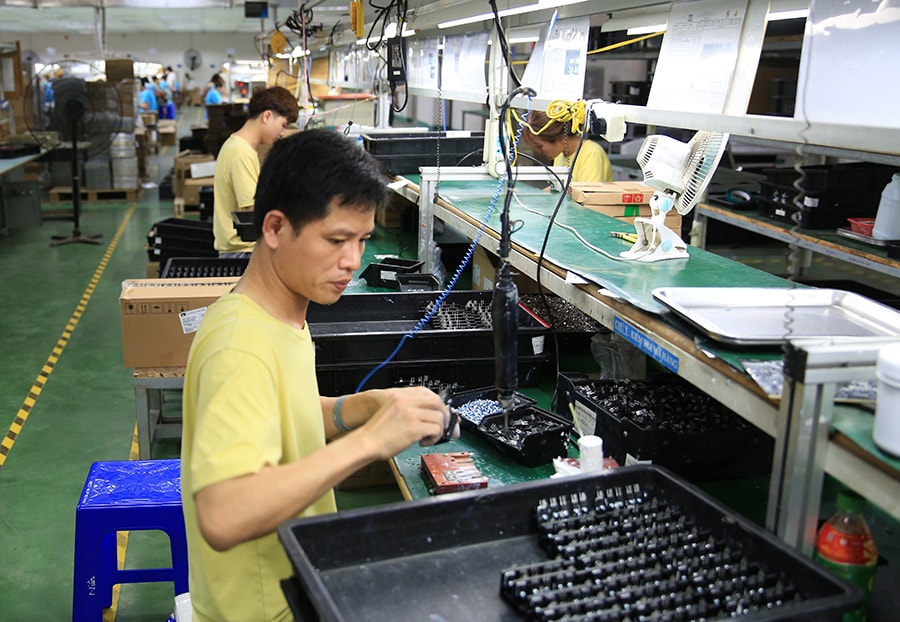
Analyzing Vietnam's opportunities in the global semiconductor supply map, Associate Professor Dr. Mai Anh Tuan (University of Technology, Vietnam National University, Hanoi ) stated that our strengths stem from our electronics assembly industry with an abundant workforce. Vietnam has been a hub for electronics manufacturing for over a decade, with the presence of global corporations such as Samsung (producing over 50% of smartphones in Vietnam), followed by LG, and then Foxconn (an Apple partner), giving us a solid technological foundation.
Furthermore, Intel's presence with its $1.5 billion chip assembly and testing plant over the past 15 years has demonstrated that Vietnam is fully capable of handling the complex processes of the semiconductor industry.
This is coupled with a large workforce and a disciplined team of engineers working in a high-tech production environment. Furthermore, Vietnam is considered to have a young, abundant workforce capable of learning and adapting quickly to new technologies (a demographic dividend).
One crucial factor is that Vietnam has significantly competitive costs compared to other semiconductor hubs such as Taiwan (China), South Korea, or Singapore, and is particularly suitable for labor-intensive processes like packaging and testing.
According to Associate Professor Dr. Mai Anh Tuan, another important point is that Vietnam maintains a golden neutrality in the geopolitical context, especially the trade and technology tensions between the US and China, forcing global corporations to diversify their supply chains to minimize risks. In this context, Vietnam, with its political stability and balanced foreign policy, becomes an ideal choice for this strategy.
In fact, the Vietnamese government is strongly committed to and has been implementing policies to attract investment. Strategically, the semiconductor industry has been identified as a key national sector. The government has issued specific development strategies and the highest level of investment incentives for semiconductors (tax exemptions and reductions on corporate income tax and land rent). In addition, the government is also promoting infrastructure development, including seaports and airports; simplifying administrative and customs procedures, etc.
Investing in chip manufacturing is linked to domestic demand.
According to experts, domestic businesses should focus on designing and manufacturing chips in practical areas that are closely linked to domestic needs.
According to Colonel, Dr. Le Hai Trieu, Director of the Institute of Electronic Engineering (Department of Security Industry, Ministry of Public Security), businesses should not aim for ultra-advanced chips because the investment cost is too high, reaching tens of billions of USD. We should invest in chip production for simple applications, such as IoT (Internet of Things), automobiles, or industrial equipment. In addition, businesses should invest in 40nm chips for use in citizen identification cards and passports, which are widely used, accounting for up to 95% of the global market share and will continue to be used for at least another 20-25 years.
Sharing the same viewpoint, Associate Professor Dr. Thai Truyen Dai Chan, a member of the Scientific Council of CT Group, analyzed that Vietnamese businesses can focus on investing in low and medium power microchips for IoT, sensors, smart devices, and 6G infrastructure. Businesses can focus on investing in security circuits, serving e-government, defense, UAVs (unmanned aerial vehicles), and smart identification; or they can focus on specialized circuits for smart transportation, AI at the border, and defense applications. Businesses can also invest in energy microchips and electric vehicles, such as battery management systems, motor controllers, and energy converters, in line with the green industrial development orientation.
With the experience of a leader who has successfully designed ADC semiconductor chips and recently signed an agreement to export 5,000 UAVs to South Korea, Chairman of the Board of Directors of CT Group Tran Kim Chung said that the market needs about 10 types of chips to serve the digital transformation process, such as: semiconductor chips for digital transformation in phases 2 and 3; MCU chips (microprocessors); AI chips at the edge; telecommunications and remote sensing chips; chips specializing in satellites... However, developing these types of chips is not a matter of one or two days, and can take up to two years for research, design, lithography, packaging, testing, etc.
Clearly, given its natural advantages, Vietnam has ample opportunity to invest in semiconductor chip supply. Investment in semiconductors needs to be self-sufficient in production and requires a realistic and selective roadmap.
The National Assembly has just passed the Law on Digital Technology Industry, which includes a separate chapter regulating the development of the semiconductor industry, especially the production and design of semiconductor chips, raw materials, materials, and equipment. Semiconductor businesses will enjoy special investment incentives, support for training costs, research and development, and the import of used equipment. Supporting businesses in the semiconductor supply chain will also receive support as stipulated.
Hopefully, these new regulations will be a boost for domestic businesses to increase investment and attract resources, soon making Vietnam a link in the global supply chain and contributing to promoting the development of the domestic digital economy.
Source: https://hanoimoi.vn/phat-huy-loi-the-trong-chuoi-cung-ung-chip-ban-dan-toan-cau-715333.html

![[Photo] Closing Ceremony of the 10th Session of the 15th National Assembly](/_next/image?url=https%3A%2F%2Fvphoto.vietnam.vn%2Fthumb%2F1200x675%2Fvietnam%2Fresource%2FIMAGE%2F2025%2F12%2F11%2F1765448959967_image-1437-jpg.webp&w=3840&q=75)
![[Photo] Prime Minister Pham Minh Chinh holds a phone call with the CEO of Russia's Rosatom Corporation.](/_next/image?url=https%3A%2F%2Fvphoto.vietnam.vn%2Fthumb%2F1200x675%2Fvietnam%2Fresource%2FIMAGE%2F2025%2F12%2F11%2F1765464552365_dsc-5295-jpg.webp&w=3840&q=75)














































![[OFFICIAL] MISA GROUP ANNOUNCES ITS PIONEERING BRAND POSITIONING IN BUILDING AGENTIC AI FOR BUSINESSES, HOUSEHOLDS, AND THE GOVERNMENT](https://vphoto.vietnam.vn/thumb/402x226/vietnam/resource/IMAGE/2025/12/11/1765444754256_agentic-ai_postfb-scaled.png)












































Comment (0)