

(NLĐO) - The unexpected appearance of the "monster" PJ308-21 in James Webb's data has overturned long-held cosmological theories.
The brilliant light from PJ308-21, a "monster" quasar, has "traveled through time" from a region less than 1 billion years after the Big Bang, the event that gave birth to the universe 13.8 billion years ago.
A billion years after the Big Bang is the period known as the "Cosmic Dawn," where long-standing cosmological theories suggest a monotonous region of space with tiny, rudimentary galaxies and black holes that have just emerged from chaos.
But the timeline has been disrupted by PJ308-21, which is 2 billion times heavier than the Sun.
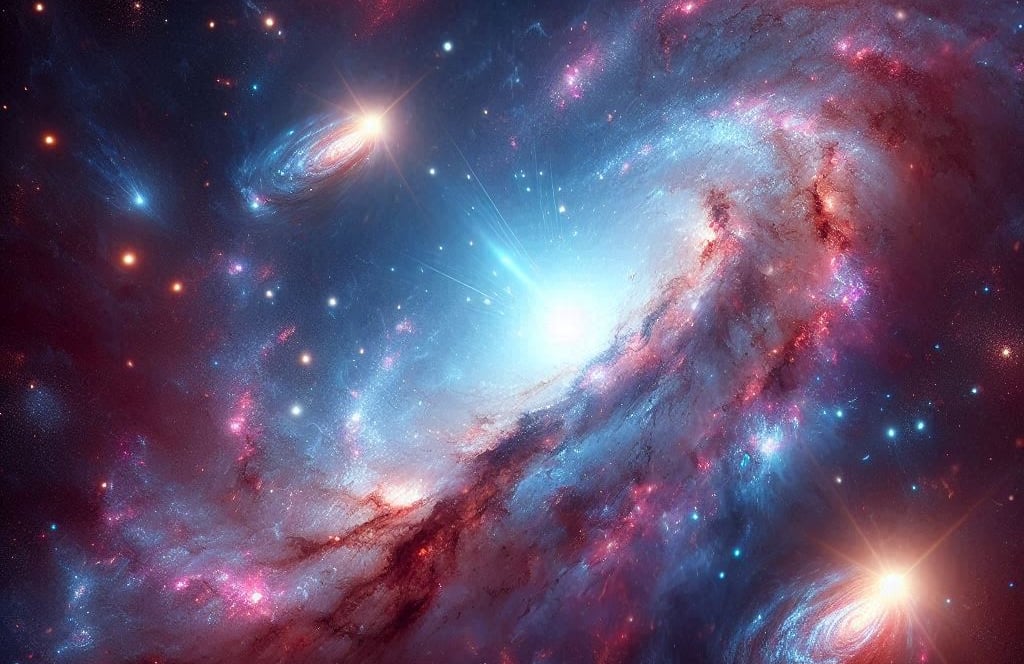
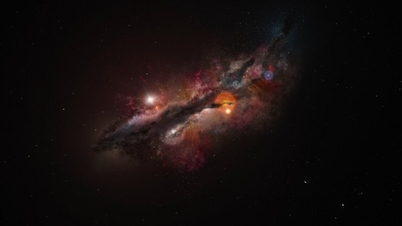
An illustration of a quasar with two small galaxies preparing to merge with its galaxy - Image by AI: ANH THƯ
A quasar is actually a black hole in disguise. It's in the process of devouring matter frantically, so it appears as bright as a star in the sky.
The images of PJ308-21 captured by the world's most powerful space telescope, the James Webb, are not of the present day, because light needs a delay equivalent to the distance to travel to Earth.
In this case, James Webb was able to see billions of years into the future, thus capturing an intact image of this object billions of years ago, in the state and location it once existed in.
In the moment captured by the telescope regarding PJ308-21, this quasar was continuing to grow thanks to a merger of its host galaxy and two satellite galaxies.
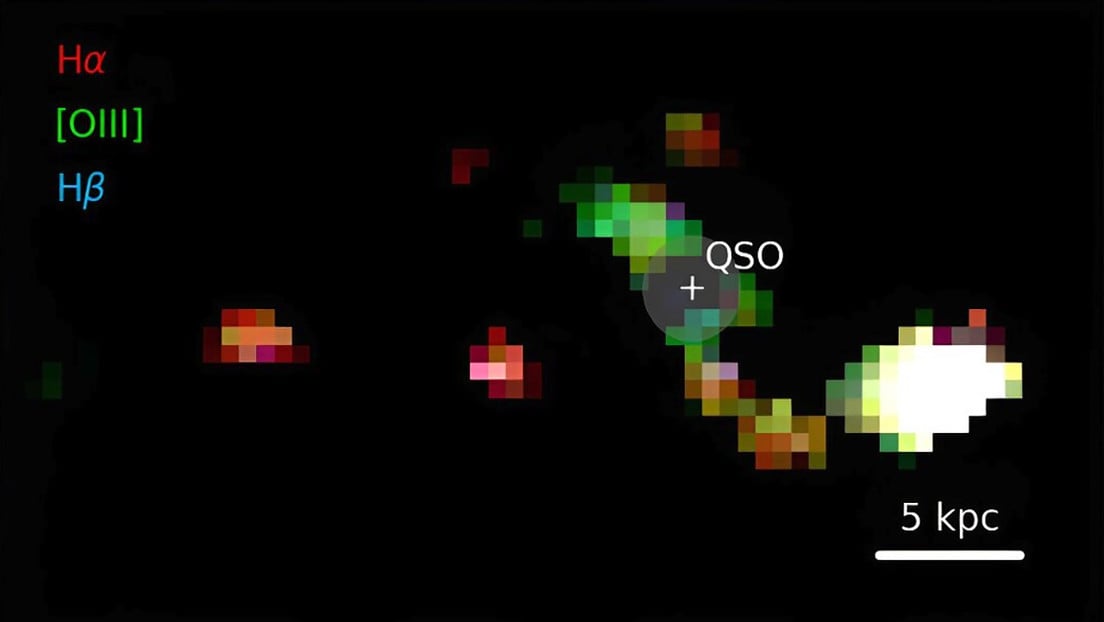
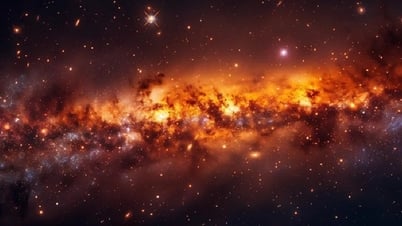
Image of an ancient quasar in the James Webb dataset - Photo: NASA
The merger of the two galaxies likely provided the monstrous black hole—this quasar—with a large amount of gas and dust, creating conditions for the black hole to grow and continue powering PJ308-21.
Even more surprisingly, both the quasar and the two galaxies on their way to merging with the quasar's galactic host were already at a highly evolved stage, something that should have only happened billions of years later, not when the universe was still in its "nascent" stage.
According to Dr. Roberto Decarli from the Italian National Institute of Astrophysics (INAF), the lead author, these objects are still undergoing extremely efficient and chaotic evolution thanks to the rich galactic environment in which they formed.
PJ308-21 is rich in metals, and the surrounding gas and dust are undergoing "photoionization"—a process in which photons provide the energy electrons need to escape from atoms, creating charged ions.
One of the galaxies merging with the main galaxy PJ308-21 is also rich in metals, and its matter is also being partially ionized by electromagnetic radiation from the quasar.
Photoionization is also occurring in the second satellite galaxy, but it is being driven by a rapid burst of star formation.
All of the above observations—as well as other similar evidence of galaxies or black holes far larger than expected in the first few billion years of the universe—are clear evidence that humanity may have to rewrite the history of the cosmic dawn.
It may not have been a primitive world as we've long believed – a place where objects may have once evolved far more rapidly than they do today. And the universe may not have expanded in steady increments, but rather in a undulating and complex manner, much like how life on Earth evolved.
Source: https://nld.com.vn/quai-vat-nang-gap-2-ti-mat-troi-hien-ve-tu-noi-vu-tru-bat-dau-196240715083730999.htm





















































































Comment (0)