

Ambitious target will challenge medical team
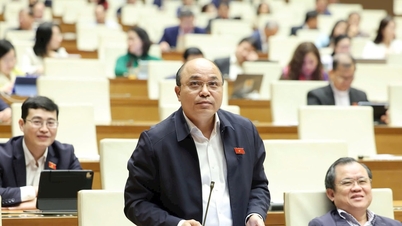
National Assembly Deputy Tran Thi Nhi Ha ( Hanoi ) highly appreciated the contents of the Program, especially the focus on bringing projects and solutions to develop grassroots healthcare, prioritizing disadvantaged areas, promoting digital transformation and managing people's health according to the life cycle.
However, the delegate also pointed out that many of the program's targets are set at a very high level in the context of Vietnam's healthcare system facing a series of challenges such as: rapid population aging; low birth rate and gender imbalance at birth are still worrying...
Therefore, the delegate suggested that the Drafting Committee should continue to improve so that the numbers stated in the Resolution truly become orders for action, ensuring feasibility and achieving substantial results when implemented.
In the target group related to primary health care, the Program sets the requirement that “90% of communes, wards, and special zones meet the National Criteria for Commune Health by 2030 and 95% by 2035”. Delegates said that this is a very high standard compared to countries with similar income levels. Meanwhile, the National Criteria for Commune Health of Vietnam issued by the Ministry of Health also approaches the issue of commune health criteria more broadly, not only regulating the conditions for health stations.
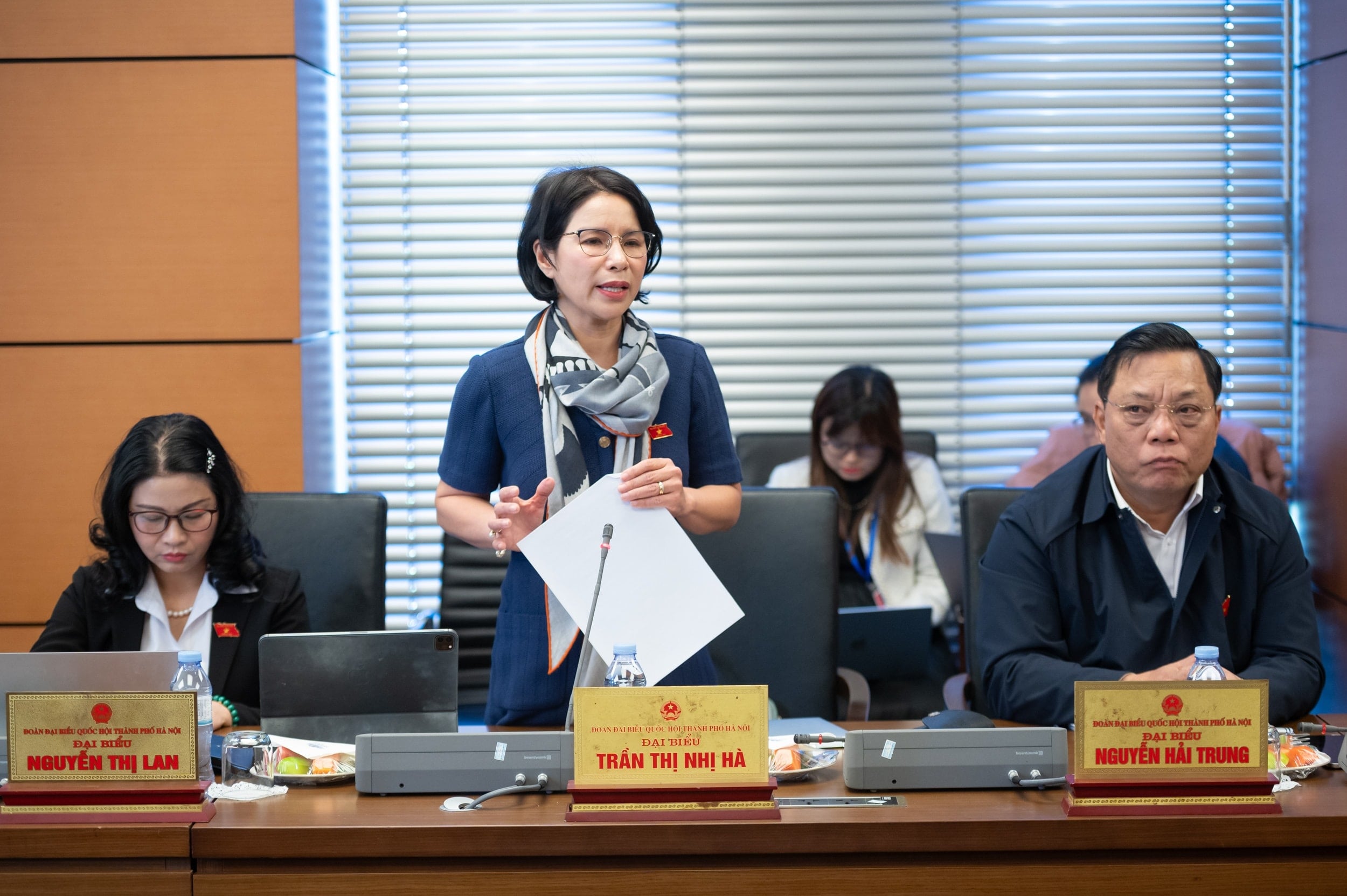
On the other hand, currently, many provinces and cities with large local budget sources have completed this target, even Hanoi and Ho Chi Minh City have reached over 95%, while many localities are only at 70 - 80%. Therefore, delegate Tran Thi Nhi Ha suggested that the National Criteria for Commune Health should be changed to suit the new model of commune health stations and that the Health Station must be a public service unit.
The draft resolution also sets a target that by 2030, 100% of commune and ward health stations will fully implement prevention, management and treatment of a number of non-communicable diseases according to standard procedures. Delegates analyzed that the World Health Organization considers this the most important capacity of the grassroots health system. The target set in the draft is also very high, exceeding the average of the region and countries with similar incomes.
According to the delegate, successful implementation requires systematic investment, policies to ensure human resources at the commune level and especially the synchronous implementation of electronic health records associated with VNeID in all localities. At the same time, the principle of central budget allocation needs to clearly stipulate ensuring a minimum of 60 - 70% of public investment capital for the commune and ward health system; and, build a higher investment priority coefficient (1.3 - 1.5 times) for difficult areas, suitable to the reality of each locality.
The delegate said that the draft Resolution has not yet clearly analyzed the current situation of each field according to each indicator, has not clarified the necessity of each target, has not been compared with international standards and has not fully forecasted the scale of resources. The delegate suggested completing the entire document in the direction of clear quantification and ensuring resource balance from the beginning, avoiding "promulgation and then having to adjust".
Agree on capital allocation plan between programs
During the discussion session in the Group, National Assembly Deputy Ly Thi Lan (Tuyen Quang) emphasized that the decisive factor for the program's success lies in the implementation capacity at the grassroots level, especially at the commune level - where health care, nutrition and population activities are directly implemented.
Therefore, it is necessary to strengthen human resources, professional capacity and operational capacity for primary health care, preventive medicine, preschool education and education in ethnic minority areas, ensuring that investment resources are used effectively.
In particular, it is necessary to focus on commune health stations and commune-level doctors to implement this national target program, ensuring compliance with the spirit of Resolution 72-NQ/TW of the Politburo on a number of breakthrough solutions to strengthen the protection, care and improvement of people's health.

And, to avoid duplication between the three national target programs on health, education, and development of ethnic minority and mountainous areas, which were presented to the National Assembly at this Tenth Session, delegates suggested that the Drafting Committees should coordinate and closely review the content of the draft Resolutions and Projects.
Delegates proposed that the National Target Program on Education should focus on investing in school facilities, information technology, boarding kitchens and improving the quality of teachers. The National Target Program on the development of ethnic minority and mountainous areas will focus on essential livelihoods such as transportation, clean water, and boarding facilities. The National Target Program on Health will focus on preventive medicine, improving grassroots health capacity and developing health human resources.
Sharing the same view, National Assembly Deputy Pham Thuy Chinh (Tuyen Quang) noted that the special mechanism for managing the program's operating expenses stated in Clause 1, Article 1 of the draft Resolution is not really special, because the State Budget Law has similar provisions.
In addition, according to the delegate, assigning the Government to specify specific mechanisms in Point b, Clause 1, Article 2 is inappropriate, so it should be clearly specified in the Resolution on specific mechanisms, avoiding setting up other mechanisms later.
Regarding the authority to decide on investment, the draft Resolution stipulates that the Minister of Health shall promulgate principles, criteria and norms for budget allocation. Delegate Pham Thuy Chinh said that this provision is not consistent with Article 27 of the State Budget Law, which assigns authority to the Prime Minister and the Minister of Finance.
“If we continue to assign the Ministry of Health, it will create a bottleneck in coordination between ministries. Meanwhile, the Resolution on Education assigns this authority to the Prime Minister.” Therefore, delegates suggested that it is necessary to unify a plan, either assigning it to the Prime Minister or assigning it to the Minister of Finance, to ensure compliance with regulations and consistency between programs.
Source: https://daibieunhandan.vn/quan-tam-dau-tu-tang-nang-luc-cho-y-te-co-so-10398230.html
![[Photo] National Assembly Chairman Tran Thanh Man attends the VinFuture 2025 Award Ceremony](/_next/image?url=https%3A%2F%2Fvphoto.vietnam.vn%2Fthumb%2F1200x675%2Fvietnam%2Fresource%2FIMAGE%2F2025%2F12%2F05%2F1764951162416_2628509768338816493-6995-jpg.webp&w=3840&q=75)

![[Photo] 60th Anniversary of the Founding of the Vietnam Association of Photographic Artists](/_next/image?url=https%3A%2F%2Fvphoto.vietnam.vn%2Fthumb%2F1200x675%2Fvietnam%2Fresource%2FIMAGE%2F2025%2F12%2F05%2F1764935864512_a1-bnd-0841-9740-jpg.webp&w=3840&q=75)




























































































Comment (0)