

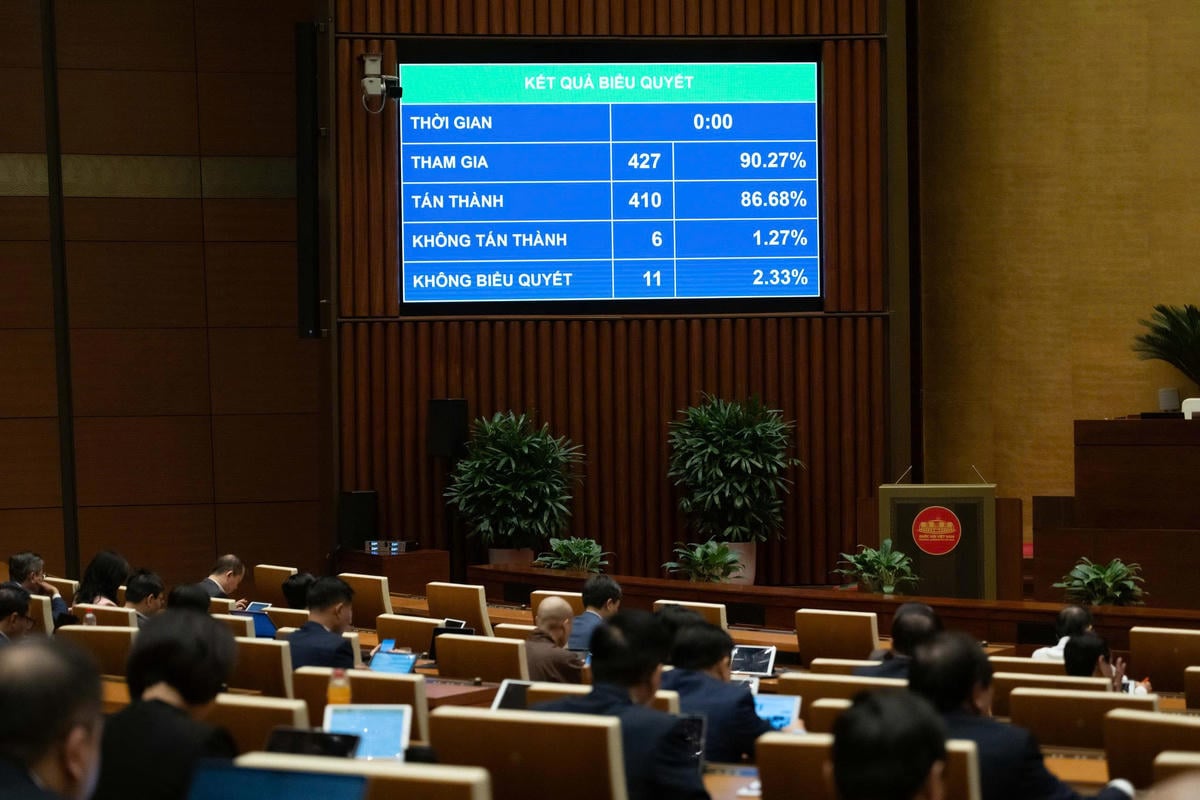
According to the Resolution, Gia Binh Airport is oriented towards being built to international standards, becoming a smart, green, sustainable, new-generation airport of international stature; meeting the needs of socio- economic development, while also serving dual-use operations, ensuring national security and defense, and hosting major diplomatic events, including the APEC 2027 Summit.
The project aims to achieve 5-star service standards, ranking among the top 10 5-star airports in the world according to Skytrax and belonging to the group of airports with excellent passenger experience according to the International Airport Council.
Gia Binh is expected to become the aviation gateway of Northern Vietnam, a transit hub for passengers and cargo, and a center for aircraft maintenance and repair in the Asia-Pacific region. The project is located in the communes of Gia Binh, Luong Tai, Nhan Thang, and Lam Thao in Bac Ninh province.
The projected operating capacity for the period up to 2030 is 30 million passengers and 1.6 million tons of cargo per year; increasing to 50 million passengers and 2.5 million tons of cargo per year by 2050.
The project requires approximately 1,884.93 hectares of land, of which 922.25 hectares are rice fields with two or more harvests per year; land acquisition will be carried out in one go according to the plan and land use conversion will be done in accordance with legal regulations.
The National Assembly agreed on a total investment capital of approximately VND 196,378 billion for the project, in which the investor must ensure that their equity capital is not less than 15% of the total investment.

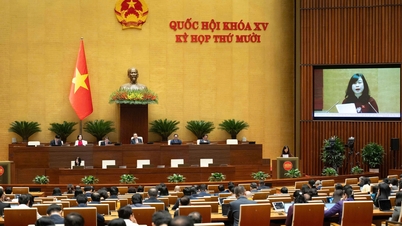
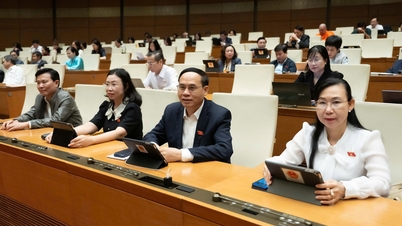
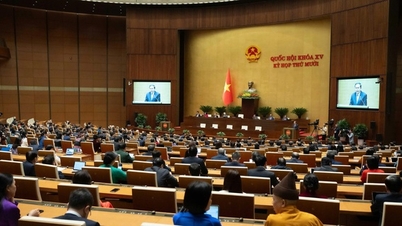
Before proceeding to the vote, the National Assembly heard Minister of Construction Tran Hong Minh, authorized by the Prime Minister, present the report explaining, accepting, and revising the draft Resolution of the National Assembly on the investment policy for the Gia Binh International Airport construction project.
Reporting to the National Assembly, Minister of Construction Tran Hong Minh stated that during the process of developing the national planning for the five transportation sectors, the Ministry of Construction directed the calculation of transportation demand across all modes of transport in general, and air transport demand in the northern region, especially the relationship between Gia Binh International Airport and Noi Bai International Airport, to ensure efficient operation between these two airports.
Regarding the project's progress, according to a report from the Bac Ninh Provincial People's Committee, with approximately 922 hectares of agricultural land, the province aims to complete land clearance by December 2025. The remaining areas are expected to be completed in 2026. To date, Bac Ninh province has handed over nearly 700 hectares to the investor for construction.
Regarding resettlement, Bac Ninh province has planned two resettlement areas with a total area of 337 hectares, and two cemetery park areas. Currently, Bac Ninh province is closely coordinating with investors to implement the construction of infrastructure for the resettlement areas, expected to be completed in the first quarter of 2026. Public works and religious buildings are expected to be completed by the end of 2026.
Regarding the project's progress, the investor is currently carrying out construction work for APEC 2027, such as runways, taxiways, aircraft parking areas, VIP terminals, and air traffic control towers.
Last November, the National Assembly delegation conducted a site survey at the project and noted that the investor had mobilized a large amount of machinery, equipment, and manpower to carry out earthworks, soil stabilization, and construction.
Regarding creating livelihoods for the local people, according to the project documents, the construction phase will require approximately 1,200 to 1,500 workers, the majority of whom will be local laborers. Simultaneously, once operational, it is expected to create around 10,000 jobs, employing at least 30% local workers. Currently, the investor is coordinating with the local authorities to organize career guidance and training to meet the workforce's needs.
Source: https://daidoanket.vn/quoc-hoi-thong-qua-chu-truong-dau-tu-cang-hang-khong-quoc-te-gia-binh.html


![[Photo] Closing Ceremony of the 10th Session of the 15th National Assembly](/_next/image?url=https%3A%2F%2Fvphoto.vietnam.vn%2Fthumb%2F1200x675%2Fvietnam%2Fresource%2FIMAGE%2F2025%2F12%2F11%2F1765448959967_image-1437-jpg.webp&w=3840&q=75)


































![[OFFICIAL] MISA GROUP ANNOUNCES ITS PIONEERING BRAND POSITIONING IN BUILDING AGENTIC AI FOR BUSINESSES, HOUSEHOLDS, AND THE GOVERNMENT](https://vphoto.vietnam.vn/thumb/402x226/vietnam/resource/IMAGE/2025/12/11/1765444754256_agentic-ai_postfb-scaled.png)



































Comment (0)