

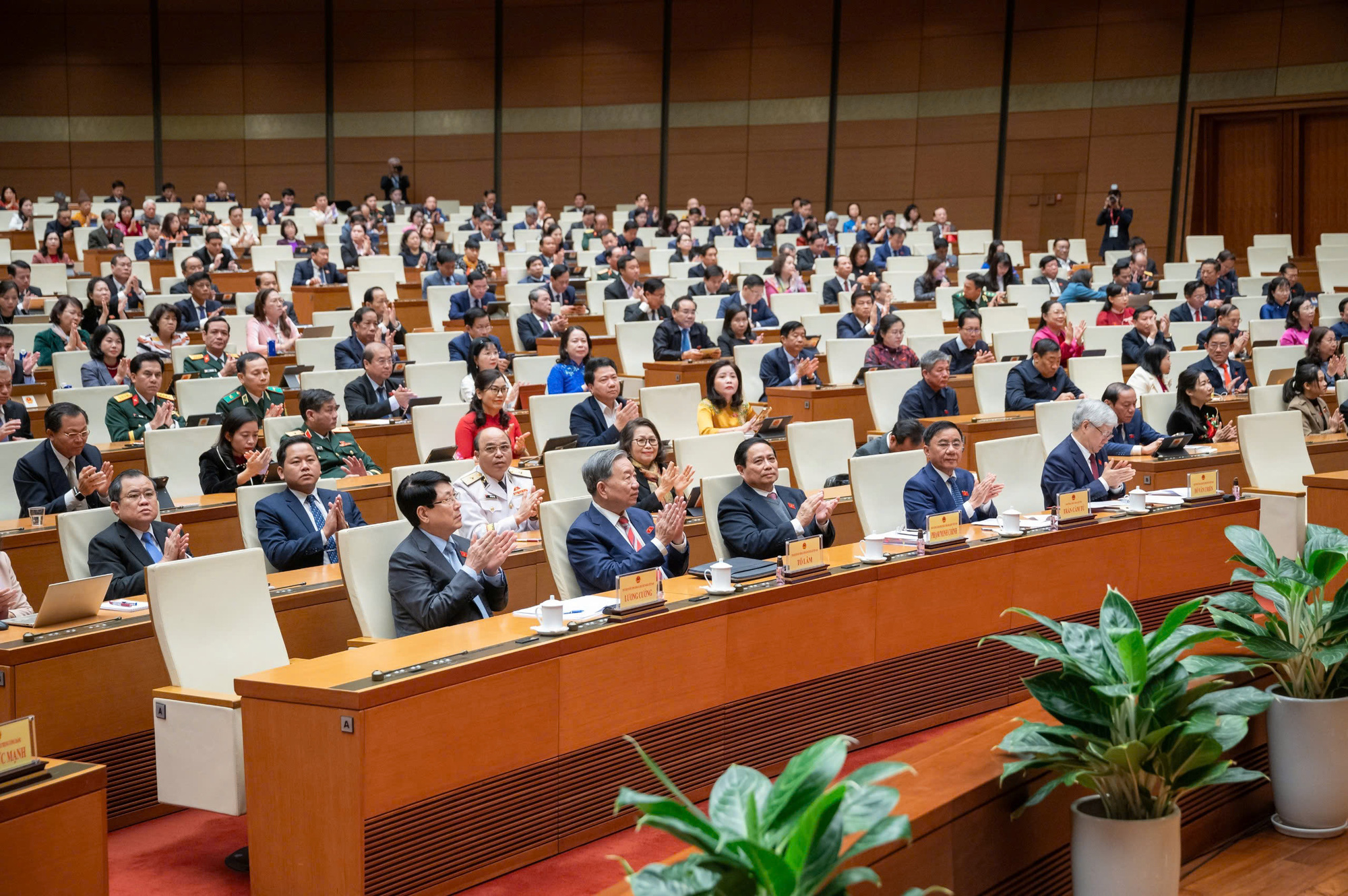
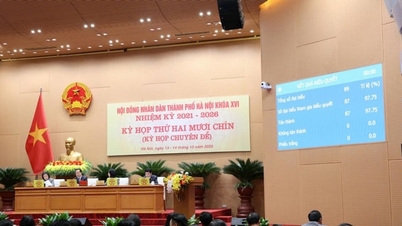
Delegates attending the morning session on February 19 - Photo: GIA HAN
On the morning of February 19th, with 455 out of 459 participating delegates voting in favor, 3 delegates voting against, and 1 delegate abstaining, the National Assembly passed a resolution on the investment policy for the construction project of the Lao Cai - Hanoi - Hai Phong railway line.
The goal is to complete the project by 2030 at the latest.
According to the resolution passed, the project starts at the railway junction across the border (Lao Cai province) and ends at Lach Huyen station ( Hai Phong ).
The main route is approximately 390.9km long; the branch routes are approximately 27.9km long; it passes through the territory of 9 provinces and centrally-governed cities including Lao Cai, Yen Bai , Phu Tho, Vinh Phuc, Hanoi, Bac Ninh, Hung Yen, Hai Duong and Hai Phong.
The new investment covers the entire single-track line, with a gauge of 1,435mm; for both passenger and freight transport.
The design speed is 160 km/h for the main line section from the new Lao Cai station to the Nam Hai Phong station.
The design speed is 120 km/h for the section passing through the Hanoi transportation hub, and 80 km/h for the remaining sections.
The investment method is public investment. The preliminary total land requirement is approximately 2,632 hectares, including about 716 hectares of rice paddy land (of which about 709 hectares are paddy land with two or more crops per year), about 878 hectares of forest land, and about 1,038 hectares of other land types as stipulated by land law.
Preliminary figures indicate approximately 19,136 people will be relocated. The preliminary total investment for the project is 203,231 billion VND (over 8 billion USD).
Funding comes from the state budget allocated in medium-term public investment plans and other legitimate sources.
The implementation schedule outlined in the resolution is to prepare a feasibility study report starting in 2025, with the goal of completing the project no later than 2030.
No provisions for exemption or mitigation of liability.
Earlier, presenting the report on the acceptance, revision, and explanation of the Standing Committee of the National Assembly, Secretary General and Head of the National Assembly Office Le Quang Tung stated that many opinions disagreed with the provisions in the draft resolution on exempting or mitigating the responsibility of heads of agencies and units when negative impacts, group interests, and waste occur.
This would violate legal principles and regulations, and create inconsistencies and unfairness for officials and civil servants undertaking similar projects. Some opinions support the government's proposal, but suggest that specific cases for its application need to be defined.
Mr. Tung stated that the Standing Committee of the National Assembly agrees with many opinions of National Assembly deputies.
In cases where such regulations are needed to protect officials and civil servants who dare to think and act, the Government is requested to conduct thorough research to develop regulations with general applicability and report to the competent authority before submitting them to the National Assembly for consideration and decision.
Therefore, please do not include this provision in the draft resolution.
Regarding the preliminary total investment and funding sources, Mr. Tung suggested clarifying the project's investment cost and comparing it with the Vientiane - Boten railway line.
The Standing Committee of the National Assembly stated that, according to the Government's report, the preliminary total investment amount was calculated in accordance with the provisions of the law on construction.
The currently published investment costs of various countries are calculated for construction and equipment, excluding land acquisition costs, compensation, support, resettlement, and other specific costs (such as the Tan Vu - Lach Huyen bridge cost, the cost of upgrading the 1,000mm gauge railway in the Lao Cai station area, and the cost of the 1,000mm gauge railway section through the Hanoi railway hub).
Compared to the investment cost of the 418km Vientiane-Boten railway line, which cost $5.96 billion, the equivalent investment cost is $16.77 million per kilometer.
The Lao Cai - Hanoi - Hai Phong railway line has an investment cost of approximately US$15.96 million per kilometer, comparable to the investment cost of some reference projects in the region.
Furthermore, comparing investment costs between projects is only for reference purposes, as it depends on many factors such as implementation time, technology, topographical, geological, and hydrological conditions, technical standards, applied technology, and localization capabilities.
Tuoitre.vn
![[Photo] Prime Minister Pham Minh Chinh attends the Conference summarizing and implementing tasks of the judicial sector.](/_next/image?url=https%3A%2F%2Fvphoto.vietnam.vn%2Fthumb%2F1200x675%2Fvietnam%2Fresource%2FIMAGE%2F2025%2F12%2F13%2F1765616082148_dsc-5565-jpg.webp&w=3840&q=75)

























































































Comment (0)