

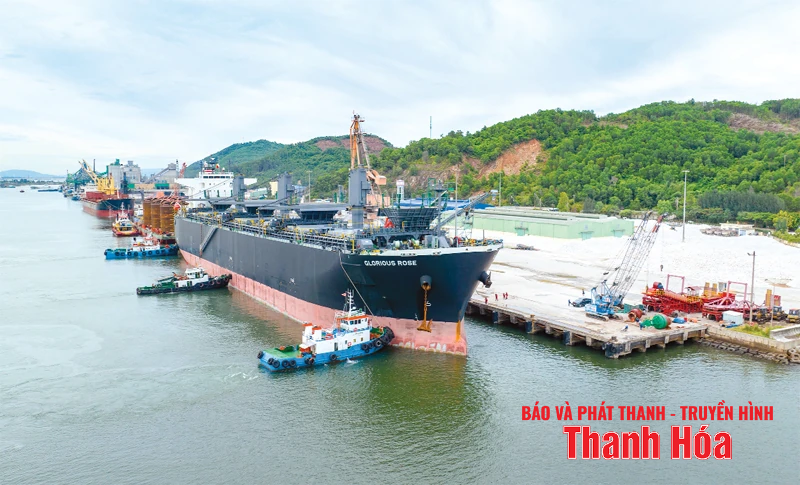
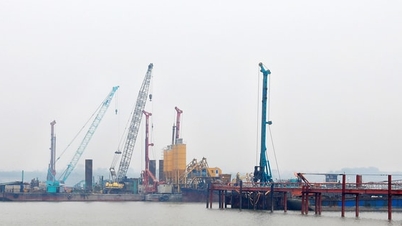
The ship docked at Nghi Son Port to load and unload cargo.
Positive signs...
The Thanh Hoa seaport system currently has 28 fixed berths with a total length of 5,343m (including 15 general-purpose berths with a length of 3,341m), an increase of nearly six times in number and five times in length compared to 2010. In recent years, the Thanh Hoa seaport system has received significant investment towards synchronization and modernization, making an important contribution to promoting the province's economic development.
Based on the approved plan, new port facilities (including berth lines and pre-berth water areas) have been invested in and constructed, and maritime infrastructure is gradually being completed. The road transport system connecting to Thanh Hoa seaport is relatively good, basically meeting the requirements for transporting goods to and from the port. Currently, Thanh Hoa seaport has the capacity to receive the largest vessels with a tonnage of 320,000 tons at the SPM buoy berth; and general cargo and bulk carriers with a tonnage of up to 70,000 tons (reduced load) at the berths. It has initially attracted container shipping routes to and from the Nam Nghi Son port area.
Along with investing in and improving infrastructure, the People's Committee of Thanh Hoa province has implemented many policies to attract investors to operate the port; especially policies to attract foreign shipping companies to the port for container handling. These policies are the driving force to continue focusing on mobilizing resources to complete the infrastructure of the Nghi Son seaport system, implementing solutions to increase the quantity and volume of import and export goods through the port, increasing budget revenue for the province, and creating jobs for many local workers.
After much effort and hard work, Thanh Hoa province has recorded a volume of goods passing through its seaport system that far exceeds the forecast in the detailed planning of the North Central seaport group up to 2020, with orientation to 2030. In 2024, the volume of goods passing through Thanh Hoa seaports reached 56.27 million tons; of which dry and bulk cargo reached 36.31 million tons (accounting for 64.5%), liquid cargo reached 19.7 million tons (accounting for 35%), and container cargo reached 0.27 million tons (21,061 TEU). Of this, the proportion of goods passing through Nghi Son Port accounts for approximately 50% of the total volume of goods passing through Seaport Group No. 2 (equal to the combined volume of Nghe An and Ha Tinh seaports). The average growth rate of goods during the 2020-2024 period reached 12.7%.
Despite the achievements, the exploitation of the potential and advantages of Thanh Hoa's seaport system still faces limitations and difficulties. Some projects lack synchronization between the investment schedule in the planning and the actual construction time of the port terminals. Regarding maritime transport connectivity, the standardization of shipping channels does not meet actual needs. Limitations in the availability of stable, long-term dredged material storage locations affect the progress of dredging and maintenance of maritime channels and the waters in front of the docks, reducing port operational efficiency. The North Nghi Son area has not yet established a public channel; the implementation of the socialized dredging project for the Le Mon channel still faces difficulties and obstacles. The port terminals in Thanh Hoa's seaports are mainly connected to inland waterway transport routes through coastal transport routes, with limited connection to inland waterway routes via rivers...
Currently, there is only one pilot boarding and disembarking area (in the southern Nghi Son area) serving both the southern and northern Nghi Son port areas. Therefore, boarding and disembarking ships entering the northern Nghi Son area is relatively difficult due to the long travel distance. Thanh Hoa has not yet developed logistics centers or large-scale inland ports that could serve as multimodal cargo transshipment hubs to support the seaports...
Getting closer to the goal of becoming a strong province in terms of marine economy.
Recently, the Ministry of Construction approved the detailed plan for the development of land and water areas of Thanh Hoa seaport for the period 2021-2030, with a vision to 2050. With many important contents, the plan creates a foundation and basis for attracting investment, comprehensively developing seaport infrastructure in Thanh Hoa, promoting maritime trade, and acting as a lever for socio-economic growth in the province and the region.
According to the planning document, Thanh Hoa seaport includes the following wharf areas: South Nghi Son; North Nghi Son; Hon Me Island; Quang Nham - Hai Chau port; Lach Sung port; Le Mon and Quang Chau ports; buoy wharfs, transshipment areas, and areas for anchorage, shelter, and storm refuge.
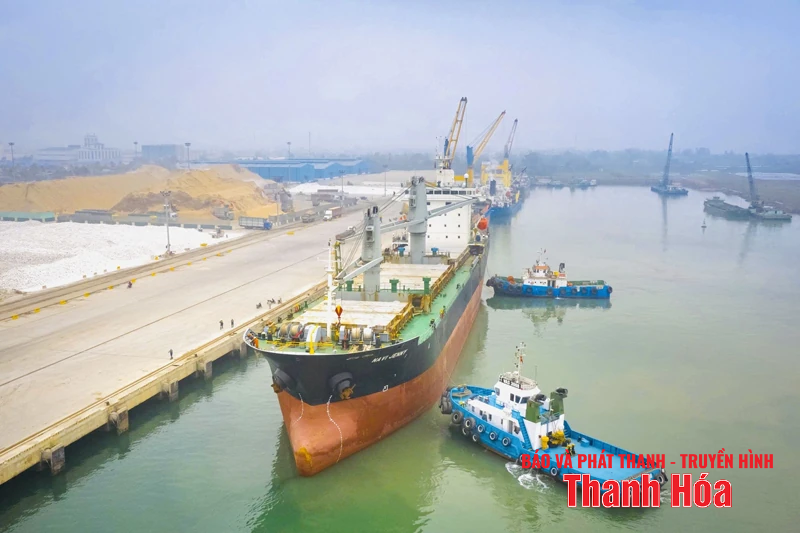
Nghi Son seaport.
By 2030, the target for cargo throughput at Thanh Hoa seaports is between 71.65 million and 86.15 million tons (including container cargo from 0.07 million TEU to 0.2 million TEU, excluding cargo from expansion/new construction projects of the integrated iron and steel production complex). Regarding infrastructure, Thanh Hoa will have a total of 20 to 24 berths, comprising 57 to 65 piers with a total length of 11,386m to 13,526m (excluding other berths). The vision for 2050 projects an average annual growth rate of approximately 3.6% to 4.5% for cargo throughput at Thanh Hoa seaports.
The total land use requirement according to the plan until 2030 is approximately 387.5 hectares (excluding areas for the development of industrial parks, logistics facilities, etc., associated with the port). The total water surface area requirement according to the plan until 2030 is approximately 99,042.9 hectares (including other water areas within the management scope where no maritime structures are located). The investment capital requirement for the period until 2030 is approximately VND 21,906 billion, including approximately VND 4,511 billion for public maritime infrastructure and approximately VND 17,395 billion for port facilities (only including ports providing cargo handling services).
The focus of investment will be on port facilities in the South Nghi Son and North Nghi Son areas; infrastructure serving maritime safety such as: anchorage areas, storm shelters, maritime traffic monitoring and coordination systems; service berths, and facilities serving specialized state management tasks. Along with this, the South Nghi Son channel will be upgraded to accommodate vessels up to 50,000 tons or larger (including a turning area), and a two-way channel will be studied when conditions permit; a public maritime channel in North Nghi Son will also be developed for vessels of 50,000 tons or larger when conditions permit.
To achieve the stated goals, the plan focuses on six groups of solutions, including: mechanisms and policies; investment capital mobilization; environment, science and technology; human resource development; international cooperation; and implementation and monitoring of the plan. Among these, solutions regarding mechanisms and policies; investment capital mobilization are the "key" to unlocking potential, while solutions concerning the environment, science and technology; human resource development; international cooperation; and implementation and monitoring of the plan create a deeper qualitative shift.
The detailed development plan for the land and water areas of Thanh Hoa's seaport for the period 2021-2030, with a vision to 2050, opens up opportunities and maximizes the potential and advantages of the seaport, thereby increasing marine economic resources, creating breakthroughs to promote socio-economic development, and gradually moving closer to the goal of becoming a strong province in the marine economy, a new growth pole in the North of the country.
Text and photos: Nguyen Thanh
Source: https://baothanhhoa.vn/quy-hoach-cang-bien-thanh-hoa-don-bay-cho-su-phat-trien-ben-vung-255473.htm


![[Photo] Prime Minister Pham Minh Chinh attends the Conference summarizing and implementing tasks of the judicial sector.](/_next/image?url=https%3A%2F%2Fvphoto.vietnam.vn%2Fthumb%2F1200x675%2Fvietnam%2Fresource%2FIMAGE%2F2025%2F12%2F13%2F1765616082148_dsc-5565-jpg.webp&w=3840&q=75)

















































































Comment (0)