


On the morning of June 4, Minister of Natural Resources and Environment Dang Quoc Khanh answered questions before the National Assembly about issues of concern to delegates.
On the morning of June 4, Minister of Natural Resources and Environment Dang Quoc Khanh answered questions before the National Assembly about issues of concern to delegates.
Concerns about the deterioration of water storage facilities
Expressing concern about the deterioration of water exploitation and utilization facilities, delegate Doan Thi Hao ( Thai Nguyen delegation) cited the following information: Currently, there are approximately 40,200 water exploitation and utilization facilities nationwide, including 6,750 irrigation reservoirs with many small lakes and dams, most of which were built in the 1970s and 1980s under conditions of limited funding, technical expertise, unsuitable design and construction quality, lack of documentation, and insufficient maintenance funds… The delegate requested the Minister to explain what solutions the Minister and the sector will implement in the future to address this situation.

Delegate Doan Thi Hao (Thai Nguyen delegation).
Responding to questions from delegates, Minister Dang Quoc Khanh stated that repairing, upgrading, and renovating over 1,100 degraded reservoirs lacking flood discharge capacity requires significant resources. According to the head of the Ministry of Natural Resources and Environment, the Water Resources Law, recently passed by the National Assembly, focuses on assigning the Ministry of Agriculture and Rural Development, the Ministry of Natural Resources and Environment, and the Ministry of Industry and Trade to coordinate in regulating and distributing water resources; and to develop water resource scenarios to ensure water security. Going forward, the ministries will propose and report to the Prime Minister to review the current status of reservoirs and dams to ensure both water storage for production and safety.
Emphasizing that investing in water storage facilities is one of the priority solutions in the 2023 Water Resources Law, Representative Quàng Thị Nguyệt (from Điện Biên province) requested the Minister to explain how policies aimed at attracting investment in the construction of water storage facilities will be implemented in the future to ensure proactive water storage, regulation, and distribution, meeting the water usage requirements for people's lives and socio-economic development.

Delegate Quang Thi Nguyen (Dien Bien delegation) questioned at the working session on the morning of June 4.
In response to questions, Minister Dang Quoc Khanh stated that in recent times, we have paid great attention to the construction of irrigation reservoirs and the implementation of hydropower projects. To date, the Ministry continues to focus on and review areas that need additional reservoirs or have the necessary conditions for the construction of dams and irrigation canal systems.
"Water storage must be associated with the effective use of water resources through irrigation systems," the Minister emphasized.
Responding to a question from delegate Luu Ba Mac (Lang Son delegation) regarding the maintenance of minimum flow rates for hydropower plants, the Minister stated that currently, all hydropower plants must comply with regulations on maintaining minimum flow rates to sustain the lives of the people, especially those in mountainous areas.

Minister of Natural Resources and Environment answered questions from delegates during the working session on the morning of June 4.
The Ministry of Natural Resources and Environment has also made many efforts to require hydropower plants to install monitoring and surveillance systems that connect to the Ministry for monitoring, supervision, and management. Currently, more than 850 hydropower reservoirs are connected to the Ministry, and when there is a failure to maintain the minimum flow rate, the Ministry will directly inspect and handle the situation according to regulations.
In the coming period, the Ministry of Natural Resources and Environment will strengthen inspection and supervision, and at the same time require localities to connect hydropower reservoirs with provincial and ministerial levels to jointly monitor and ensure the maintenance of minimum flow, without affecting the lives of the people.
Responding to concerns from delegates, Minister of Agriculture and Rural Development Le Minh Hoan stated: Currently, the Ministry of Agriculture and Rural Development directly manages 5 large reservoirs and 25 other reservoirs that have been decentralized to local authorities. All of these structures are in a safe condition.
Regarding the approximately 900 other reservoirs directly managed by local authorities, the Ministry will continue to submit proposals to the Prime Minister for review in order to gain a comprehensive overview. The Minister also suggested that local authorities should proactively promote a multi-purpose, multi-livelihood approach, creating revenue streams to supplement the maintenance and repair costs of reservoirs and dams based on the development of tourism and specific economic activities.
Early solutions are needed to ensure water security.
Regarding questions related to water security, Minister of Natural Resources and Environment Dang Quoc Khanh affirmed: Currently, climate change is having a strong impact on Vietnam. Therefore, Vietnam needs to have solutions in place early to ensure water security.
According to the Minister, currently, 60% of Vietnam's water resources depend on foreign sources, and only 40% are domestically sourced. Therefore, ensuring water security must first and foremost guarantee domestically sourced water, based on continued protection and development of forests while using water in the most efficient way possible.
“80% of the water is currently used for agriculture through flood irrigation… But the amount of water we are able to utilize in this activity is only about 10%. This also needs to be gradually addressed,” Minister Dang Quoc Khanh said.
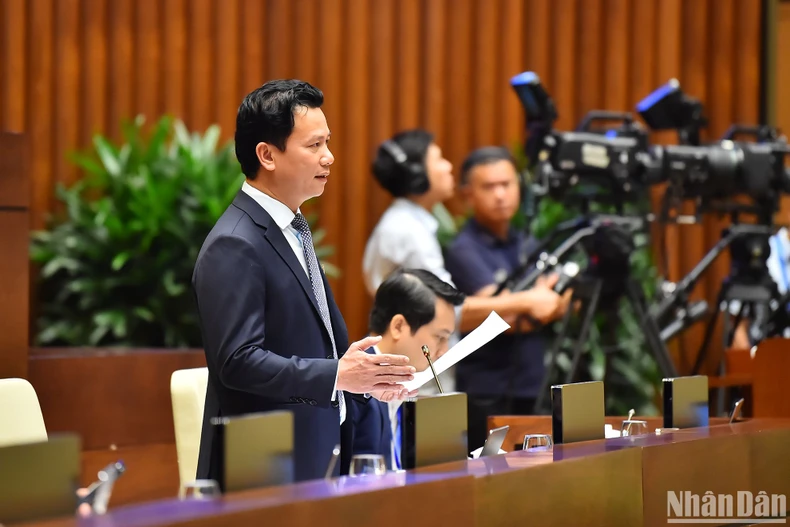
Minister of Natural Resources and Environment Dang Quoc Khanh.
The Minister added that, in addition to existing water resource and river basin plans, the Ministry of Natural Resources and Environment is continuing to advise the Government to approve five more related plans. This also serves as a basis for establishing a link of responsibility between localities to ensure that water resources are used most effectively.
On a macro level, the Minister said he will continue to coordinate with countries in the region to regulate and ensure national water security.
Regarding the recent localized freshwater shortage due to saltwater intrusion in the Mekong Delta, the Minister stated that, first and foremost, it is necessary to continue raising awareness and encouraging people to proactively store and use water sparingly.
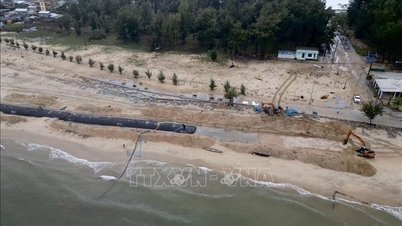
Responding to delegates' concerns about landslides in the Mekong Delta, the Minister of Natural Resources and Environment outlined four main causes. Firstly, the region's sedimentary geological foundation is formed with relatively young sedimentary layers compared to other deltas. Observations indicate that the region is still subject to natural subsidence.
"We also measured the subsidence funnels, many of which sank up to 10cm, all due to the very young geological foundation," said the Minister.
Other contributing factors include: a significant decrease in sediment; encroachment on riverbanks for construction and aquaculture; and especially sand mining. Many localities report that people are using dredgers to extract sand, leading to increased subsidence.
In the near future, the Ministry of Natural Resources and Environment will conduct a comprehensive assessment of which areas are permitted for sand mining, relocate residents in areas at risk of landslides, and address encroachment on rivers and riverbanks.
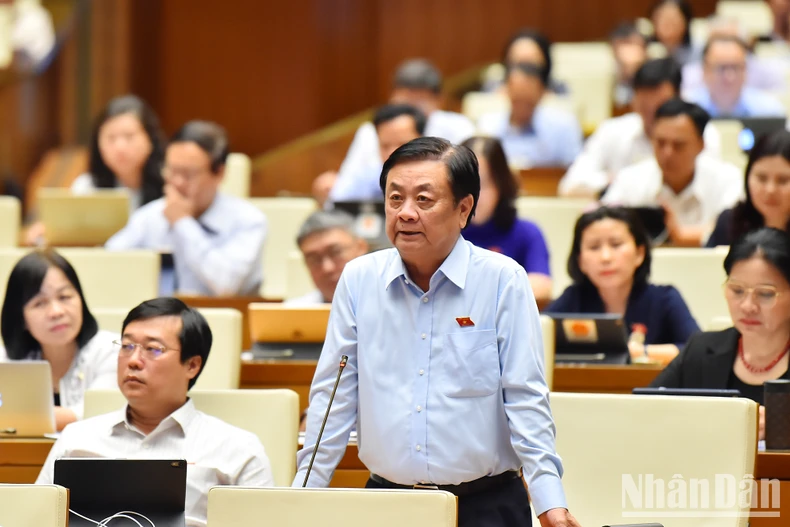
Minister of Agriculture and Rural Development Le Minh Hoan answered questions at the working session on the morning of June 4.
Meanwhile, the Minister of Agriculture and Rural Development stated that landslides are occurring, significantly impacting the lives of the people. According to the Minister, the Prime Minister recently conducted an inspection and instructed the Ministry of Agriculture and Rural Development to submit a comprehensive plan on this issue. The plan is expected to be submitted by September, offering a more holistic and strategic approach to drought and saltwater intrusion.
Citing global assessments that "we are in an era of global drought," Minister Le Minh Hoan stated that we need to approach the issue of water conservation from three perspectives: the quantity of water, the quality of water, and the way water resources are used. Of these, the way water is used impacts both the quantity and quality of water.
“By now, we need to send a message to farmers in the Mekong Delta and the whole country that: We are not a country with a surplus of water, but rather water will become increasingly scarce. From there, we need short-term and long-term approaches through a comprehensive agricultural strategy to transform agriculture, from flood irrigation to drip irrigation,” Minister Le Minh Hoan said.
Regarding immediate solutions to mitigate saltwater intrusion and conserve freshwater, Minister Le Minh Hoan stated that the Ministry will propose to the Government to prioritize investment in the Mekong Delta, especially projects with wide coverage that benefit many people.
Source





















![[Photo] Prime Minister Pham Minh Chinh holds a phone call with the CEO of Russia's Rosatom Corporation.](/_next/image?url=https%3A%2F%2Fvphoto.vietnam.vn%2Fthumb%2F1200x675%2Fvietnam%2Fresource%2FIMAGE%2F2025%2F12%2F11%2F1765464552365_dsc-5295-jpg.webp&w=3840&q=75)













































Comment (0)