

In all high-income developed countries around the world , domestic private enterprises play the most important role in creating wealth for society as a whole and jobs for the people.
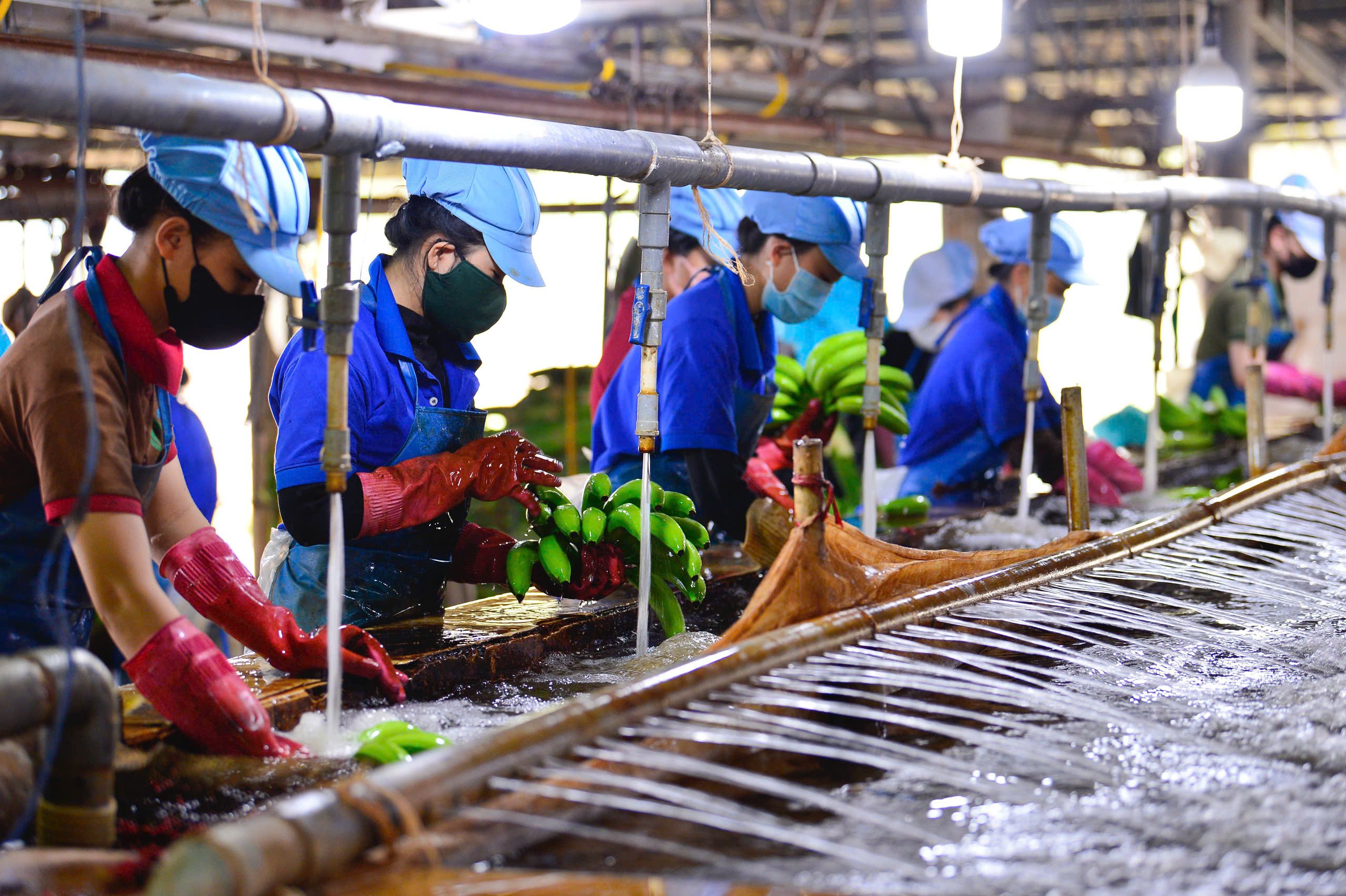
Processing bananas in Long An province for export - Photo: QUANG DINH
For Vietnam to achieve its goal of becoming a high-income country by 2045, further promoting the role of domestic private enterprises is essential.
Based on the most recent and complete data (2022), among the three types of businesses, private enterprises (officially classified as non-state enterprises) play the most important role in all three criteria: job creation, contribution to the state budget, and GDP generation. However, the informal sector remains the largest and needs to be reduced.
In terms of job creation, businesses nationwide created 15.2 million jobs, accounting for nearly 30% of the total jobs in the country. Of these, private enterprises accounted for 17.9%, FDI enterprises for 10.4%, and state-owned enterprises for 2%.
Regarding contributions to the state budget, revenue from businesses nationwide accounted for 44.2% of total budget revenue according to the 2022 financial statement.
Of that total, 16.9% came from private enterprises, 13.9% from state-owned enterprises, and 13.4% from FDI enterprises.
Regarding GDP, estimates using the income method (GDP = income of workers + profit of business owners + interest paid on the use of capital + land rent and other assets + taxes paid to the State), it is highly likely that private enterprises generate significantly higher GDP than the 20.5% of FDI enterprises and around 10% of state-owned enterprises.
Private enterprises alone account for 18.4% of GDP from employee income + pre-tax profits + corporate VAT, compared to 14.7% for FDI enterprises and 6.4% for state-owned enterprises.
Furthermore, the total fixed asset inventory of private enterprises is significantly higher than that of the other two groups.
Therefore, the contribution to GDP from other sources of private enterprises is unlikely to be lower than 5.8% of the GDP contributed by FDI enterprises.
The significant role of private enterprises is undeniable. However, there are currently at least two problems in the Vietnamese economy that need to be addressed.
Firstly , the position of businesses in general, and private businesses in particular, in the economy is still quite modest, especially in terms of job creation.
Approximately one million businesses create 30% of jobs for society, while over 60% of the workforce remains in the informal sector. This ratio needs to be reversed.
Secondly , Vietnam does not have many large enterprises with global competitiveness. The Fortune 500 list of Southeast Asian countries shows this. We only have 63 enterprises, accounting for 12.6%, which is lower than the proportion of the population.
If measured by market value, Vietnam's scale is even more modest. The reason many domestic private businesses cannot grow is due to informal costs and other conditions, which, as Professor David Dapice has pointed out, are borne most heavily by medium-sized enterprises.
Furthermore, the lack of collaboration and coordination among businesses is another reason why Vietnamese businesses are unable to expand further.
To enhance the position and role of domestic private enterprises, Vietnam can learn from the experiences of other economies, especially in the region.
Taiwan has utilized a model of interconnected small and medium-sized enterprise (SME) supply chains, with the active role played by associations and intermediary organizations.
They knew how to go far together. South Korea developed large private enterprises with proactive state-sponsored industrial programs.
China also has policies that encourage international competition, like the other two and many other economies. The role of the state in creating a level playing field and conditions for domestic businesses to grow is extremely important.
To better promote the role of private enterprises, the first thing to do is to create a level playing field among the three components.
In reality, domestic private enterprises are often at a disadvantage compared to state-owned enterprises and FDI enterprises.
The next step is to encourage domestic businesses to take the lead in key areas and enhance their international competitiveness.
International cooperation, linkages, and competition, along with proactive government policies, are extremely important. Ultimately, the government's role in supporting business development needs to be strengthened, and the creation of obstacles and extortion by businesses should be minimized.
This equality not only demonstrates a proper appreciation of the role of private enterprises but also reflects a healthy, transparent, and fair economy for all.
Source: https://tuoitre.vn/san-choi-binh-dang-cho-doanh-nghiep-tu-nhan-20250301080735477.htm




























































































Comment (0)