

In Ha Tinh province , instead of directly discharging livestock and poultry waste into the environment, in recent years, livestock farmers in Cam Xuyen district have strongly developed techniques for circular waste treatment.
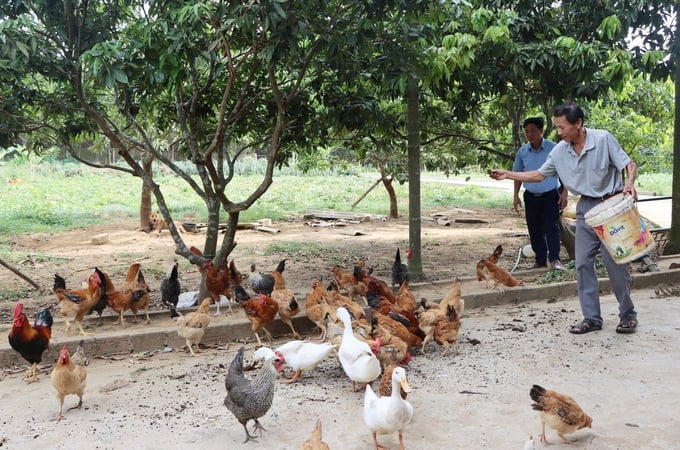
The circular farming model of Mr. Vo Van Thang's family (Hoa Tham village, Cam Lac commune) has both increased economic efficiency and protected the environment. Photo: TN.
Cam Xuyen district is one of the localities with the highest rates of household livestock farming in Ha Tinh province. The strong development of livestock farming has contributed to creating jobs and increasing income for the people, but it has also created pressure on the environment.
Previously, people collected livestock waste directly into cement or earthen pits without lining or covering, causing it to seep into the groundwater over time, leading to water pollution and strong, foul odors. Currently, the majority of people have built biogas pits to collect waste, using microbial preparations to treat the odor and minimize environmental impact.
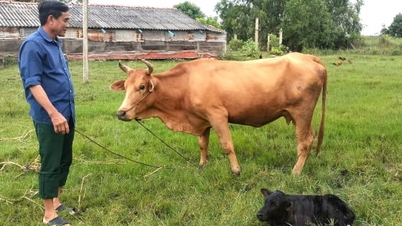
In Cam Lac commune (Cam Xuyen district), at the beginning of 2023, after receiving training from the local government, Mr. Vo Van Thang's family in Hoa Tham village utilized their large hillside garden to build a system of barns for raising 5 sows, 30 cows, and 300 chickens and ducks.
To provide organic feed for his livestock, Mr. Thang planted nearly 1 hectare of peanuts and built a worm farm. This is the first organic pig farming model in partnership with Que Lam Group to be implemented in Cam Lac commune.
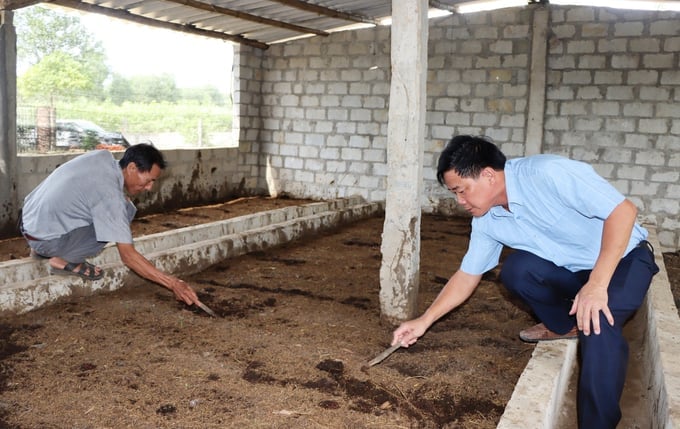
Mr. Thang built a worm farm. Photo: TN.
According to Mr. Thang, pig and cow manure are used as food for earthworms. Earthworms are then used as feed for chickens. The peanut stalks, after harvesting, are dried and stored as feed for cows and pigs. With this method, his family doesn't have to worry about the cost of buying feed because everything is in a closed loop.
"In the first year of implementation, my family's integrated farm model generated over 200 million VND in revenue. Organic and circular agriculture not only helps my family save on production costs and create high-quality, safe products, but also solves the environmental problem," Mr. Vo Van Thang said enthusiastically.
Also pioneering organic farming, the family of Mr. Vo Huu Tung, residing in Hoa Tham village, boldly invested in building a model of rice production combined with fish farming. On his 1.5-hectare plot of land, Mr. Tung both produces organic rice and digs ponds to raise various types of grass carp and common carp around the field.
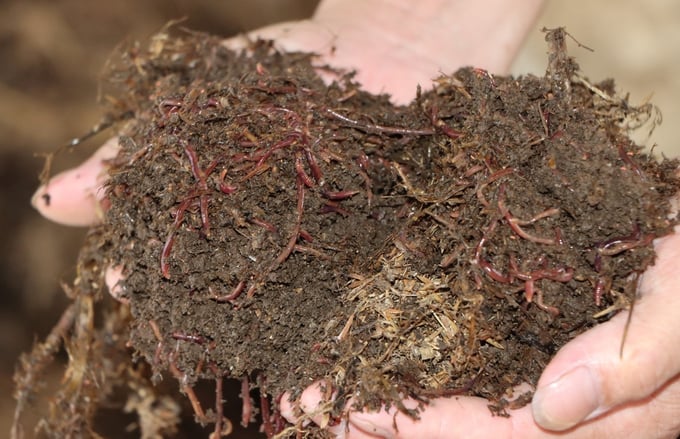
Pig and cow manure are used as food for earthworms, and earthworms are used as food for chickens. Photo: TN.
Mr. Tung said that the integrated fish-rice farming model not only helps his family increase production value per unit area, but the rice is produced organically without any pesticides, ensuring safety and quality for consumers, and the fields are also improved for higher yields in subsequent seasons.
"The selling price of organically grown rice in the recent summer-autumn crop reached about 10,000 VND/kg, so after deducting expenses, my family earned a profit of over 30 million VND, three times higher than traditional production as before," Mr. Tung calculated.
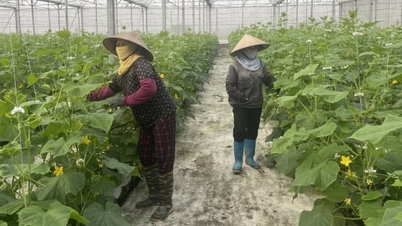
In addition to the above models, Cam Lac commune has also developed other effective models such as: organic rice production using tray seedling techniques and transplanting machines on an area of 3 hectares in Phu Doai village; applying greenhouse gas emission reduction farming processes on an area of 10 hectares in Quang Trung 2 village; and using biological products to treat rice straw on an area of 20 hectares in Quang Trung 1 and Hoa Tham villages.
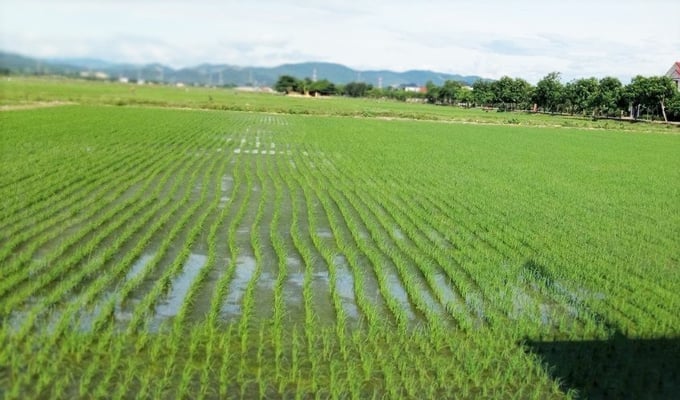
In Cam Xuyen, many models of organic rice production are developing strongly. Photo: TN.
Mr. Nguyen Van Dung, Chairman of the People's Committee of Cam Lac commune, informed that to successfully implement these models, the locality has actively supported people with technical assistance and a portion of production costs. These models are based on improved farming techniques, contributing to soil protection, reducing greenhouse gas emissions, adapting to climate change, protecting public health, improving product quality, and increasing economic efficiency.
"In 2024 and the following years, Cam Lac will continue to encourage people to develop agricultural production in an environmentally friendly direction," Mr. Dung emphasized.
Through policies supporting agricultural development and the construction of new rural areas, the call for businesses to link agricultural production towards organic farming and reduce environmental emissions has developed quite strongly in Cam Xuyen in recent years. Importantly, this initiative has been supported by the people, who have registered to participate, demonstrating a significant change in their awareness towards green agricultural production.
Source: https://nongsanviet.nongnghiep.vn/san-xuat-nong-nghiep-than-thien-moi-truong-len-ngoi-d391161.html


![[Image] Close-up of the newly discovered "sacred road" at My Son Sanctuary](/_next/image?url=https%3A%2F%2Fvphoto.vietnam.vn%2Fthumb%2F1200x675%2Fvietnam%2Fresource%2FIMAGE%2F2025%2F12%2F13%2F1765587881240_ndo_br_ms5-jpg.webp&w=3840&q=75)















![Major policy decisions for agricultural development in Thanh Hoa: [Part 3] The vast forest waters awaken the entire land.](https://vphoto.vietnam.vn/thumb/402x226/vietnam/resource/IMAGE/2025/12/13/1765583676489_z7282526539020_1ee647dc8468da9b9f2428712b435ae7-nongnghiep-184805.jpeg)
















































Comment (0)