Ho Chi Minh City is among the leading cities in the nation's digital transformation.
At the event, Mr. Nguyen Phu Tien, Deputy Director of the National Digital Transformation Department, stated that since 2020, the Ministry of Science and Technology (formerly the Ministry of Information and Communications) has issued and implemented the Digital Transformation Index (DTI) to assess the level of digital transformation at three levels: ministerial, provincial, and national. The DTI is an important tool for monitoring progress, evaluating effectiveness, and guiding policies to promote digital transformation nationwide.

The national-level Digital Transformation Index (DTI) comprises 12 indicators divided into three main pillars: Digital Government (400 points), Digital Economy (300 points), and Digital Society (300 points), with a total score of 1,000. The provincial-level DTI is structured similarly around three pillars: Digital Government, Digital Economy, and Society. Within this structure, the common foundational indicators (digital awareness, digital institutions, digital infrastructure, digital workforce, and cybersecurity) account for the majority, alongside the operational indicators (digital government, digital economy, and digital society). The ministerial-level DTI includes six main indicators and 31 sub-indicators with a total score of 1,000, reflecting the specific characteristics of each ministry and sector in implementing digital transformation.
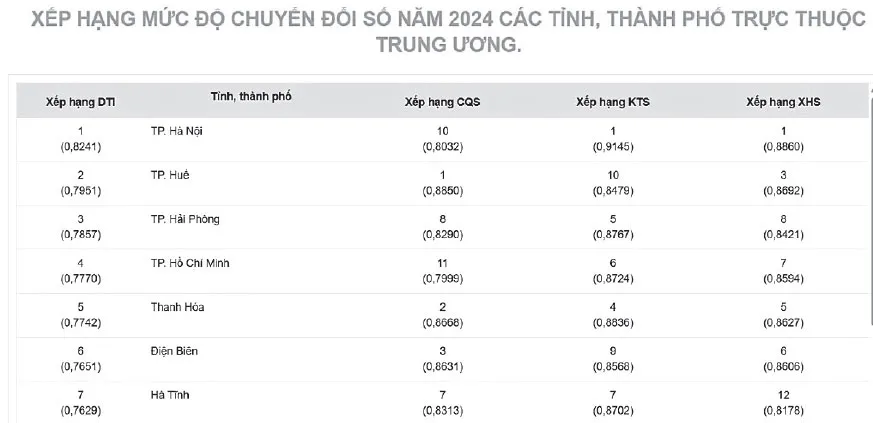
At the local level, the 2024 DTI (Digital Transformation Index) was conducted using two assessment groups: the group of 63 provinces and cities (before mergers) and the group of 34 provinces and cities (after mergers). This method reflects both changes in administrative scale and ensures close monitoring of the digital transformation development of localities. Accordingly, Ho Chi Minh City leads the group of 63 provinces and cities and ranks 4th (after Hanoi , Hue, and Hai Phong) in the group of 34 merged provinces and cities. This clearly demonstrates the comprehensive development and expansion of the "megacity" after the merger. Ho Chi Minh City leads in criteria related to digital awareness and digital institutions, along with high positions in the areas of digital social activities, digital infrastructure, and digital economy.



Deputy Prime Minister Nguyen Chi Dung requested that the popularization and use of digital identities be accelerated; striving to ensure that by 2026, 100% of adults will have digital identities, payment accounts, and electronic identification accounts. Public databases must be shared according to controlled principles, considering data as the lifeblood of innovation and digital transformation.
Maintaining its position among the top national leaders in the Digital Transformation Initiative (DTI) 2024 in the first year of implementing the new administrative model is a testament to the continuous efforts of the entire political system of Ho Chi Minh City. This achievement clearly reflects Ho Chi Minh City's orientation in identifying science and technology, innovation, and digital transformation as the main drivers of growth. Ho Chi Minh City not only focuses on developing strategic technologies such as artificial intelligence, semiconductor chips, and blockchain, but also promotes administrative reform, creating a favorable environment to attract investment. Although still facing some challenges regarding infrastructure and project progress, Ho Chi Minh City continues to implement key solutions to enhance the effectiveness of digital transformation, realizing the goal of becoming an internationally standardized innovation center by 2030.
Digital transformation must be more effective, measured by concrete results.
According to the Permanent Deputy Minister of Science and Technology, Vu Hai Quan, entering the 2026-2030 period, Vietnam's digital transformation will aim for depth and tangible effectiveness, focusing on transforming digital achievements into economic growth, productivity, and national competitiveness. The digital world is moving every second; "if we are slow, we will fall behind." Therefore, digital transformation needs to be faster in perfecting institutions, in implementing strategies, in applying technology, and especially in changing mindsets and working methods. Along with speed, digital transformation must be more effective, measured by concrete results and the value it brings to people, businesses, and the economy.
Speaking at the event, Deputy Prime Minister Nguyen Chi Dung emphasized that from 2022 to the present, Vietnam has accelerated its development and digital transformation, gradually integrating it into daily life: state management activities and administrative procedures have been digitized; 80% of ministries, sectors, and localities have a shared data sharing platform; digital government and smart city models have been formed; the Government has directed the accelerated implementation of Project 06 and the development of the population database and electronic identification. Along with that, public services such as residence registration, birth certificate issuance, health insurance, transportation, etc., have all been digitized, helping people live, study, and work in a digital environment; the national digital infrastructure has been strengthened, and the digital economy has reached nearly 20% of GDP.


Deputy Prime Minister Nguyen Chi Dung requested that central and local ministries and agencies continue to accelerate the improvement of institutions, promptly implement laws in the fields of science and technology and digital transformation, and issue complete, timely, and comprehensive guiding decrees and circulars; focus resources on investing in digital infrastructure, paying attention to both hard infrastructure (data centers, telecommunications infrastructure) and soft infrastructure (digital platforms, national databases).
Source: https://www.sggp.org.vn/som-so-hoa-cac-dich-vu-cong-post819243.html










![[GALLERY] Which is more energy-efficient: induction, gas, or infrared cooktop?](https://vphoto.vietnam.vn/thumb/402x226/vietnam/resource/IMAGE/2026/07/05/1783252570043_bep-1-png.webp)

![[GALLERY] Businesses are burning through money on AI; experts point out how to avoid losses.](https://vphoto.vietnam.vn/thumb/402x226/vietnam/resource/IMAGE/2026/07/05/1783244771594_ai-6-png.webp)