

In recent years, Ho Chi Minh City's literature has become increasingly youthful, expanding its creative methods from essays, short stories, and novels to poetry and interactive works. Many representative works about President Ho Chi Minh and those emulating his example have been reprinted, widely disseminated, and found in school libraries, offices, and residential areas. Author-reader interactions and book introductions about President Ho Chi Minh are regularly maintained, helping literature reach the public naturally and effectively.
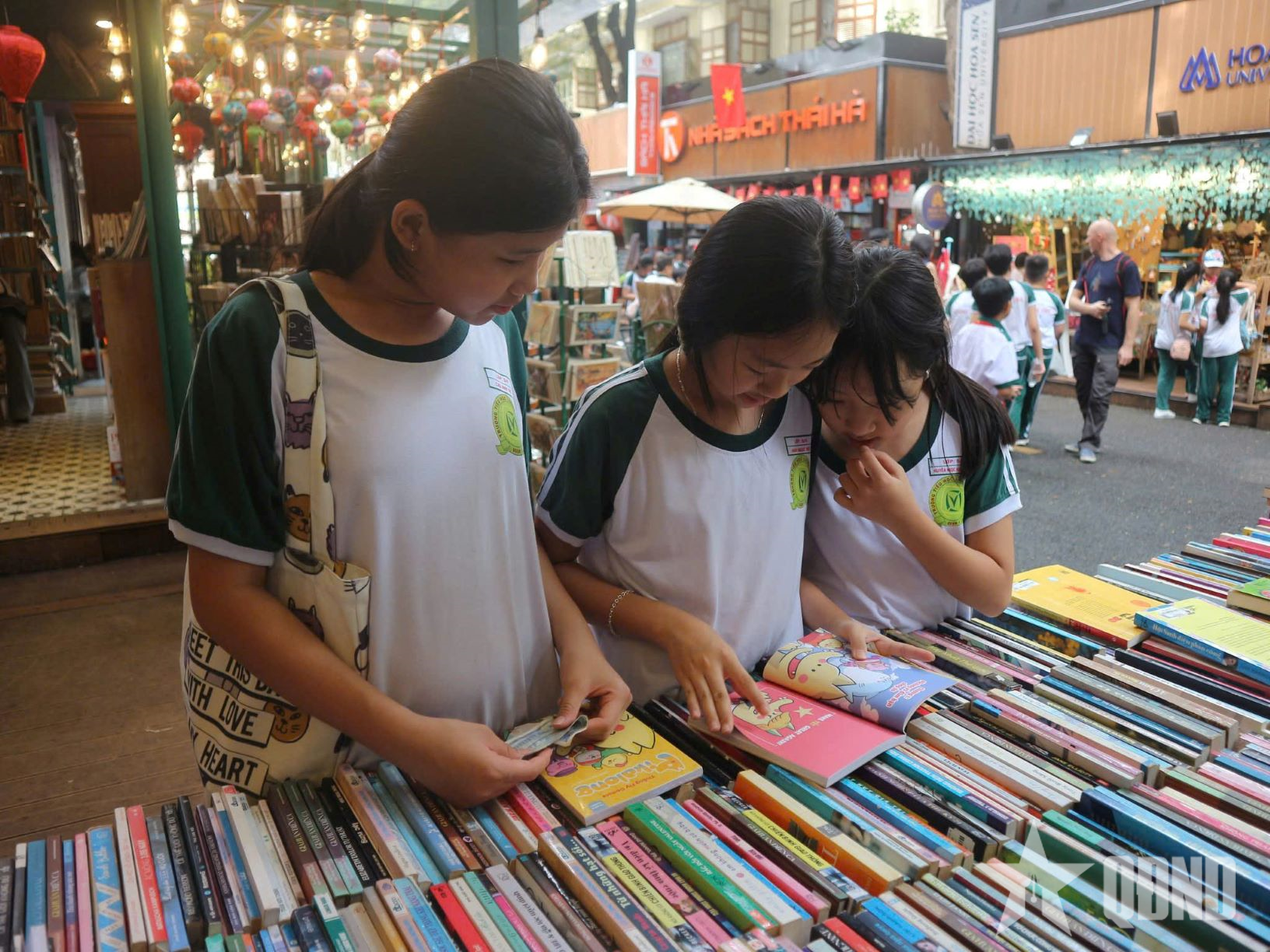 |
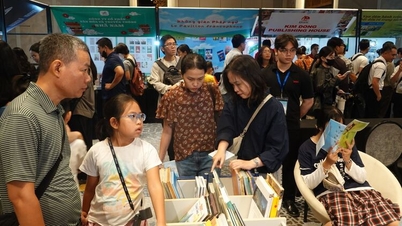
Students in Ho Chi Minh City explore literary works at a book fair. |
Notably, during the period of 2021-2025, many outstanding literary works were published, such as the collection of essays "City People" by author Do Viet Nghiem, which offers simple yet emotionally rich writings about ordinary people who live beautiful and decent lives. Meanwhile, the novel "Sparkling Sunset" by Nguyen Tan Phat explores the journey of transformation and overcoming challenges to achieve goodness. This also conveys a very clear moral message in the spirit of Ho Chi Minh.
Uncle Ho's simple yet profound writing style has also served as a model for many writers in the city. For example, Ho Duy Hung's "Broken Wings of a Spy" is a documentary-rich memoir that recreates stories of unwavering loyalty and beautiful lives dedicated to the nation and its people, contributing to the portrayal of the qualities of "diligence, frugality, integrity, and righteousness" through concrete life examples. Many prose works such as "The Silent Flame" (short story by Nguyen Khanh Ninh), "The Journey of Change" (novel by Tran Ngoc Bao Nguyen), or "Ho Chi Minh - Far Yet Near" (prose by Pham Van Thieu) also serve as inspiration. Furthermore, Tran Nguyen Ngoc Phuong's prose work "The Day the Cactus Bloomed" chronicles a journey of overcoming difficulties and striving for success, thereby highlighting the resilient and persistent spirit following Uncle Ho's example, inspiring many young readers.
Sharing about his writing process, author Do Viet Nghiem said that when writing "People of the City," his biggest concern was how to maintain authenticity. He only hoped that each page of his memoir would contribute to portraying the simple beauty of the city's people—people who live good lives and do good work every day. Learning from Uncle Ho, writing about Uncle Ho, or writing in his spirit, for him, first and foremost means writing with the kindness and responsibility of a writer.
Studying and following the ideology, ethics, and style of Ho Chi Minh has become an important guiding principle for literary activities in Ho Chi Minh City. This is not only a political requirement but also a driving force for the city's artists and writers to create many valuable works, contributing to building a Vietnamese literature rich in identity, humanistic values, and in tune with the times. Literary works imbued with Ho Chi Minh's ideology, ethics, and style are not only artistic creations but also sharp weapons on the ideological and cultural front. This is an important foundation contributing to building the people of Ho Chi Minh City to be strong-willed, compassionate, and loyal; at the same time, fostering faith, strengthening national unity, and successfully fulfilling political tasks in the new era.
Source: https://www.qdnd.vn/van-hoa/doi-song/song-dong-qua-tac-pham-van-hoc-1016731














![[Photo] Prime Minister Pham Minh Chinh receives the Chinese Ambassador to Vietnam](https://vphoto.vietnam.vn/thumb/1200x675/vietnam/resource/IMAGE/2026/04/05/1775397481797_ndo_br_dsc-5512-jpg.webp)










































Comment (0)