

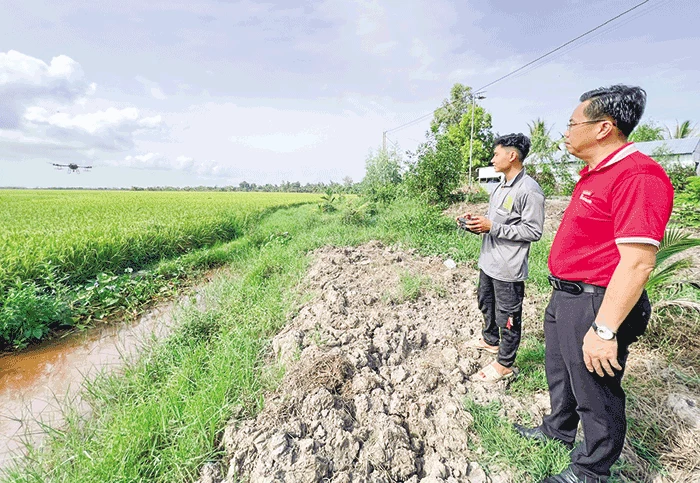
Agricultural insurance helps farmers partially compensate for losses caused by risks occurring during cultivation. In the photo: Farmers in An Giang province operate a drone to fertilize rice crops.
Inflexible, not appealing
Agricultural insurance is an important economic and technical tool aimed at minimizing production risks and increasing farmers' resilience to the impacts of natural disasters and diseases. However, after more than six years of implementation under Decree No. 58/2018/ND-CP on agricultural insurance, the results achieved are still very limited, both in scale and scope.
According to the Department of Cooperative Economics and Rural Development under the Ministry of Agriculture and Environment , based on reports from localities, fewer than 17,000 farmer households nationwide participate in agricultural insurance, with premium revenue reaching only about 6.9 billion VND and compensation payments totaling 198 million VND. The number of participating households has decreased sharply, from over 16,000 households in the 2019-2021 period to only 3,630 households since 2022. Insurance products for aquaculture and some new crops such as rubber, coffee, and pepper have not yet been implemented in practice, despite being expanded in current regulations. The main reasons are that insurance companies are still hesitant, agricultural insurance operations are complex, and lack flexibility. The agricultural insurance model has not yet been closely integrated with credit, production chains, or digital technology.
According to Mr. Le Duc Thinh, Director of the Department of Cooperative Economics and Rural Development, insurance products for aquaculture and some new crops such as rubber, coffee, and pepper... have not yet been implemented in practice, despite being expanded in current regulations. The main reason is that insurance companies are still hesitant: agricultural insurance operations are complex, lack flexibility, and are not attractive to international reinsurers; at the same time, many barriers still exist regarding data, human resources, and service networks in the area.
The above reality reflects a significant gap between policy design and implementation conditions. Businesses are not proposing new products due to low economic efficiency, high risks, cumbersome procedures, and especially a lack of technical data and tools for monitoring and verifying losses. As a consequence, from 2022 to the present, almost no localities have implemented agricultural insurance products, even though many provinces and cities have issued lists of eligible areas and beneficiaries. These figures and realities show that the current policy is not attractive enough and does not meet the expectations of both providers and beneficiaries. The agricultural insurance model has not yet been closely integrated with credit, production chains, or digital technology—essential pillars for forming a modern, sustainable, and effective agricultural insurance ecosystem.
The primary role of agricultural insurance is to help mitigate losses from risks. The agricultural sector is strongly impacted by natural disasters such as floods, droughts, storms, diseases, pests, and market fluctuations. In such cases, agricultural insurance helps organizations and individuals partially compensate for losses caused by risks occurring during production and business. However, in reality, in many localities, farmers are not fully aware of the risks of natural disasters and diseases, and therefore are not truly willing to participate in agricultural insurance. Some farmers are interested but are not yet confident in participating in insurance, and there are not many insurance products available for farmers to choose from.
According to Mr. Tran Minh Hieu, representative of the Insurance Management and Supervision Department (Ministry of Finance), currently, not many insurance companies participate in providing services because agricultural insurance is a complex and high-risk business with a nationwide geographical scope, requiring insurance companies to have large financial capacity, a team of capable and experienced staff, and a network reaching the grassroots level. In addition, agricultural insurance is a new and complex product; its implementation in some localities and facilities is still confusing, and the approval of eligible beneficiaries is slow and untimely. Because agricultural insurance is a new product, people have not yet researched it or developed the habit of participating in insurance. Insurance companies face difficulties in data sources. Disaster data is currently limited to general data for the entire province, lacking detailed data down to the district and commune levels, making it difficult to assess risks, develop insurance policies, and determine premium rates.
Removing the "bottlenecks"
To expand the agricultural insurance market, experts suggest perfecting the legal framework and proposing amendments and additions to Decree No. 58/2018/ND-CP to ensure consistency with the amended Law on Insurance Business and suitability to the practical development of modern agriculture.
According to Mr. Le Duc Thinh, Director of the Department of Cooperative Economics and Rural Development, to restart and expand the agricultural insurance market, it is necessary to focus on perfecting the legal framework, reviewing and simplifying procedures and processes for assessment and compensation, and creating conditions for insurance companies to proactively design products. Insurance companies and international reinsurance partners should be encouraged to develop flexible product packages based on risk data and the specific needs of each sector: rice, aquaculture, industrial crops, etc.
Furthermore, according to Mr. Le Duc Thinh, it is necessary to pilot new models in the Mekong Delta through public-private partnerships, focusing on investing in a digital agricultural database system, standardizing farming processes, and establishing a framework for measuring losses. Training local officials, cooperatives, and insurance companies in loss assessment, risk evaluation, and the application of remote monitoring technology is also crucial. Connecting the government, businesses, international organizations, industry associations, banks, and farmers is essential to integrate insurance with credit, value chain production, and digital transformation.
According to Mr. Bui Gia Anh, Secretary General of the Vietnam Insurance Association, agricultural insurance is not just a simple financial tool but also an important pillar that helps agricultural organizations and individuals become more resilient in the face of fluctuating risks, especially in the context of increasingly severe and complex climate change. Therefore, the State and relevant ministries and sectors need to continue improving the legal framework for agricultural insurance, creating conditions for agricultural organizations, individuals, and businesses to access it easily. Attention should be paid to building accurate databases on the agricultural insurance market, including market information, actual payout data, loss data, natural disasters, and diseases for each locality and each commodity sector.
Mr. Bui Gia Anh believes that it is crucial to designate an agency or unit to manage and provide such database information. This would help insurance companies feel more secure in researching and participating in the insurance market. State management agencies need to combine this with organizing propaganda, training, and capacity building for agricultural officials at the local level. Agricultural insurance is extremely important, contributing to the implementation of state policies and the continued development of agriculture, farmers, and rural areas. Therefore, appropriate mechanisms are needed to leverage the strengths of the entire political system, ministries, and local governments to develop agriculture. Strong involvement from the entire political system is needed to propose specific goals and solutions for more significant changes in the field of agricultural insurance.
Text and photos: MINH HUYEN
Source: https://baocantho.com.vn/tai-khoi-dong-bao-hiem-nong-nghiep-theo-chuoi-gia-tri-nganh-hang-a188212.html

















































































Comment (0)