

Roundabouts are becoming increasingly common in the US due to their ability to reduce traffic congestion and collisions between vehicles.
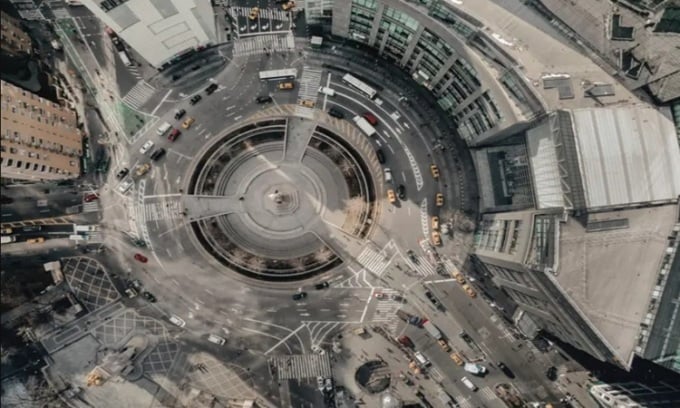
The East Coast of the United States has more roundabouts than the West Coast. Photo: Orbon Alija
Despite being a relatively new traffic regulation measure, roundabouts are becoming increasingly popular across the United States, according to Business Insider . Roundabouts, also known as traffic circles or traffic rings, are circular areas located at intersections, designed to improve traffic flow and safety. They offer several advantages over conventional intersections regulated by traffic lights or stop signs. Deogratias Eustace, a professor of mechanical, environmental, and civil engineering at the University of Dayton, has conducted several studies examining the safety and operational efficiency of installing roundabouts at intersections. He also compared the performance of roundabouts with intersections regulated by stop signs.
In the early 18th century, some urban planners proposed, and even built, circles at intersections, such as Circus in Bath, England, and Place Charles de Gaulle in France. In the United States, engineer Pierre L'Enfant constructed several circles in his design for Washington, D.C. These circles were precursors to roundabouts.
In 1903, the influential French architect and urban planner Eugène Hénard was one of the first to introduce the idea of circular traffic flow to regulate busy intersections in Paris. Around the same time, William Phelps Eno, an American businessman and the father of traffic safety, also proposed using roundabouts to reduce traffic congestion in New York City. Over the following years, several other cities experimented with roundabout-like designs with varying degrees of success. These roundabouts lacked any standardized design guidelines, and most were too large to be effective, as vehicles would enter the roundabout at higher speeds.
The introduction of modern roundabouts was accompanied by yielding regulations, implemented in some English cities in the 1950s. Under these regulations, vehicles entering a roundabout must yield to vehicles already moving inside. This regulation was implemented nationwide in England in 1966 and in France in 1983.
Giving way at the roundabout entrance meant vehicles passed through modern roundabouts at slower speeds. Over the years, engineers added various features that gave roundabouts their current appearance. Some added pedestrian crossings and lane islands to help regulate vehicle speed. Engineers, urban planners, and lawmakers around the world recognized that roundabouts improved traffic flow, reduced congestion, and increased safety at intersections. Roundabouts subsequently spread throughout Europe and Australia.
Three decades later, modern roundabouts appeared in North America. The first modern roundabout in the U.S. was built in Summerlin, west of Las Vegas, in 1990. Since then, the construction of roundabouts has become increasingly common in the country. Today, the U.S. has approximately 10,000 roundabouts nationwide.
Roundabouts have developed so rapidly because they help reduce the number of potential intersections. An intersection is a location where the paths of two or more vehicles cross or have the potential to intersect. The more intersections there are, the more likely vehicles are to collide. Roundabouts have only 8 potential intersections compared to 32 at a typical 4-lane intersection. At roundabouts, vehicles do not cross each other at the appropriate angle.
The narrow circle of the roundabout forces oncoming vehicles to slow down and yield to vehicles inside, then move smoothly around the island. As a result, the roundabout experiences fewer stopping and parking issues, reducing fuel consumption and emissions, and allowing drivers to make U-turns more easily. Because traffic flows continuously at a slower speed within the roundabout, this minimizes the need for vehicles to stop, thereby reducing congestion. The Federal Highway Administration estimates that when roundabouts replace traffic light intersections, the number of fatal accidents or serious injuries decreases by 90%. When roundabouts replace intersections using traffic lights, the number of serious accidents decreases by nearly 80%.
Engineers and planners typically build roundabouts at intersections with severe congestion or a history of accidents. But with community support and funding, roundabouts can be installed anywhere. In areas without congestion problems, city planners generally don't push for roundabouts. For example, there are about 750 roundabouts in Florida, but fewer than 50 in North Dakota, South Dakota, and Wyoming combined. In 2000, the U.S. had only 356 roundabouts. Over two decades, that number has risen to over 10,000.
An Khang (According to Business Insider )
Source link














































































Comment (0)