

When traveling to large deserts around the world , such as the Sahara in North Africa, people usually bring plenty of jackets and sunscreen to avoid sunburn. However, few people know that at night, desert temperatures drop significantly compared to daytime, so you also need additional warm clothing. To understand why deserts get cold at night, one can learn about the dynamics of the sand dunes.
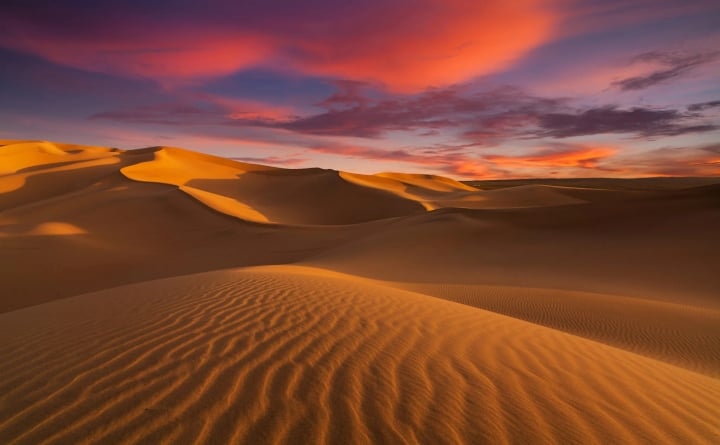
At night, temperatures in deserts drop significantly.
Why does the desert get cold at night?
In arid deserts like the Sahara or the Atacama Desert in Chile, humidity—the amount of water vapor in the air—is virtually zero. At the same time, unlike sand, water has a very high heat-retaining capacity. Therefore, when water vapor in the air traps heat near the ground, it helps prevent this heat from dissipating into the atmosphere.
Air with high humidity also requires more energy to heat up, meaning it takes longer for that energy to dissipate and for the surrounding environment to cool down. Therefore, the lack of moisture in deserts allows these arid places to heat up quickly but also cool down just as quickly.
To put it more simply, at night, without the sun's heat warming these vast stretches of sand, the temperature drops very quickly. As everyone knows, sand has very poor heat retention, so if it's not heated, the old heat will dissipate. Therefore, sand is the main reason for this strange phenomenon in deserts.
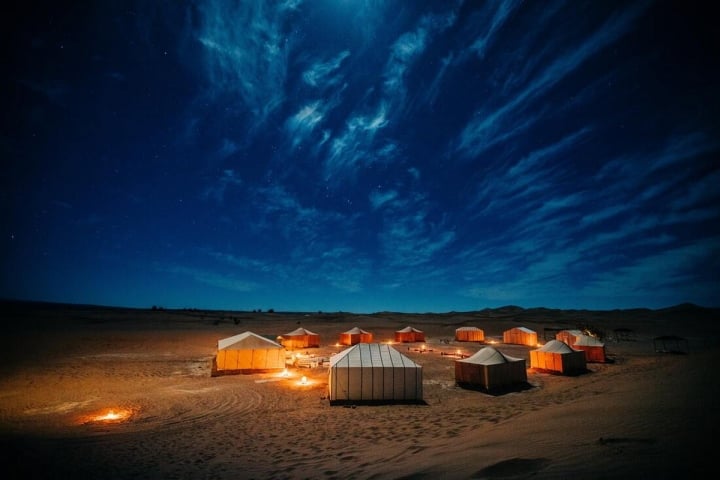
Nighttime temperatures in the desert can drop to as low as 18 degrees Celsius.
When the air is extremely cold, it means these sands have very little moisture. These hot, dry deserts have average annual temperatures ranging from 20 to 25 degrees Celsius, with peak temperatures reaching 43 to 49.5 degrees Celsius during the day and as low as -18 degrees Celsius at night.
Therefore, most of the plants that grow here are short and stout, such as low-lying shrubs, and there are very few large mammals because they are generally unable to store enough water. At the same time, in places like deserts, annual rainfall is very low and there are virtually no large trees to provide shade, making it very difficult to survive.
Some species of plants and animals live in the desert.
Despite the erratic temperature changes in desert regions, many plant and animal species adapt and thrive. However, these species still face some unavoidable difficulties, such as finding food and water when temperatures rise.
Reptiles are known to be the most abundant and diverse group of animals in the desert, well adapted to extreme temperature changes. Because they are cold-blooded, they don't need to seek energy to maintain a stable body temperature. Their small size also helps many reptiles find shady spots during the day or warmer rocks at night.
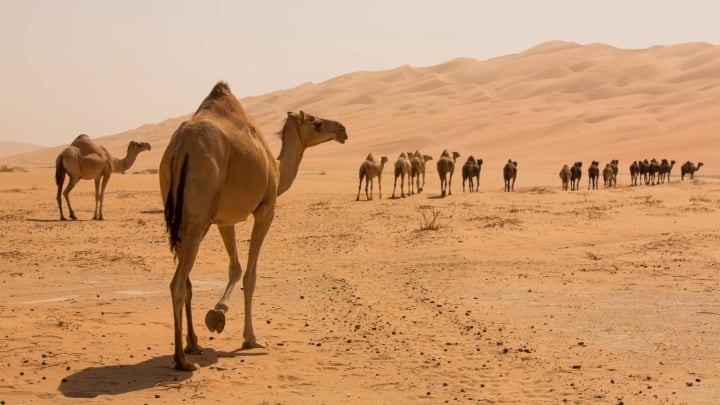
Camels thrive in desert environments.
However, warm-blooded or heat-reducing mammals like camels have such large body sizes that they find it difficult to find shelter from the sun and lower their body temperature. Camels, on the other hand, can maintain a stable body temperature in both hot and cold temperatures. This is because their bodies have many layers of insulation in the form of fat and thick fur, preventing them from absorbing too much heat during the day and losing too much at night.
Meanwhile, plants are more vulnerable in desert environments because they cannot move. That's why iconic desert plants like cacti have developed a range of defenses, such as thorns and toxins, to protect their precious water supply from predators.
Tuyet Anh (Source: Compilation)
Beneficial
Emotion
Creative
Unique
Source





















































































Comment (0)