

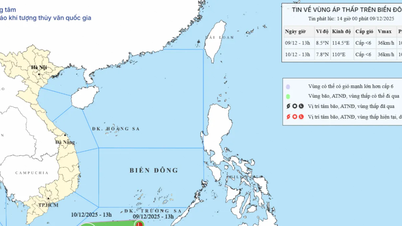
According to the National Center for Hydro-Meteorological Forecasting, at 10:00 AM on October 21, 2025, the typhoon's center was located at approximately 17.8 degrees North latitude and 112.4 degrees East longitude, about 125 km north of the Hoang Sa Special Economic Zone. The strongest winds near the center of the typhoon were at level 9-10 (75-102 km/h), with gusts up to level 12. It was moving southwest at a speed of 10-15 km/h.
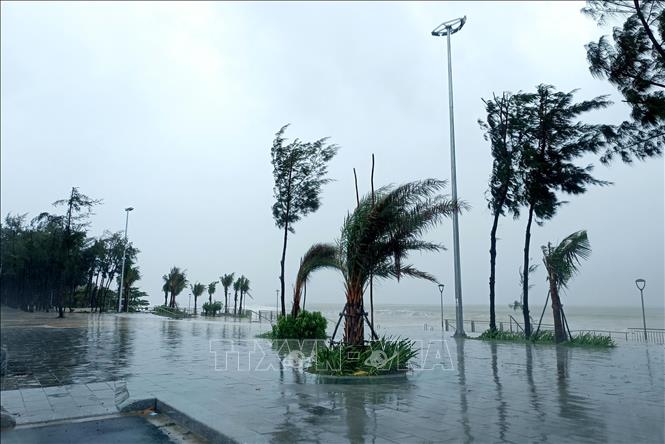
In the next 24 hours, the storm will move northwest, reaching its strongest intensity of level 11, gusting to level 13 (when in the northern area of Hoang Sa special zone). From tomorrow, October 21, the storm will interact with cold air, possibly changing both its direction of movement and intensity.
Due to the influence of the storm's circulation, combined with other weather patterns, from October 22nd to 26th, the Central region, especially from Ha Tinh to Quang Ngai, is highly likely to experience widespread and prolonged heavy rainfall, with localized areas receiving over 900 mm; there is a high risk of flash floods and landslides in mountainous areas, and flooding in low-lying areas and urban areas; and water levels on rivers from Quang Tri to Quang Ngai may rise above flood warning level 3.
This is a complex storm with a high risk of prolonged heavy rainfall over a wide area, causing major floods, deep flooding, flash floods, landslides, and mudslides in many localities. In implementing Prime Minister's Directive No. 200/CĐ-TTg dated October 20, 2025, and the Ministry of Construction 's Directive No. 78/CĐ-BXD dated October 20, 2025, on proactively responding to Typhoon No. 12 and heavy rain, floods, inundation, landslides, and flash floods, the Vietnam Road Administration requests the above-mentioned agencies and units to monitor, update, and closely track the storm's developments. Focus on leadership and guidance, review and update plans, and be ready to immediately implement measures to respond to Typhoon No. 12 with a decisive spirit, early and from afar, to ensure the safety of people's lives, minimize damage to people's and state property, and avoid being caught off guard in any situation.
For Road Management Zones, Departments of Construction, investors, and BOT project enterprises, it is necessary to closely monitor the developments of Typhoon No. 12; proactively implement plans to ensure traffic flow and take measures to protect roads, bridges, culverts, warehouses, vehicles, and construction machinery to minimize damage caused by Typhoon No. 12; prepare bridge girders, pontoons, spare materials, machinery, equipment, vehicles, and personnel ready to ensure traffic flow in case of incidents; maintain forces and vehicles ready to participate in rescue operations to ensure traffic flow and minimize damage.
In addition, the Road Management Zones, in coordination with the Departments of Construction and local authorities, reviewed and finalized scenarios and plans for emergency response, traffic diversion, and the deployment of personnel to guard, place buoys, barriers, and warning signs at locations affected by flooding, submerged bridges, broken roads, and landslides; controlled traffic, proactively regulated traffic; and closed roads at dangerous locations such as submerged bridges, ferries, etc., on national highways in areas affected by storms and floods, resolutely preventing people and vehicles from entering these locations to ensure traffic safety.
For major landslides causing traffic congestion, leaders from the Road Management Area and the Department of Construction must be immediately dispatched to the scene to implement traffic diversion plans from a distance and proactively coordinate with traffic police and local authorities to manage traffic flow; at the same time, they must urgently address the problem, mobilizing all available machinery, equipment, and personnel in the area to ensure traffic flow is restored as quickly as possible.
The relevant units have plans in place to relocate equipment, assets, and reinforce houses to cope with Typhoon No. 12; inspect and assess the condition of bridges located in the area affected by Typhoon No. 12; for weak bridges, regular monitoring and timely action must be taken when bad weather affects operation, ensuring the safety of the structures as well as the safety of people and vehicles crossing the bridges.
Specifically, Project Management Boards 4 and 5 proactively implemented measures to mitigate the consequences of natural disasters and ensure smooth traffic flow, guaranteeing the safety of people, construction equipment, and ongoing construction projects; proactively developed plans to prevent damage from natural disasters to ensure the safety of completed work, traffic safety, and the safety of auxiliary works, construction equipment, material storage facilities, workshops, and living quarters for staff and workers; coordinated with the local Disaster Prevention and Search and Rescue Command to organize rescue forces to ensure traffic flow 24/7 and regularly reported the developments and impacts of Typhoon No. 12 to the Disaster Prevention and Search and Rescue Command of the Vietnam Road Administration via telephone number “1900.54.55.70 - extension number 3”.
Source: https://baotintuc.vn/xa-hoi/tap-trung-chu-dong-ung-pho-voi-bao-so-12-va-mua-lon-lut-sat-lo-dat-20251021164831275.htm















![Advance Information: [Lesson 1] Grasp information to master the season](https://vphoto.vietnam.vn/thumb/402x226/vietnam/resource/IMAGE/2025/12/10/1765332826736_dsc06522-210030_916-091151.jpeg)








![[Photo] Urgently help people soon have a place to live and stabilize their lives](/_next/image?url=https%3A%2F%2Fvphoto.vietnam.vn%2Fthumb%2F1200x675%2Fvietnam%2Fresource%2FIMAGE%2F2025%2F12%2F09%2F1765248230297_c-jpg.webp&w=3840&q=75)






























































Comment (0)