

Rice fields revive after the flood
In the last days of the season, standing in the middle of the fields on the southern bank of Hau canal in the three hamlets of Ca Gua, Ca Rung and Dau Sau, Tuyen Binh commune, Tay Ninh province, it is not difficult to feel the rhythm of life returning after the flood season. Straw is still scattered all over the fields, each plow turns the soil in preparation for sowing the winter-spring crop. That scene partly shows: this place has gone through the flood, not in desolation, but in peace.
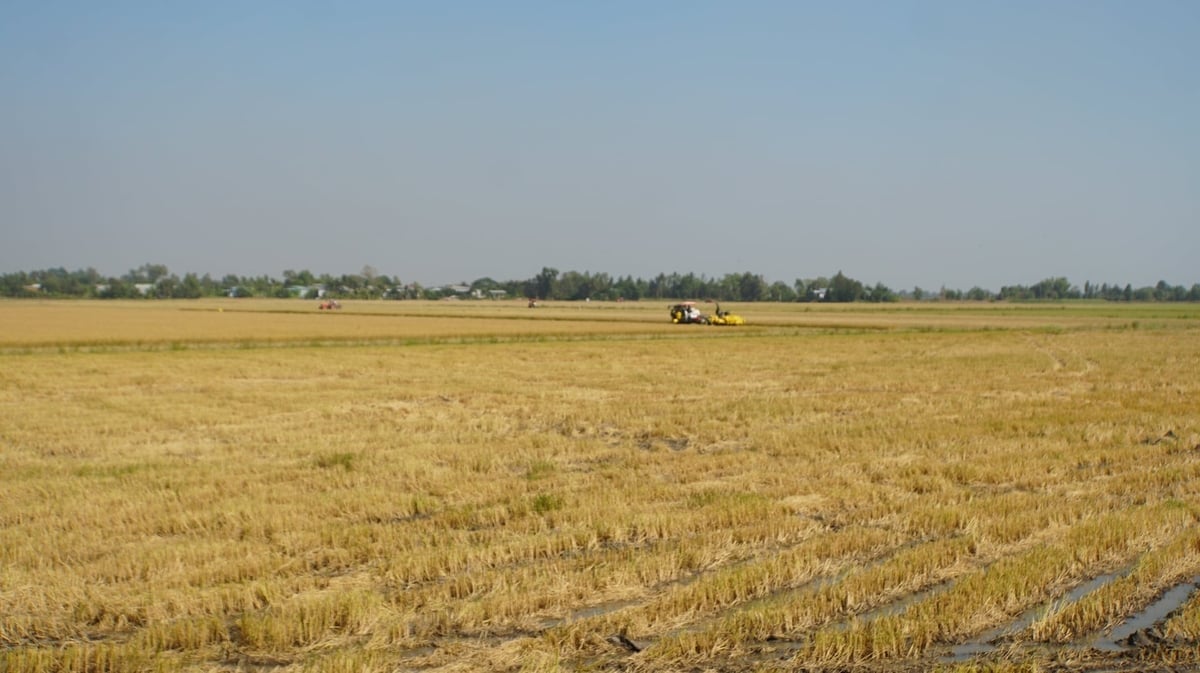
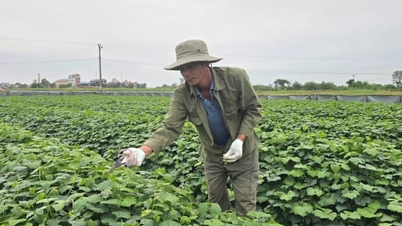
The rice fields on the southern bank of the Hau Canal, belonging to the three hamlets of Ca Gura, Ca Rung, and Dau Sau in Tuyen Binh commune, these days. Photo: Tran Trung.
A few months ago, these fields were at risk of being submerged in water. Tuyen Binh is located entirely within the influence of Dong Thap Muoi, low-lying terrain, surrounded by canals. In 2025, the rains and floods came early, the water rose quickly, high tides caused many dikes to collapse, many rice fields were flooded and lost.
However, amidst that bleak picture, the rice fields on the southern bank of the Hau Canal became a "bright spot." Over 360 hectares of rice were safely protected during the flood season, not thanks to luck, but to a fundamental change: the people proactively accessed and used information to act early.
"Farming now requires more than just relying on the weather; it also requires paying attention to forecasts. Listening to the radio and reading news about rain, floods, and tidal surges has become a habit for the people here," said Mr. Nguyen Van Thanh, Head of Dau Sau Hamlet.
According to Mr. Thanh, in this area, every hydrological bulletin and water level announcement is no longer unfamiliar information. From village loudspeakers to smartphones, people update the weather as an essential part of their lives.
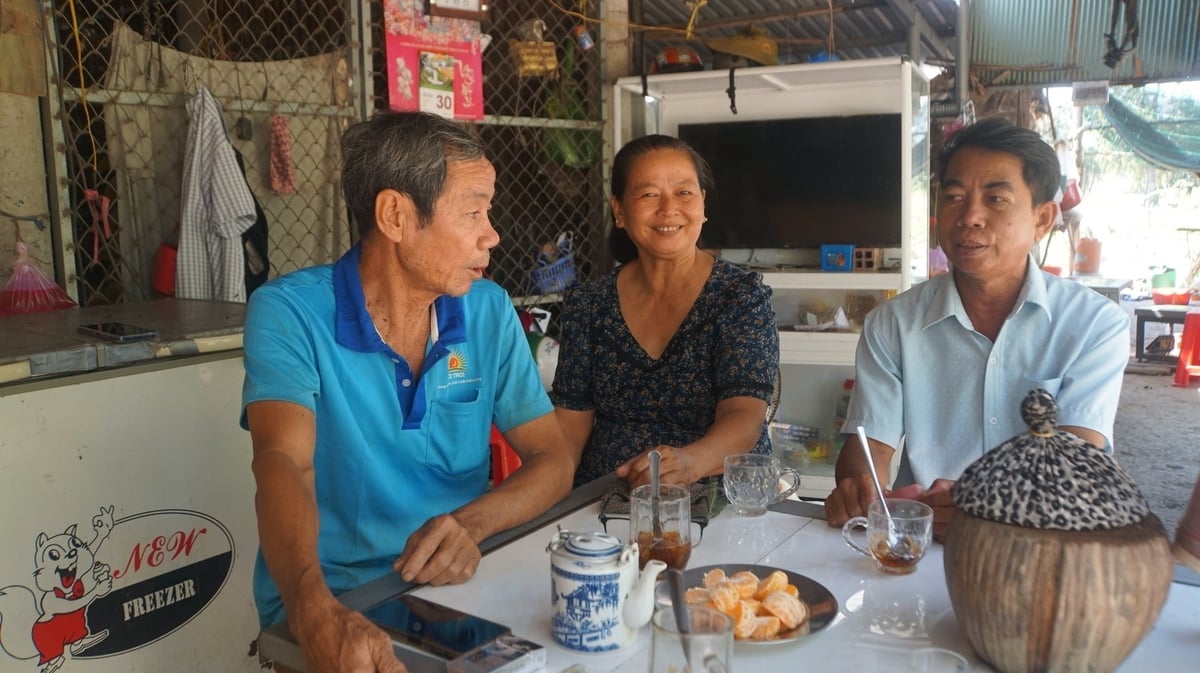
Mr. Thanh (right cover) and farmers in the hamlet summarize their experiences in recent flood prevention. Photo: Tran Trung.
"We grow rice without considering the weather; it's like gambling with nature," a farmer said with a laugh, but his tone was not at all mocking.
Unite to keep the dike - keep the livelihood
Following the local officials, we visited Mr. Nguyen Van Gioi, whom the villagers consider the "leading figure" in this year's dike rescue effort. Along the kilometers-long earthen dike, the man, now over 60 years old, led us meter by meter, recounting the tense days of the operation.
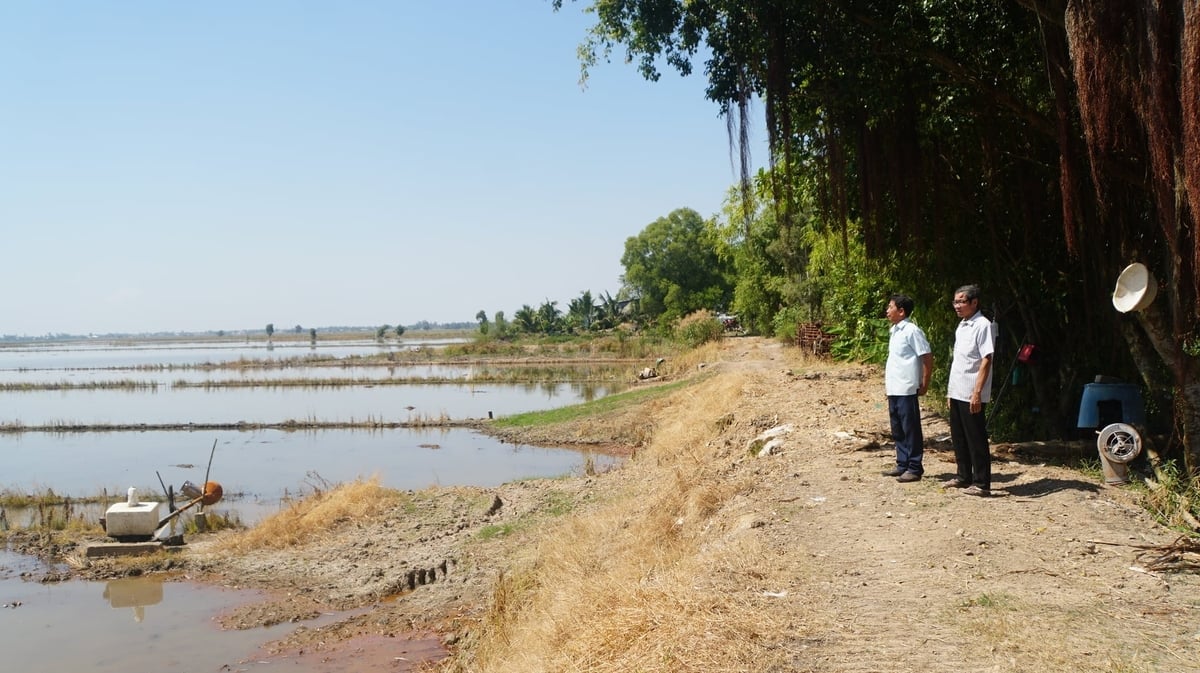
Mr. Gioi (left cover) visits the dike surrounding the fields on the southern bank of Hau canal. Photo: Tran Trung.
“A few years ago, the water level was still a matter of luck, but this year the water level was unusually high, the flood peak was higher than usual. There were sections where the water level was tens of meters high, and if we missed something overnight, the fields would be completely covered the next day. Thanks to accurate weather forecasts, when the flood forecast was issued, Dau Sau Hamlet did not wait until the water reached our feet to jump. The Hamlet Executive Committee and the Commune Government held an urgent meeting to discuss plans to reinforce the dike and build a sluice to prevent tides,” said Mr. Gioi.
What's unique about the fields on the south bank of the Hau Canal is that the people are not excluded from decisions related to their livelihoods. When the financial plan was presented, the villagers unanimously agreed that those with land would contribute 2 million VND per hectare.
Mr. Gioi's family owns 6 hectares of land, and the contribution of 12 million dong is equivalent to the profit from one hectare of rice per season. Mr. Gioi recalled: "It was heartbreaking, but I thought about it in reverse; if we didn't do it, and the water came in and we lost all 6 hectares, it would be even more painful."
During the emergency reinforcement effort, the total cost for the entire hamlet was recorded at approximately 700 million VND, of which the residents contributed about 200 million VND. The local government provided resources and organized a force to monitor the dike day and night.
“None of the commune officials stood outside. At night they were on duty with the water, and during the day they built earth bags and reinforced each section,” Mr. Gioi added.
After the floods, the results were evident in the rice fields. The third rice crop was harvested in over 20 days, with an average yield of 5.5 - 5.8 tons/ha, and a profit of 7 - 8 million VND/ha. The total amount of nearly 1 billion VND contributed by the farmers has "yielded profits" through the safety of the entire production area.
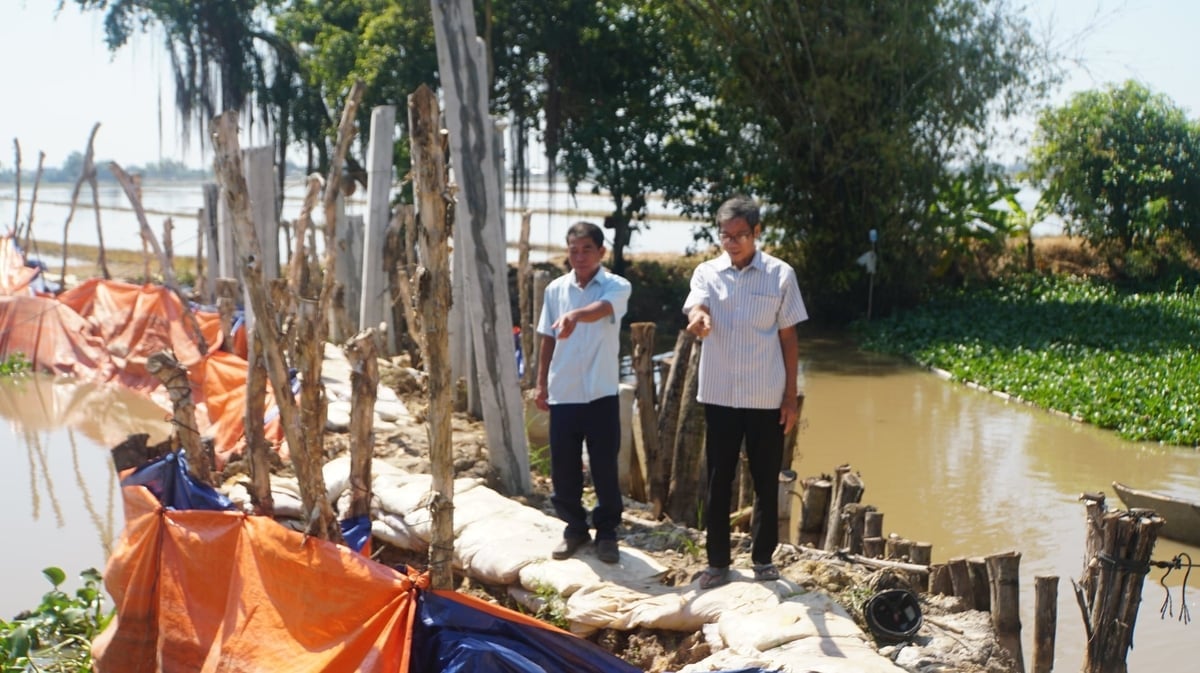
Locals hope the government will invest in building electric pumping stations combined with flood control sluices at the two temporary sluice locations to protect the fields in the coming period. Photo: Tran Trung.
The story in the fields on the southern bank of Hau canal shows that, in the era of climate change, the dike is not only a construction of earth and stone, but also a construction of information. When people understand the risks and see the dangers, they are ready to act. When the government does not stand aside, but stands with the people, then every contribution becomes an investment for the future.
In the midst of the flood plains of Dong Thap Muoi, the people of Tuyen Binh have chosen a very “ agricultural ” way to combat natural disasters: grasping information, making early preparations, and working together to protect their fields. And from the simple earthen dikes, a path to sustainable poverty reduction is gradually emerging, starting from hearing timely news and taking timely action.
Source: https://nongnghiepmoitruong.vn/thong-tin-di-truoc-bai-1-nam-thong-tin-de-lam-chu-mua-vu-d788292.html

![[Photo] Explore the US Navy's USS Robert Smalls warship](/_next/image?url=https%3A%2F%2Fvphoto.vietnam.vn%2Fthumb%2F1200x675%2Fvietnam%2Fresource%2FIMAGE%2F2025%2F12%2F10%2F1765341533272_11212121-8303-jpg.webp&w=3840&q=75)

























![[Video] The craft of making Dong Ho folk paintings has been inscribed by UNESCO on the List of Crafts in Need of Urgent Safeguarding.](https://vphoto.vietnam.vn/thumb/402x226/vietnam/resource/IMAGE/2025/12/10/1765350246533_tranh-dong-ho-734-jpg.webp)




















































Comment (0)