

The risk of "AI brain hollowing"
Dr. Rakhee Das, from Amity University and an international AI expert, stated: "The application of artificial intelligence technology has increased rapidly over the past year, with a growth rate of over 400%. It is projected that by 2025, global companies will invest more than $200 billion in this field. In fact, AI has been shown to help the healthcare industry detect diseases 30% faster, reduce financial fraud by 40%, and increase office productivity by up to 45%."
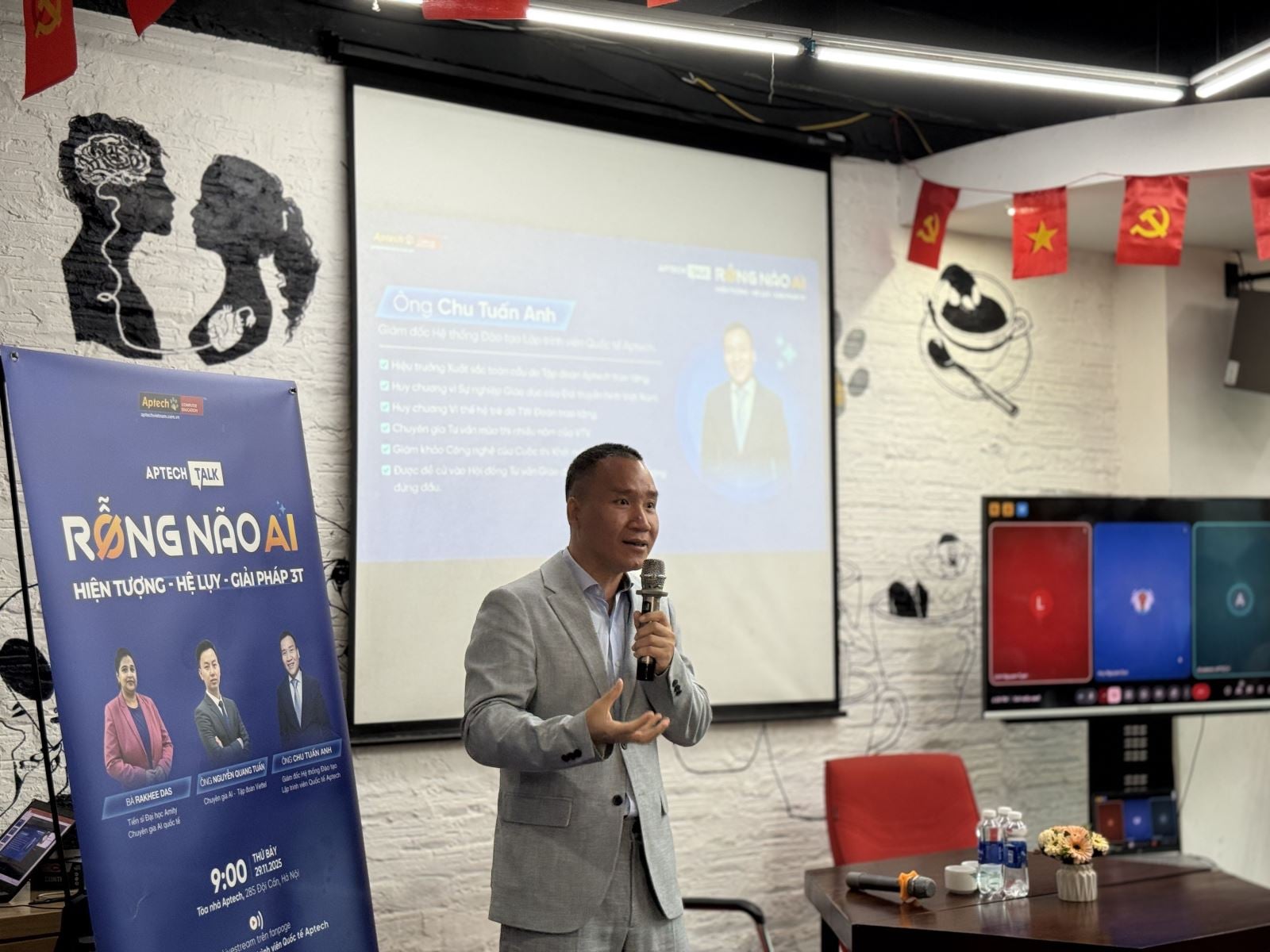
However, Rakhee Das warned about the emergence of a "copy-paste" generation. According to her, the biggest problem today is that students and young professionals are using AI while neglecting to learn fundamental knowledge. When they become overly reliant on it, critical thinking decreases, basic knowledge weakens, and problem-solving skills disappear. If this trend continues, the future workforce will lose the ability to think independently.
Rakhee Das cited the example of many students who complete their homework well but cannot directly answer simple questions, only to find out later that they relied on AI for help. Many young students are losing their real-world skills. Their thinking abilities are weakened because AI is doing all the work. This is a state of AI brainlessness, which has become increasingly common since the explosion of generative applications.
Sharing the same view, Mr. Chu Tuan Anh, Director of Training at Aptech International Programmer System, called this phenomenon "AI-induced cognitive decline." He cited the example of over-reliance on digital maps (Google Maps). During the recent flooding in Hanoi , many drivers only followed the map's directions, losing their ability to navigate in real-world conditions and assess risks, leading them to drive into deeply flooded areas.
According to the analysis, this cognitive decline does not occur immediately but progresses through three stages, from lazy habits to complete dependence.
The first level is "thinking laziness," which usually appears after 1 to 3 months of continuous AI use. Users tend to immediately accept the machine's output, copying it for reporting or running code without questioning why or verifying its accuracy.
The second level is “skill loss”, which usually occurs after 3 to 6 months. At that time, the staff cannot complete the job without support tools.
A programmer might forget how to write basic algorithms, or a content writer might be completely stumped without ChatGPT's suggestions.
The most dangerous level is "cognitive blindness." At this point, the AI produces an incorrect or low-quality result, but the user no longer has sufficient background knowledge to recognize the error.
"This is a stage where people are completely controlled by tools, endangering not only their personal careers but also affecting businesses, and even the nation," Mr. Tuan Anh emphasized.
On a broader level, the consequences could be a declining workforce and falling productivity. "Without the right direction, in about 3-5 years, we will have a generation that knows how to use AI but doesn't know what to do with it, losing our competitive advantage compared to countries that still maintain their original mindset," Mr. Tuan Anh commented.
Warnings about the risk of brain degeneration due to AI are not new. In June, a four-month study by a team of experts from the MIT Media Lab also found that users of AI chatbots experienced a decline in brain activity and memory.
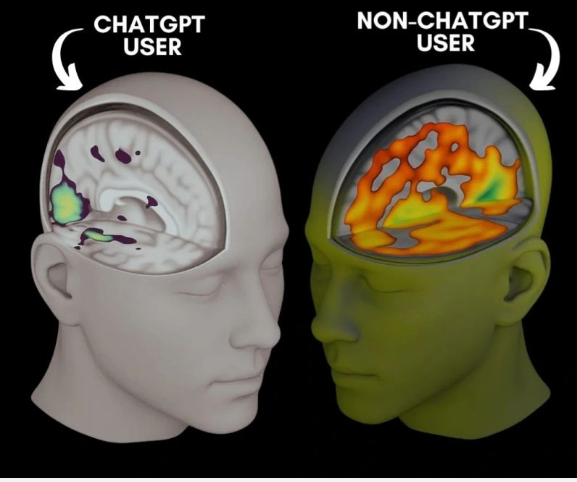
Accordingly, those using ChatGPT experienced a 47% decrease in brain connectivity (from 79 points to 42 points) and 83.3% were unable to recall sentences they had just written just minutes later, while the group not using AI maintained significantly higher levels of brain interaction.
The decline in memory and creativity persisted even after switching from AI to entirely handwritten essays, a phenomenon researchers call "cognitive debt." Essays from the AI-powered group, while completed faster, were perceived by teachers as superficial and lacking depth.
The results showed that optimal results were only achieved when AI was intentionally integrated: The group using a hybrid method (starting with handwriting first, then using AI to assist in editing/expanding) achieved the highest neural activity and recall ability. However, due to the small sample size, the current conclusions are only certain within the scope of academic tasks and cannot be generalized broadly.
From a technology business perspective, Mr. Nguyen Quang Tuan, an AI expert at Viettel , shared his insights on the misuse of automatic code generation (Gen Code). Many programmers today create products very quickly thanks to AI, but lack depth in logical thinking. The biggest risk is that programmers become outdated because they only know how to use AI to write working code without understanding the underlying principles.
Mr. Tuan also pointed out that AI models are a collection of human knowledge, but they also contain "junk" or misinformation. If personnel only issue superficial commands (prompts) like "write me the login screen" without specific context, the resulting product will have many vulnerabilities. Mr. Tuan believes that using AI is very good, but using it responsibly and effectively is another story.
Remedies
To solve this problem, experts agree that banning AI is not an option; instead, a change in approach is needed. Mr. Chu Tuan Anh proposed the "3T" formula as a solution to empower users to master technology instead of being controlled by it.
First, think first. Before asking for AI assistance, users should take some time (about 3 minutes) to think about the problem themselves, visualizing an outline or solution in their heads. This helps activate the brain and maintain independent thinking abilities.
The second "T" stands for viewing AI as a tool, not a tutor. Users need to understand that AI is merely a support tool, not a replacement or an all-powerful teacher. The effective way to use it is to perform the work themselves, then use AI to correct errors, optimize, or critique ideas.
Finally, there's Techback. This is considered the most important step in transforming machine learning into human knowledge. After receiving results from the AI, users need to practice explaining that knowledge to others or reinterpreting it themselves.
"We shouldn't be afraid of AI. Human history has witnessed the transition from the Stone Age and Bronze Age to the steam engine and computers. Whoever grasps and masters these new tools will be the winner. Let's master AI to have a better future," the Aptech representative concluded.
According to Le Cong Nang, an AI expert and head of the AI for Business community, the concern that "using AI excessively will empty your brain" stems from a genuine worry, but it needs to be viewed in a balanced way. AI can indeed make people lazy thinkers if we completely rely on it, just like when a computer does the calculations for us, we easily forget how to do them manually.
“However, the problem isn't the technology itself, but how we use it. AI is a productivity tool, not a replacement brain. For the businesses I train, the first thing I emphasize is: AI helps you do things faster, not more accurately, if the user lacks the necessary knowledge. For example, an AI guide who doesn't understand the culture can't write a good presentation; an AI operator who lacks professional skills can't create an accurate itinerary. AI only exaggerates what the user already knows. In reality, those who use AI regularly and correctly learn faster and update their knowledge better because they have access to diverse information and shorten the trial-and-error cycle.”
The most important thing is to educate our thinking: AI assists, humans decide; AI synthesizes, humans analyze; AI creates drafts, humans refine. If we know how to ask the right questions, verify information, and develop critical thinking, AI will not make us inferior but faster, stronger, and more competitive in the new era.
Source: https://baotintuc.vn/xa-hoi/canh-bao-tinh-trang-suy-giam-nhan-thuc-do-lam-dung-tri-tue-nhan-tao-20251209150842912.htm


![[Photo] Explore the US Navy's USS Robert Smalls warship](/_next/image?url=https%3A%2F%2Fvphoto.vietnam.vn%2Fthumb%2F1200x675%2Fvietnam%2Fresource%2FIMAGE%2F2025%2F12%2F10%2F1765341533272_11212121-8303-jpg.webp&w=3840&q=75)









![[Photo] Digital transformation of the National Assembly - from awareness to action](https://vphoto.vietnam.vn/thumb/402x226/vietnam/resource/IMAGE/2025/11/08/1762588869971_9-4305-jpg.webp)


















![[Video] The craft of making Dong Ho folk paintings has been inscribed by UNESCO on the List of Crafts in Need of Urgent Safeguarding.](https://vphoto.vietnam.vn/thumb/402x226/vietnam/resource/IMAGE/2025/12/10/1765350246533_tranh-dong-ho-734-jpg.webp)































































Comment (0)