

The Odysseus automated spacecraft from Intuitive Machines took several selfies with Earth shortly after launching on SpaceX's Falcon 9 rocket on February 15th.
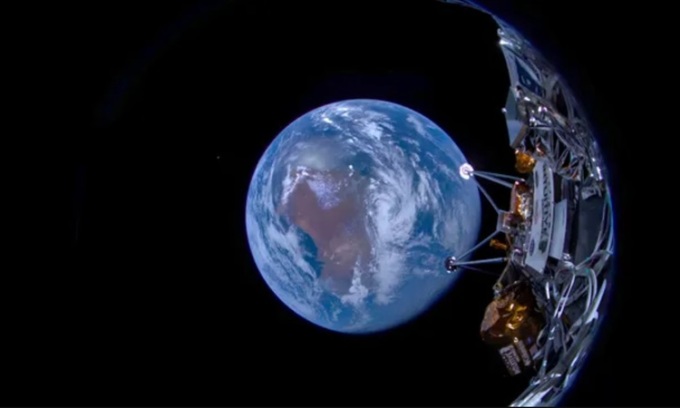
A selfie of the Odyssey spacecraft with Earth. Photo: Intuitive Machines
Intuitive Machines successfully transmitted the first images from the IM-1 mission back to Earth on February 16th. The images were taken shortly after the lander separated from the rocket's second stage during its first flight to the Moon under NASA's CLPS program, the Houston-based company shared in a social media post.
CLPS is a Commercial Lunar Payload Services program designed to transport NASA's scientific equipment on privately-owned lunar landers like Odysseus. These devices are designed to collect data to support NASA's Artemis program, which aims to establish a manned base near the Moon's south pole by the end of the 2020s. Odysseus carried six NASA experiments and technology testing devices, along with six other privately-owned payloads, on its mission codenamed IM-1.
IM-1 wasn't the first mission to launch in the CLPS program. Prior to that, Peregrine, a lunar lander built by Astrobotic in Pittsburgh, launched last month aboard a United Launch Alliance Vulcan Centaur rocket. The launch went smoothly, but Peregrine suffered a fuel leak shortly after separating from the rocket's upper stage. The lander failed to reach the Moon, so the crew controlled its controlled descent into Earth's atmosphere on January 18th.
The flight went more smoothly for Odysseus. The lander performed well and communicated with the mission control team as it headed toward landing on the Moon on February 22. Odysseus's various systems operated normally, including the engines. "Intuitive Machines flight control personnel successfully fired the first methane and liquid oxygen engines in space, completing engine testing during the IM-1 mission," the company announced on February 16.
If successful, the IM-1 mission would go down in history as no private spacecraft has ever landed smoothly on the Moon. Odysseus's method of combining methane and liquid oxygen is also being applied to SpaceX's new giant Starship rocket. This vehicle is preparing for its third test flight, which could take place in the next few weeks.
An Khang (According to Space )
Source link
























![[Photo] Prime Minister Pham Minh Chinh holds a phone call with the CEO of Russia's Rosatom Corporation.](/_next/image?url=https%3A%2F%2Fvphoto.vietnam.vn%2Fthumb%2F1200x675%2Fvietnam%2Fresource%2FIMAGE%2F2025%2F12%2F11%2F1765464552365_dsc-5295-jpg.webp&w=3840&q=75)















































Comment (0)