


Numbness, pain, weakness in hands... are symptoms that many people experience - Illustration photo
This could be an early sign of carpal tunnel syndrome - a common peripheral neuropathy that, if left untreated, can lead to irreversible damage.
What is carpal tunnel syndrome?
According to MSc. Pham Thi Ngoc Linh - Neurology Center, Bach Mai Hospital, carpal tunnel syndrome is a very common disease in the hand and wrist. In terms of anatomical structure, the carpal tunnel is like a small tunnel, created by the wrist bones and transverse ligament. Inside contains the median nerve and flexor tendons of the fingers.
The median nerve controls sensation in the inside of the palm of the hand. When this nerve is compressed in the carpal tunnel, the patient will experience inflammation, pain, numbness and weakness in the hand.
In normal condition , the pressure in the carpal tunnel is only about 2-10 mmHg. However, when the wrist is flexed and extended excessively, this pressure can increase 8-10 times.
If the increased pressure persists, the median nerve will be damaged. Short-term compression may be reversible, but if it persists, the damage becomes permanent and difficult to repair.
According to Dr. Linh, carpal tunnel syndrome can occur in anyone, but some high-risk groups such as women more than men, often occurring between the ages of 40-60.
People who do jobs such as office workers, craftsmen, garment workers, carpenters, porters… jobs that require repetitive use of hands are more susceptible to the disease than other groups.
Also, it can be during pregnancy due to hormonal changes and water retention; postpartum women carry their babies a lot.
People with underlying diseases such as diabetes, rheumatoid arthritis, gout, hypothyroidism or genetic factors, people with congenital small carpal tunnel.
Typical symptoms, early detection
This expert said that symptoms usually progress from mild to severe. Patients should pay attention to:
Early stage: Numbness, tingling sensation in the area controlled by the median nerve (thumb, index finger, middle finger and half of the ring finger).
Worse at night : Many people wake up at 1-2 am because their hands are too numb; they have to swing their arms or change positions to relieve the symptoms.
During activity: Flexing or extending the wrist or pressing for a long time (for example, riding a motorbike long distance) increases the level of numbness.
Progression : Initially occasional, then more frequent and progressively severe; numbness may radiate up the forearm, but not up the neck.
Late stage : Weak hands, clumsy, difficulty holding small objects, easy to drop; most severe is atrophy of the oculomotor muscles - a sign of serious nerve damage.
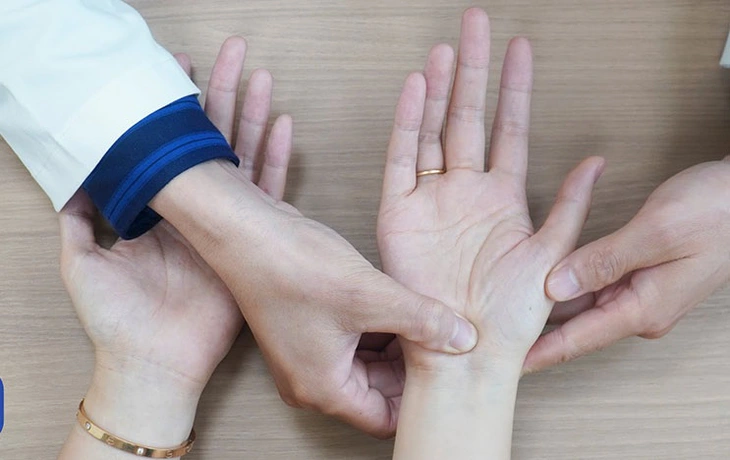
When detecting unusual symptoms in the wrist, the patient needs to go to a medical facility for timely examination - Illustration photo
"Patients should see a doctor early when they experience the following symptoms: numbness and pain in the hand that lasts for several weeks; numbness at night, causing insomnia, weak hands, often dropping things; difficulty performing delicate movements such as buttoning a shirt or writing; muscle atrophy at the base of the thumb.
If rest and changing habits do not improve, the patient needs to be examined to avoid serious progression.
When coming for examination, in addition to asking about the patient's condition and performing clinical examinations using tests such as Tinel and Phalen, the doctor may prescribe additional paraclinical techniques to confirm the diagnosis as well as assess the extent of the injury," Dr. Linh stated.
If a patient is diagnosed with this syndrome, the goal of treatment is to relieve pain, reduce numbness and preserve hand function. There are currently two main groups of methods: non-surgical (conservative) treatment and surgery. Conservative measures are always preferred in mild and moderate stages.
How to prevent disease?
Dr. Linh said that prevention plays a very important role. People can apply the following measures:
Arrange your work space properly: Ensure the table and chair height is suitable, helping to keep your wrists in a neutral position.
Take reasonable breaks: For jobs that require continuous use of hands, take breaks and do wrist stretching and rotation movements.
Hand Exercises: Increase daily finger and wrist stretching exercises.
Avoid bad posture: Avoid excessive wrist flexion or extension for long periods of time.
Control underlying diseases well: Especially diabetes, arthritis… according to doctor's instructions.
Source: https://tuoitre.vn/te-bi-dau-nhuc-tay-loai-benh-dan-van-phong-tho-thu-cong-phu-nu-noi-tro-hay-gap-20251203183204237.htm


![[Photo] Cat Ba - Green island paradise](/_next/image?url=https%3A%2F%2Fvphoto.vietnam.vn%2Fthumb%2F1200x675%2Fvietnam%2Fresource%2FIMAGE%2F2025%2F12%2F04%2F1764821844074_ndo_br_1-dcbthienduongxanh638-jpg.webp&w=3840&q=75)
















































![[VIMC 40 days of lightning speed] Da Nang Port: Unity - Lightning speed - Breakthrough to the finish line](https://vphoto.vietnam.vn/thumb/402x226/vietnam/resource/IMAGE/2025/12/04/1764833540882_cdn_4-12-25.jpeg)













































Comment (0)